








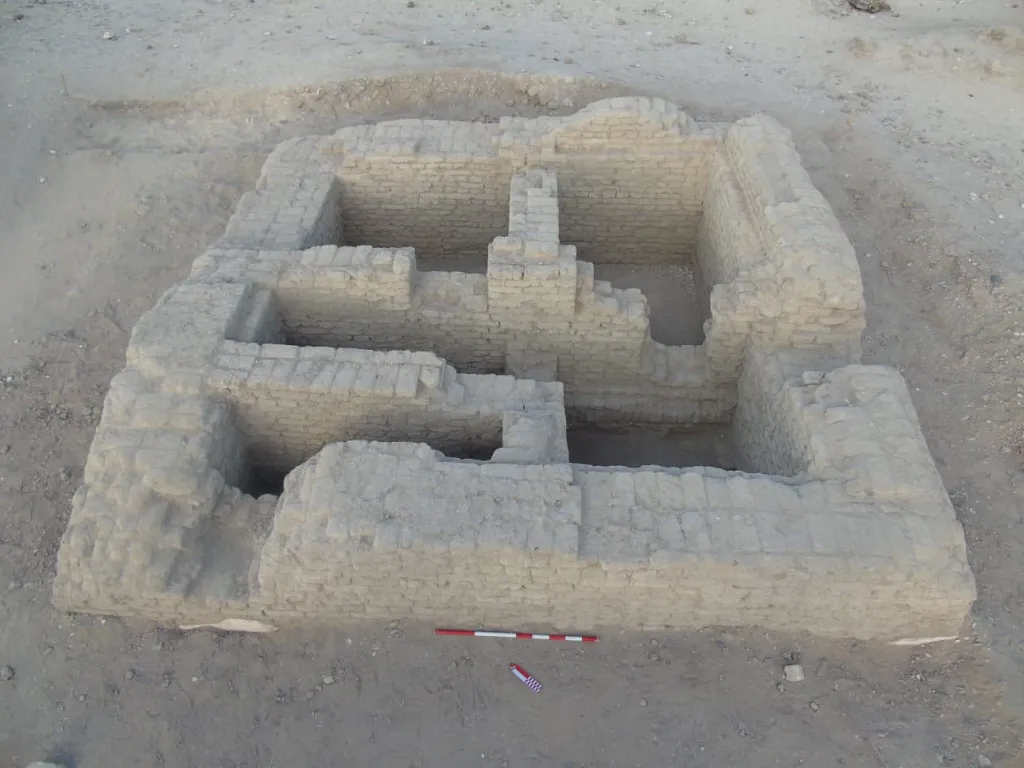
The foundations of a building complex from the 5th–6th century CE were recently uncovered at Al-Qarya bi-Al-Duweir, an archaeological site in Sohag, a city along the Nile River in central Egypt. The Ministry of Tourism and Antiquities posted about the discovery on January 8 on X, noting that the mission was overseen by the Supreme Council of Antiquities.
According to Ahram Online, Sherif Fathy, minister of tourism and antiquities, observed that the Byzantine-era residential complex “shed[s] new light on early Christian monastic life in Upper Egypt.” Fathy also hopes that this discovery will draw attention from both tourists and potential researchers to Al-Qarya bi-Al-Duweir, which is not as well known as other archaeological sites in Egypt.
Mohamed Ismail Khaled, secretary general of the Supreme Council of Antiquities, reported that the mud-brick building complex was well-organized and likely housed a self-sustaining community. Each building was about 25 by 23 feet at the smallest to 45 by 25 feet at the largest, with spaces for worship and devotion. Some of the courtyards contain the remains of circular structures, which researchers believe were used as dining tables. There was also a larger (approximately 45 by 33 foot) structure—complete with nave, choir, semi-circular sanctuary, and pillars that once supported a dome—that served as the monastic community’s church.
In addition to the buildings, archaeologists also uncovered brick and limestone basins likely used for water storage, amphorae (storage jars), ostraca (pottery shards), and tools.


