








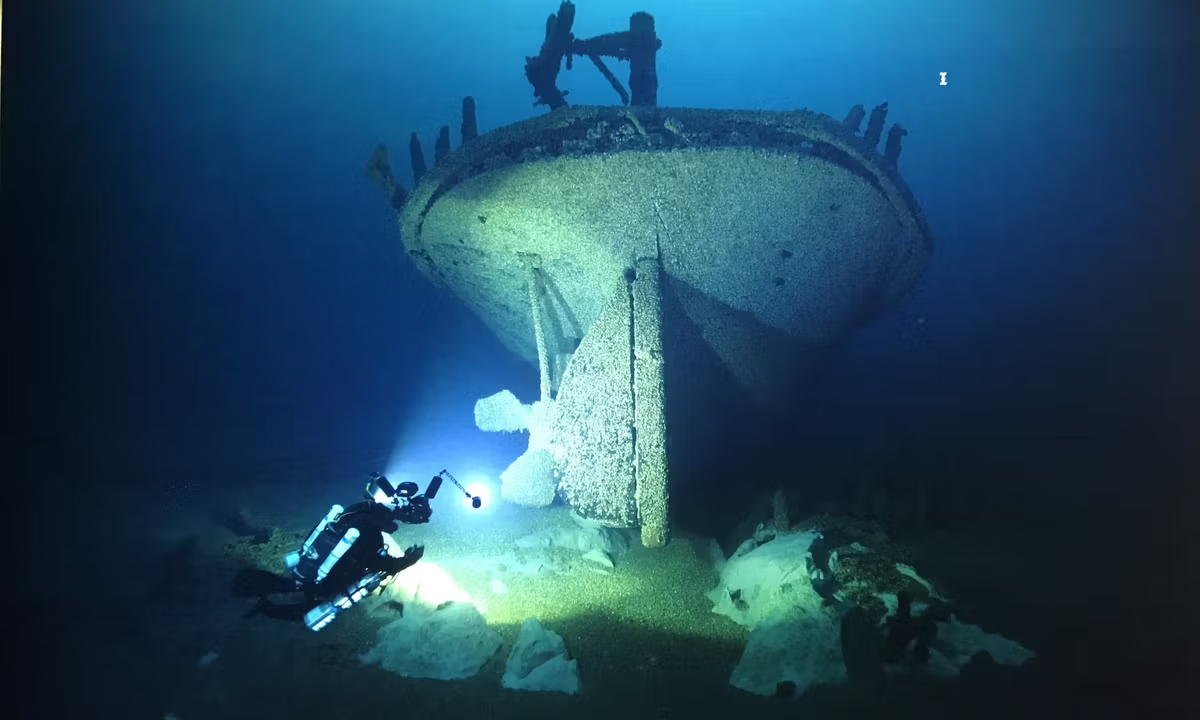
“Shipwreck hunting is a passion, a disease—once you start, you cannot quit,” says the shipwreck hunter Paul Ehorn. The 80-year-old recently announced the discovery of the Lac La Belle, a 217ft passenger steamer that lay at the bottom of Lake Michigan for more than 150 years. On a stormy October night in 1872, just two hours after departing Milwaukee for Grand Haven, Michigan, the wooden ship was damaged in a gale and sank. Eight of the 53 people on board died when a lifeboat capsized; the rest survived.
The Great Lakes have a treacherous history. More than 6,000 shipwrecks have been documented, most dating from between 1840 and 1900. “There were too many ships in a confined space next to bad weather, mainly in the fall,” says Brendon Baillod, the president of the Wisconsin Underwater Archaeology Association. In Lake Michigan alone, 1,500 vessels went under. “The most common cause of wrecks was being pushed to shore, with fragments often exposed,” he adds. “Far fewer sank in deep waters like the Lac La Belle.”
Luxury and commerce
The photographer W.H. Sherman’s 1872 stereograph of the Lac La Belle in Milwaukee Courtesy Brendon Baillod
“The Lac La Belle was a top vessel in quality and demand,” Baillod says. “It was also 30% faster than other steamers.” The ship had parlours and an elegant main salon with ornate chandeliers. In addition to serving well-to-do passengers, it was part of a commercial route—the ship was carrying 19,000 bushels of barley, 1,200 barrels of flour, 50 barrels of pork and 25 barrels of whiskey when it sank.
“The Lac La Belle operated in connection with the railroad completed in 1858 across Michigan, linking Detroit to Grand Haven and facilitating the movement of people and cargo to and from Wisconsin,” says Theodore J. Karamanski, a professor emeritus of history at Loyola University Chicago.
Yet 1872 was not even the first time the Cleveland-built steamer sank. In 1866, the two-year-old Lac La Belle capsized in the St Clair River’s shallow waters; it was reconditioned and brought back to use in 1869. “Refurbishing damaged ships was common,” Baillod says, “but the Lac La Belle remained underwater for an extended period”, so it was more susceptible to future issues.
A lifelong passion
Ehorn’s interest in shipwrecks began at age 15, when he started scuba diving. He has uncovered 15 shipwrecks since 1965, including the automobile-carrier Senator in 2005. Ehorn looked for clues about the Lac La Belle for decades. The ship was particularly hard to find because its location was unknown and it sank in deep waters. “I spent hundreds of hours in libraries and archives,” Ehorn says.
A breakthrough came when a fellow shipwreck hunter, Ross Richardson, found a key clue and shared it with Ehorn. In October 2022, after two hours of searching, Ehorn’s side-scan sonar revealed the steamer’s upright silhouette. (“It was late in the year to go out, but conditions allowed us to navigate,” he says.) Two years later, he returned with two divers who documented the site. Ehorn says he delayed announcing his find because he wanted his team to capture a 3D modelling video of the wreck first—and bad weather kept getting in their way. Luckily, “many parts are in great shape”, he says of the ship, “especially its hull”.
Ehorn has no plans of slowing down. On Saturday (7 March), he will share video footage from the wreckage at the 2026 Ghost Ships Festival in Manitowoc, Wisconsin, and he continues looking for more shipwrecks. “You always have 20 or 30 ships on your radar,” Ehorn says.


