
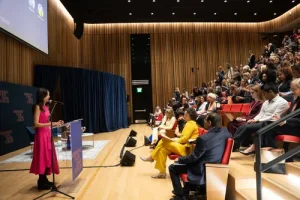







This Women’s History Month, art world leaders are calling for a reckoning. Works by women artists account for just 11% of museum acquisitions since 2008. Museums’ rates of collecting work by women have declined since 2009. And data suggests that women artists won’t reach parity in auction sales until 2053.
These statistics, presented by Charlotte Burns and Julia Halperin in the Burns Halperin Report, set the tone for the inaugural Making Their Mark Forum in Washington, D.C., organized by collector and philanthropist Komal Shah and curator Cecilia Alemani. The convening grew out of Shah’s publication and traveling exhibition, “Making Their Mark: Works from the Shah Garg Collection,” curated by Alemani and drawn from her collection of women artists’ works. The show is now on view at the National Museum of Women in the Arts, where the forum kicked off on March 5.

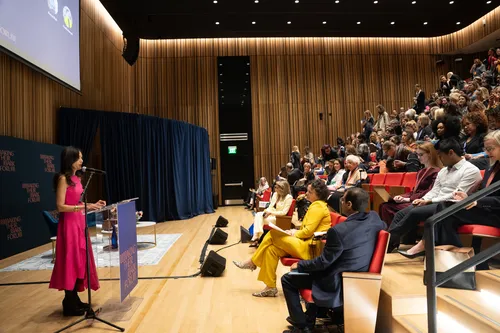
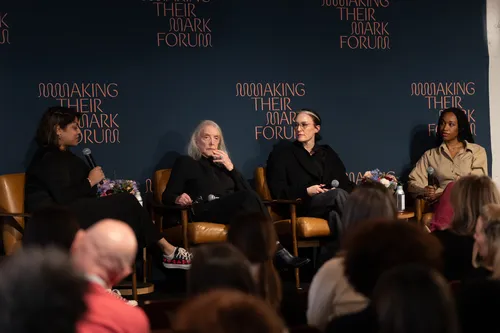
Over three days, speakers including Ava DuVernay, Chelsea Clinton, and Jodie Foster joined art world leaders for conversations about the industry’s inequities and the structural change needed to address them. The main day of talks, held at the Martin Luther King Jr. Memorial Library, brought together artists, curators, collectors, scholars, and museum leaders, primarily women, from across the United States, the U.K., and Europe.
In her opening remarks, Shah framed what was at stake: “Visibility without sustainability is temporary. Sustainability determines who builds legacy. Legacy determines who shapes culture, and culture shapes policy, ambition, and imagination—the very architecture of what a society believes is possible.” That work feels especially urgent now, given what Clinton described as the current political climate’s “volume and velocity of vile.” DuVernay offered a response rooted in self-determination: to effect change, she argued, it is not enough to seek a seat at the table—“Better have your own table. Better have a place to go.”
Below are five takeaways from the Making Their Mark Forum on how the art world can drive structural change.
1. Stop treating “firsts” as progress
Burns opened the forum with a pointed challenge: “How many times have you read headlines announcing the very first solo show by a woman artist at a major museum? What should be a source of shame is often reframed as a story of progress.”
Museums, galleries, auction houses, and publications often frame overdue recognition—long-delayed institutional attention or market success for an older artist—as a breakthrough. Those moments are worth celebrating, but they are not, on their own, evidence of progress.
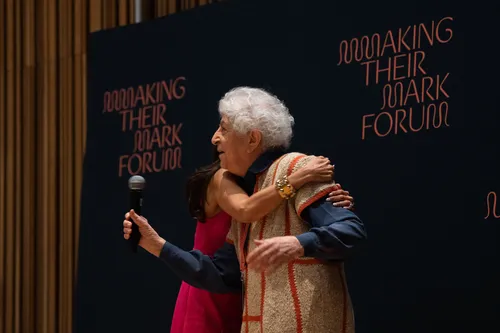
Joan Semmel, 93, and Samia Halaby, 89, who both presented at the forum, vividly made that point. Shah recalled accompanying Semmel to her retrospective at the Jewish Museum in New York earlier this year, where the artist reflected on the many decades it took to have a museum show in her home city. Semmel described generations of women who “should have been in the mainstream” but were instead left out, “completely isolated in the men’s world as minor artists.”
Halaby, a pioneer of digital art who has been creating kinetic paintings through coding since acquiring an Amiga computer in 1986, has only gained major institutional opportunities in recent years: Her work currently fills the entryway to SFMOMA, and she is the oldest artist in this year’s Whitney Biennial.
The challenge is to treat these long-overdue milestones as prompts: to ask who else has been overlooked, what structures delayed recognition, and how the industry can stop producing “firsts” so late in the first place.
2. Rewrite the rules of “quality”
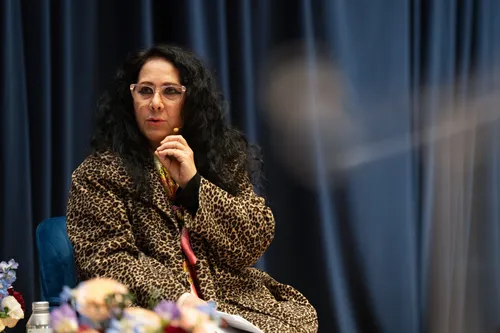
Economist Renée B. Adams, a professor of finance at Oxford’s Saïd Business School, challenged one of the art world’s most persistent assumptions: that women’s underrepresentation reflects differences in the quality of their work. Her research finds that paintings by women sell at what she describes as a 42% discount in auctions—a gap that cannot be explained by quality differences.
In another study, Adams had gallery-goers rate identical artworks; participants described the works as less compelling when told the artist was a woman. Any argument that women’s work is underrepresented in museum collections because of its lower quality is simply “gatekeeping,” she said.
Cecilia Fajardo-Hill, co-curator of the landmark 2017 exhibition “Radical Women: Latin American Art, 1960–1985,” experienced that bias firsthand. When she first proposed the show, one institution’s response was unambiguous: “Absolutely not. We are not going to dedicate energy to only women.” She kept pursuing it at a second institution—and was fired for it, with a director asking why she was chasing “all these unknown women.” The show eventually found a home at the Hammer Museum, where director Ann Philbin agreed to take it on the spot. “Radical Women” went on to travel internationally and reshape conversations about an overlooked art-historical period—a rewrite of “quality” in practice.
Christophe Cherix, director of MoMA, pointed to the museum’s permanent collection galleries as evidence that greater inclusion does not come at the expense of quality. More than 60% of the works now on view on the second floor are by women artists. “If those galleries are so vibrant and engaging,” he said, “it’s because we are more inclusive.”
3. Change the narrative
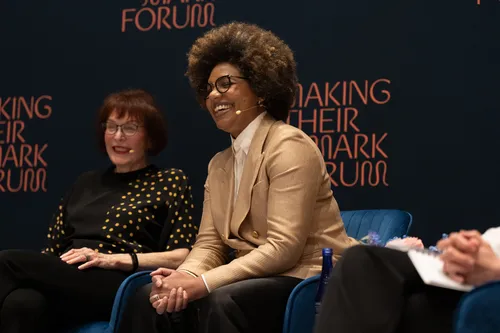
Professor and historian Sarah Lewis, speaking with Chelsea Clinton, recalled a quote from the late artist Elizabeth Murray: “Cézanne painted apples and tablecloths and clocks. The Cubists painted still lifes. But when I paint the still life, the critique of my work is that I’m making this feminist statement about the home, and that critique is political.”
Again and again, speakers returned to the question of who gets canonized—and how. Curators described some of the past two decades’ most important exhibitions of women’s work as acts of recovery. Connie Butler’s “WACK! Art and the Feminist Revolution” (2007) and Katy Siegel’s “High Times, Hard Times: New York Painting 1967–1975” (2006–08) helped write women artists into histories from which they had long been excluded.
Artist LaToya Ruby Frazier has long centered activists and cultural figures in her work. At the forum, she described using a recent honor—her induction into the Daughters of Pennsylvania Society—to spotlight unsung photographer Sandra Gould Ford, who documented the collapse of Pittsburgh’s steel industry and preserved Black workers’ grievance records at personal risk. “It’s not about me,” Frazier said. “It’s about using this platform to direct it back towards a woman like Sandra, who has been overlooked, erased from history.”
The broader point was clear: changing the narrative means changing not only whose work is shown, but whose contributions are circulated, interpreted, and remembered.
4. Collect like museums are watching
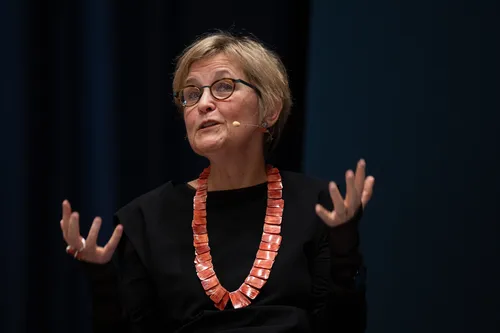
Museum leaders drove home how deeply their collections are shaped by their boards and donors. As Kaywin Feldman, director of the National Gallery of Art, put it, “At least 80% of our collections come through gifts, not from purchase,” meaning institutions are heavily dependent on what collectors acquire in the first place.
That also means museums have to educate collectors—especially board members and patrons—to collect in the institution’s long-term interests, not just their own.
In a later conversation about the market, Christie’s CEO Bonnie Brennan expressed optimism about the coming Great Wealth Transfer—the massive intergenerational transfer of baby boomers’ wealth—which is expected to leave women controlling a greater share of that wealth and, in turn, more financial influence. “I think women are also more civic-minded,” Brennan said. “They’re not just putting things on the walls—they’re thinking about the institutions they support, what they want to see in those institutions, and having those conversations with galleries.”
“We’re all looking for that next generation,” said Mary Sabbatino, partner at Galerie Lelong, during the same conversation. “When I talk among colleagues, that’s one of the big topics…How do you bring people up to the level of people who want to make a great collection and contribute civically to the preservation of culture?”
But buying work is only the beginning. It’s then on museums to show that work to the public. As Cherix put it, “What good does it do to acquire works and put them in storage for 20 or 30 years?” Acquisition without exhibition is its own kind of erasure.
5. Measure progress—and keep measuring
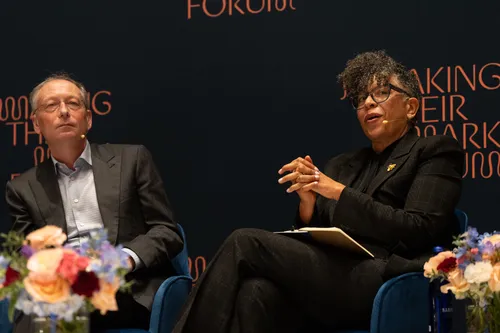
Without long-term tracking, it’s too easy for the art world to mistake passing attention for real change. “Progress isn’t linear,” Halperin said. “It comes in waves, and it often reverses.”
Measurement matters to both drive improvement and reveal who is still left out. Museum leader and educator Sandra Jackson-Dumont stressed that even positive-looking numbers can hide deeper inequities: “We can say this is however many percentages of women artists. But if you break that down and say, well, how many of them are Black? How many of them are differently abled?”
Museums similarly need to analyze who they’re hiring. “You can’t manage what you don’t measure,” said Anne Pasternak, director of the Brooklyn Museum, quoting Michael Bloomberg. That means tracking not just the makeup of acquisitions and exhibitions, but also the staff, leadership, and board composition—“it’s about keeping us honest,” she added.
Data alone confirms that art world rhetoric is turning into real change.


