







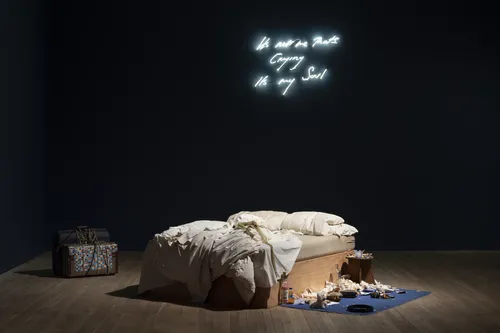
For decades, Dame Tracey Emin has produced raw meditations on abortion, rape, alcoholism, disability, death, love, strength, and perseverance. Her confessional artmaking has garnered both praise and rage. The installation My Bed (1998)—which features the British artist’s own soiled bed with crumpled sheets, used condom wrappers, and liquor bottles—compelled a South Wales housewife to drive 200 miles to London and rush at the work with cleaning supplies. She later told The Daily Mail: “Tracey is setting a bad example to young women.”
The art world labeled Emin an “enfant terrible” in the 1990s as she experienced a meteoric rise to infamy with the Young British Artists, a loose group of London-based artists who sensationalized the British scene. The artist labeled herself “Mad Tracey from Margate.” Drama continued, and in 2020, she survived a near-deadly battle with cancer. Four years later, King Charles III made her a dame in recognition of her service to British art. The public, it seems, has finally caught up with Emin.

Now, the artist’s retrospective, the largest-ever survey of her career, has arrived at Tate Modern. “A Second Life,” curated by director Maria Balshaw, is on view through August 31st. It features over 90 works spanning 40 years, including key pieces shown for the first time. A massive white box where Emin painted non-stop for three weeks is on view, as well as towering feminist textiles and blood-red paintings that document Emin’s grief following her mother’s death.
A fighting spirit runs through Emin’s oeuvre. “Art is a vocation in life,” she told the BBC last year. “It’s something you feel you have to do, and you can’t stop yourself from doing it.”
Here, Artsy highlights essential works that reveal the depth of Emin’s legendary career.
Why I Never Became a Dancer (1995)
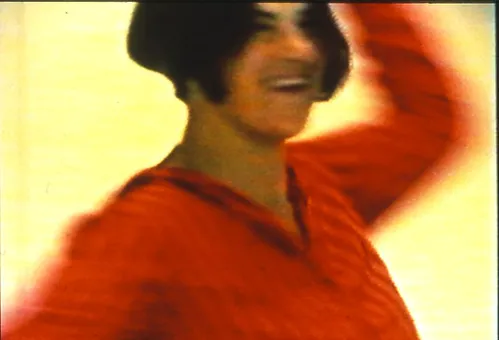

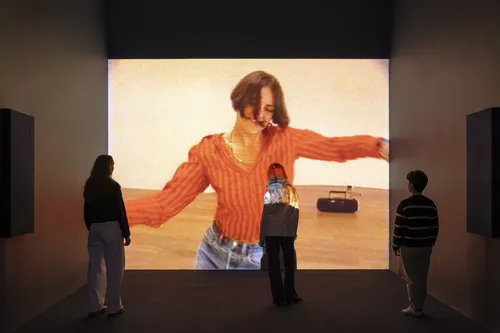
This film, shot with grainy Super 8 film, captures the seaside town of Margate, England. Seagulls fly along the beach, people play games in the local arcade, and Emin recalls the events of the late 1970s that led her to leave for London at age 15. The artist speaks of sex, often with older men, and a brief stint in dance competitions. Emin was mid-routine at the 1978 British Disco Dance Championship when a group of men she’d slept with began chanting “slag.” She ran offstage and out of the building. It’s a memory tinged with both shame and liberation. In the film’s final minutes, the artist identifies the men by name. She appears onscreen in a dance studio, smiling and twirling to Sylvester’s “You Make Me Feel (Mighty Real).”
The nearly seven-minute film is often overshadowed by Everyone I Have Ever Slept With 1963–1995 (1995), a thematically concurrent but far more critically lauded work that helped launch Emin’s career. While the installation featured the names of everyone she’d shared a bed with—sexually or platonically—stitched into the fabric of a tent, Why I Never Became A Dancer is more direct: Emin forcefully reclaims her own narrative and vocalizes how her early sexual encounters made her feel. “There were no morals or rules or judgments. I just did what I wanted to do,” she recalls in a voiceover. “Sex for me had been an adventure, a learning. I was the innocent.”
The work confirmed Emin’s uncompromising, autobiographical approach as well as Margate’s formative pull. It cleared the way for her eventual return home in 2017, nearly four decades later.
Exorcism of the Last Painting I Ever Made (1996)
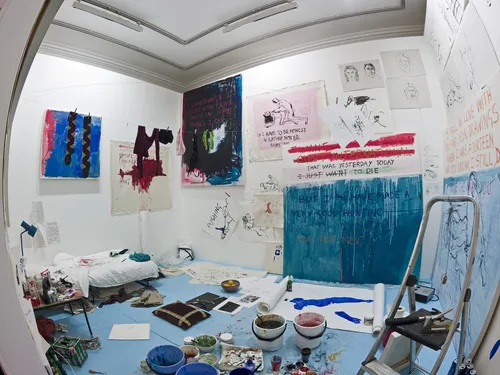

Six years after a nearly fatal abortion led her to stop painting, Emin entered a large white box in Stockholm’s Galleri Andreas Brändström completely naked and got to work. For three and a half weeks, she prowled the room, viewable only through fisheye lenses embedded in the walls. She smoked, drank, called friends, and worked through the trauma she’d come to associate with painting. Complications from her procedure, including blood poisoning, deepened this association and turned painting into a source of revulsion. “Every time I smelt turps or oil paint, this repugnant fear and loathing of myself and a really massive sense of failure came back,” she recalled in a 2024 interview with White Cube. The performance helped the artist shake her anxieties about the medium.
Visitors flocked to the gallery to watch Emin create works that referenced the styles of Egon Schiele, Pablo Picasso, Piet Mondrian, and Yves Klein. While she intended to drag the paintings into the snowy courtyard and burn them, the gallerist intervened to preserve the room and enshrine its legacy. Thirty years later, the nearly one hundred paintings and drawings, as well as the bed, radio, CDs, magazines, and kitchen utensils she used, have been restaged in the Tate. The work is more than a snapshot of the creative process or testament to her resilience: The performance collapsed the boundary between private catharsis and public spectacle, establishing radical self-exposure as a key facet of Emin’s practice.
My Bed (1998)
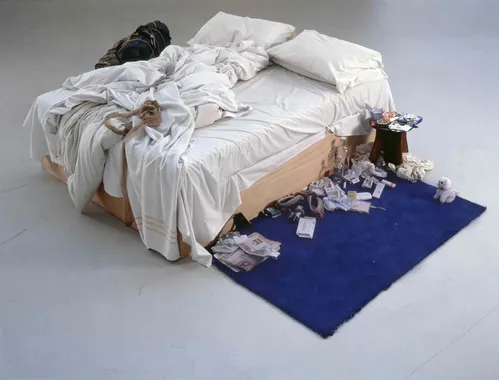

Emin’s famed diaristic installation My Bed (1998) functions as a still life of emotional unraveling. It features the artist’s imported bed along with its tangled, stained sheets and a rug strewn with what one critic called “uncomfortably personal debris”—of sex, drink, smoking, and other vices.
It first appeared at Tokyo’s Sagacho Exhibition Space and New York’s Lehmann Maupin gallery before entering the 1999 Turner Prize group show at Tate Britain—and setting off a media furor.
Art critics tore into the work, with The Guardian’s Adrian Searle lambasting it as “tortured nonsense” and The Herald’s Clare Henry calling Emin a “silly show-off screaming for attention.” Despite the controversy, Emin’s Tate installation became a career-defining moment that raised her international profile. The feminist work offered a frank depiction of depression, shattering taboos around mental health and female sexuality.
The work now feels prescient. “Bed rotting” has become romanticized, and an imitation of Emin’s bed recently appeared as a set piece in And Just Like That, the Sex and the City sequel series. “Much has changed since the days when David Frost could not bring himself to mention the word tampon on breakfast TV for fear of upsetting viewers,” Balshaw told Artsy. “Emin says these days people look at the bed with tenderness, rather than shock.”
The Last of the Gold (2002)
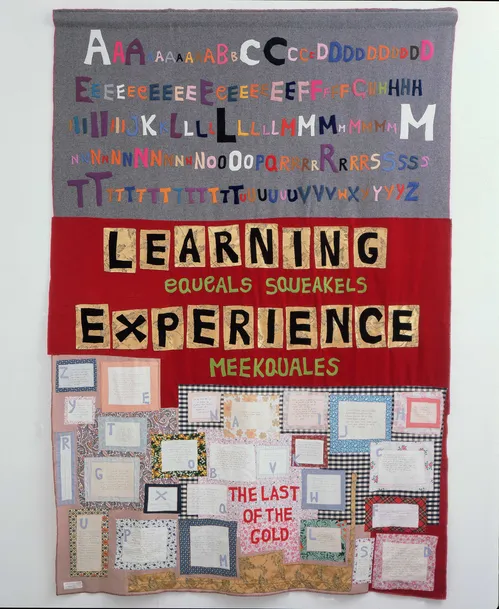

This monumental quilted blanket, measuring nearly 10-feet tall, is Emin’s largest textile to date. The title refers to the materials: repurposed remnants of a gold curtain the artist’s mother hung in her childhood home. The bottom half includes 26 handwritten notes by the artist detailing the “A to Z of abortion,” from the literal to emotional cost of the procedure. “You may feel in a state of euphoria from the relief, be careful as depression may follow,” one warns.
The piece is on public view for the first time since its 2002 debut at Lehmann Maupin in New York. “It offers a very early example of her ethics of care for others, which was at odds with how she was portrayed in the media and art history in the early 2000s,” Balshaw said. While critics like Searle ripped the “neon shouting” of her series of neon signs produced during this period—featuring phrases like “Fuck off and die, you slag”—her quieter, more empathetic embroideries went largely unappreciated.
Textiles are key to Emin’s oeuvre, and this work is both an ode to her own abortion and a manifesto for women going through the same process. Emin has said she wishes she’d had something similar as a young woman; the work is still just as urgent today, as reproductive rights are rolled back worldwide.
I was too young to be carrying your Ashes (2017–18)
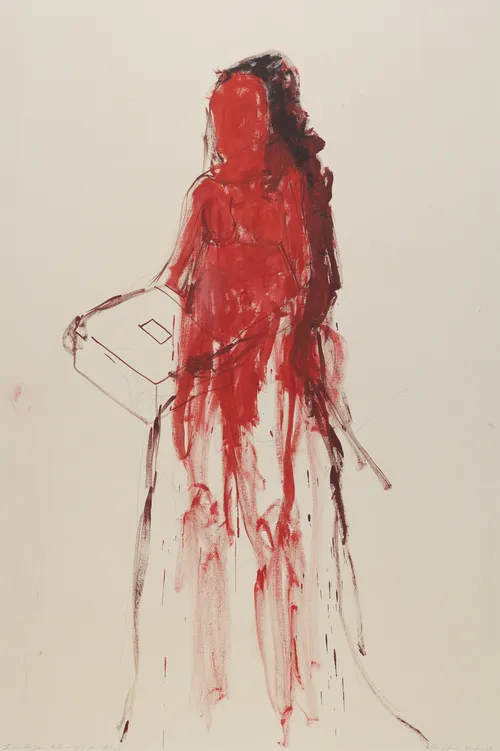

British journalist Lynn Barber once said of Emin that “if a wound shows any signs of healing, she’ll pick the scab until it starts bleeding again,” that while it may have offered a boon to her art, “it must be quite a drawback in her life.” Those wounds resurface in this painting, made after the death of Emin’s mother in 2016 from squamous cell bladder cancer—the same illness that nearly took the artist’s life a few years later.
In the work, vivid blood-red brushstrokes run down the canvas, staining a figure, a stand-in for the artist, who clutches a box of ashes. The streaks of pigment are charged with movement and rage. The painting anchors the exhibition’s second half, as “Second Life” turns toward reflection and spiritual reckoning. Emin transmuted her grief into propulsive new work, laying the foundation for subsequent pieces that explored transcendence and self-care.
I Followed You To The End (2024)
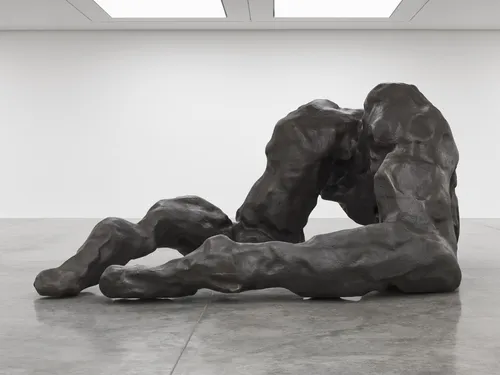
When a cancer diagnosis and major surgeries removed her bladder and other organs in 2020, Emin’s defining artistic relationship to her body shifted yet again. This monumental bronze sculpture gives the reconfiguration physical form. Sprawled legs ground the work as hips rise into the air; the position straddles the line between vulnerability and cheeky defiance.
The work appears outside the Tate, visible for all passersby. Its public placement mirrors the artist’s own transformation from “enfant terrible” to nurturing elder arts leader: In 2023, she founded the Tracey Emin Foundation in a former bathhouse and mortuary. The program offers professional studio spaces for 14-month artist residencies. “When you’ve been seriously ill and you come out the other side, you really don’t fuck around anymore, ever,” she told Jerry Saltz in 2023.
For Balshaw, this sculpture and its companion piece—a large-scale painting of the same name—provide a throughline for the exhibition: “Each [piece] speaks to Emin’s great subject: love and its loss,” she said. “Love is an ecstasy that becomes almost religious in many recent works, and it nearly always tips into pain, as love and loss are bound together.”


