







As the avant-garde reshaped the artistic centers of Europe in the early 20th century, Nordic artists responded in strikingly different ways. Many acted as emissaries, carrying the visual language of the international avant-garde from Paris, Berlin, and Moscow back home, while others turned inward toward a deeply Scandinavian consciousness shaped by extreme seasonal light, landscapes of vast and untamed scale, and cultures in the midst of asserting their national identities.
“Modernist art has never been a single, coherent, linear movement, but rather the result of multiple approaches and trajectories, what we may call ‘many modernisms’,” said Else-Brit Kroneberg, head of collections at Kunstsilo in Norway. The museum is custodian to the Tangen Collection, one of the most significant collections of Nordic modernist art, and is currently exhibiting three shows focusing on modernist artists in the Nordic region.
“Artists from the Nordic countries have consistently crossed borders, connecting with peers in other Nordic contexts as well as in major European cities and schools,” said Kroneberg. “They were not merely passive recipients of broader currents but actively contributed to shaping them.”
A few names from this milieu will be familiar to most. The profile of Hilma af Klint has risen dramatically over the past decade, bolstered by shows at the Serpentine Galleries in London and the Guggenheim in New York. Finland’s Helene Schjerfbeck is undergoing a similar reappraisal, with a recent exhibition at the Metropolitan Museum of Art showing the power of her searching self-portraits. Below, discover more modernist Scandinavian artists who are also deserving of wider recognition.
Jakob Weidemann
B. 1923, Norway. D. 2001
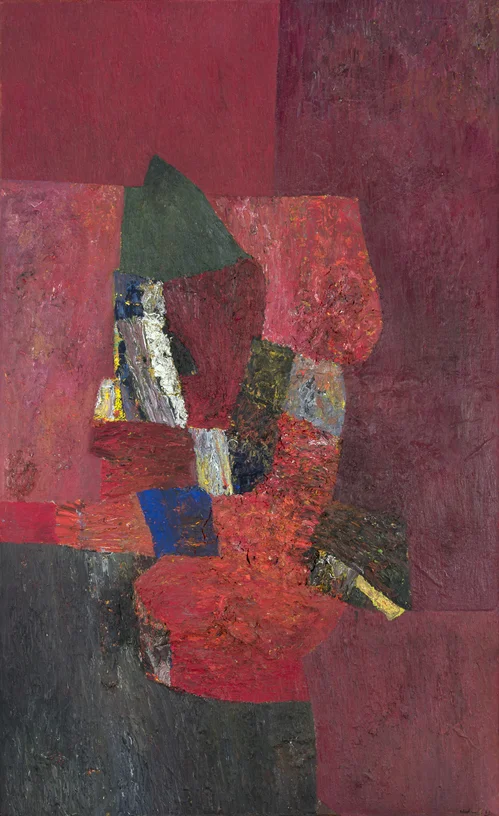

Jakob Weidemann was one of the central figures of Norwegian post-war modernism, and the artist most responsible for establishing abstraction in Norway. The roots of this sensibility lie, in part, in World War II. Weidemann served in the Norwegian resistance, and after escaping to Sweden in 1944, a severe explosives accident left him permanently partially blind. The months that followed, in which he could perceive only light, sharpened his relationship to color.
“I will find the character in every little thing,” he reportedly said following a walk to the Vettakollen hiking area. His skogbunn, or “forest floor” paintings, developed from the late 1950s onward, define this approach. All are, to varying degrees, non-figurative visions of nature: aerial views of parceled pastorals and abstracted still lifes. In Autumn Leaves (1959), for example, the viewer is left to assemble the titular image from the rough, pasty tessellated color planes.
Later in his career, when his gaze lifted from the forest floor, light flooded in, giving way to brighter and choppier markmaking as seen in Crocus (1974) and Towards the Light (1976).
Gösta Adrian Nilsson (GAN)
B. 1884, Sweden. D. 1965
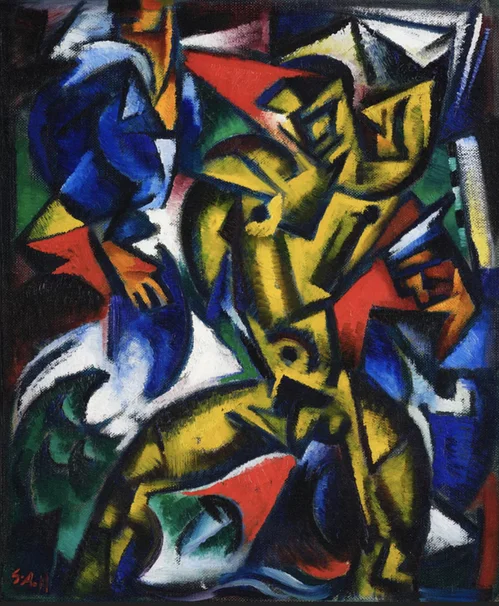

Gösta Adrian-Nilsson, often known as GAN, held fickle allegiances to the artistic movements of his time. He moved through Art Nouveau, Expressionism, and Futurism, settling most comfortably into a Cubist idiom that revealed his fascination with machine industry and its muscular force. GAN grew up in Nöden, Lund, Sweden’s working-class quarter, the son of smallholders who ran a grocery shop there. In his paintings, architectural structures such as cranes and locomotives are placed on an equal plane with laboring bodies, all refracted into dynamic geometries that flatten the hierarchy between man and machine.
A queer artist, a homoerotic dimension runs through much of his work. From around 1917, his paintings of industrial progress gave way to lithe, angular sailors, drawn from nights spent cruising the docks and later, his relationship with a young Swedish Navy torpedo operator. These figures’ bulging proportions anticipate Tom of Finland by decades and would feature in his landmark 1918 exhibition “Sjömanskompositioner” (Sailor Compositions) at Gummesson’s art gallery in Stockholm.
Sigrid Hjertén
B. 1885, Sweden. D. 1948
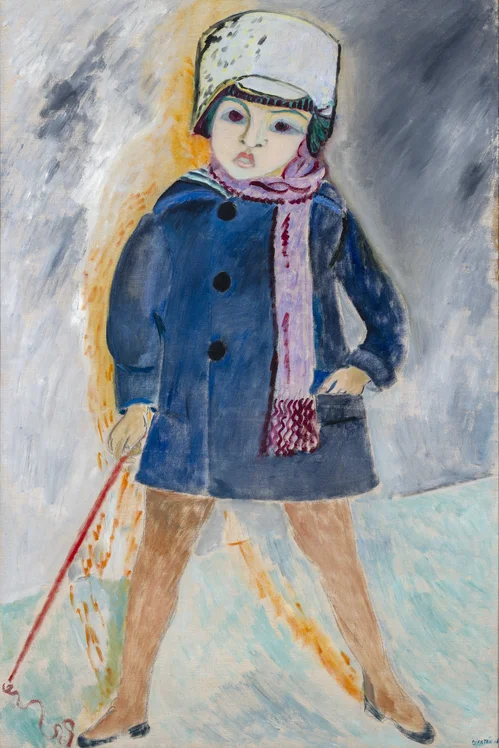

Swedish artist Sigrid Hjertén was one of the few conduits through which Henri Matisse’s radical vision of color would reach Scandinavia. She enrolled at the Académie Matisse run by the artist from 1908–11. Among the large number of Nordic students who attended the Paris school was Isaac Grünewald, whom she would marry in 1911.
An important teaching for Hjertén was to understand color as an autonomous and active means of expression, unencumbered by formal or symbolic associations. Her paintings are subsequently distinctly Fauvist in style with unnatural, often lurid coloring. These naively stylized depictions include domestic figures—sometimes based on herself—as well as Denmark’s chalk cliffs and Parisian rose gardens. In 1912, her exhibition with the group De Åtta (The Eight), which included such works as Från Kornhamnstorg and Den blå skutan (The Blue Boat) (both 1912), marked her official entry into the art world.
Hjertén battled harsh criticism throughout her career and spent the last 12 years of her life far removed from the artistic circles of her youth. Diagnosed with schizophrenia, she lived out her life in a psychiatric hospital where she would die from the consequences of a lobotomy.
Bendik Riis
B. 1911, Norway. D. 1988
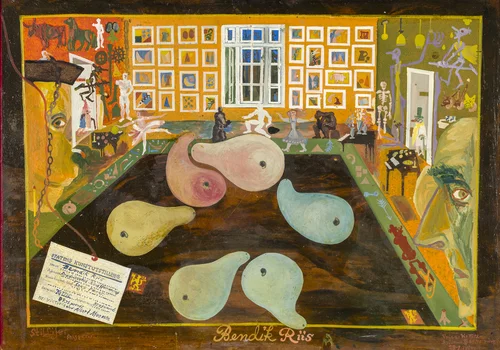

Bendik Riis is viewed as something of an outlier in Norwegian art history, not least due to a troubled personal history that kept him largely absent from the global art world stage.
Some of his most affecting works were conceived during a period of involuntary institutionalization at the Gaustad psychiatric hospital in Oslo, where he was sometimes subject to the barbaric pseudo-therapies carried out by physicians. Castraktion visualizes the artist’s fears around castration and lobotomy, while Seks Pærer (Six Pears) (both 1950), exhibited in Oslo in 1952, takes a more absurdist turn. Here, a sextet of pears dances before gnomes, demons and figurative sculptures, presided over by the same figure that haunts Castraktion as an omen of violence.
Discharged in 1952, Riis went on to produce several more oil-on-board pieces such as Bendik og Årolilja (1955). Adorned with traditional Scandinavian rosemaling, he reimagines a tragic Norwegian folk ballad in which lovers are separated by a king and united only in death, casting himself as the bridegroom and claiming the happy ending denied him by both legend and life.
Rolf Nesch
B. 1893, Germany. D. 1975, Norway
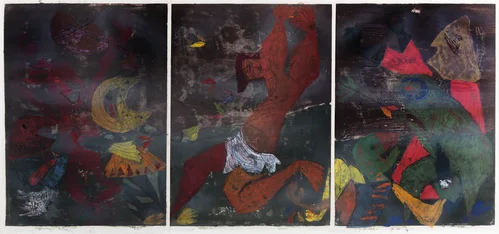

A German émigré who became one of Norway’s most significant modern artists, Rolf Nesch emerged from the four years he spent in Hamburg with two innovations that would mark his legacy. Among the first artists to use metal collage in printmaking, he also pioneered a dry pigment powder-painting technique. Here, loose pigments were sprinkled onto a lacquered surface and fixed with varnish, producing a chalky, diffused palette visible in Negerrevy (1930) and the “St. Pauli” series (1931).
Following the Nazis’ ascension to power in 1933, Nesch relocated to Norway, a decision that purportedly stemmed from his belief that “a country that has a Munch must be a good place to live.” Indeed, in the years since, critics have cast Nesch as Edvard Munch’s natural successor. Here he abandoned brush and canvas entirely, his material experimentalism led to works of raw Nordic force. Among them is the “Lofoten” series (1936), in which the craggy Arctic archipelago is rendered in muted silvers and blacks, the cold weight of the northern sea besieging the shorelines.
Rita Kernn-Larsen
B. 1904, Denmark. D.1998
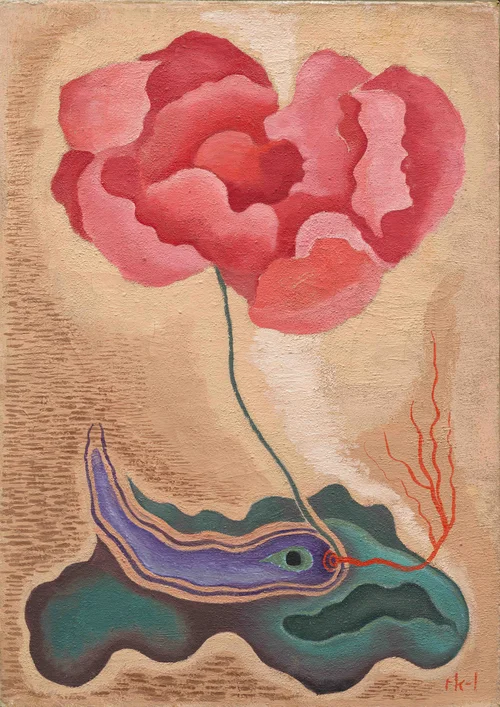

Born to a wealthy family in Hillerød, Denmark, Rita Kernn-Larsen’s practice took shape in Paris, where she studied under Fernand Léger from 1932 to 1934 and first encountered Surrealism, a vocabulary she would continue to develop throughout the decade.
In 1935, she was one of the few women invited into the watershed exhibition “Kubisme=Surrealisme” in Copenhagen, the world’s first international Surrealist exhibition, alongside figures like Jean Arp, René Magritte, and Salvador Dalí. Indeed, there are traces of Dalí’s precise biomorphic surfaces in her painting Valume (Poppy) (1935): a flesh-flushed bloom on a thin stem, growing from an amoeba-like organism. It is an early variation on her recurring femme-arbre, or “woman-tree” motif, which she returns to more explicitly in Self-Portrait (Know Thyself) (1937). The device was popular among male Surrealists like Paul Delvaux, who cast women as fertile and passive in nature, but here Kernn-Larsen redirects it inward, supplanting her own image to appropriate the motif into an act of self-examination rather than projection.
Asger Jorn
B. 1914, Denmark. D. 1973

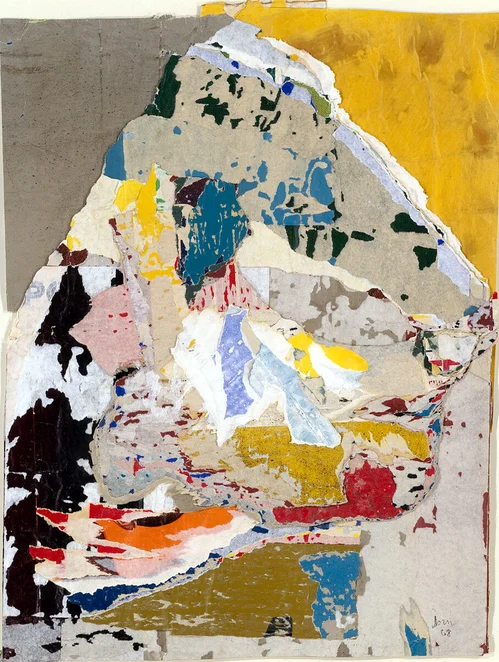

Verheißungsvolle Schichten, 1968
Asger Jorn
DIE GALERIE
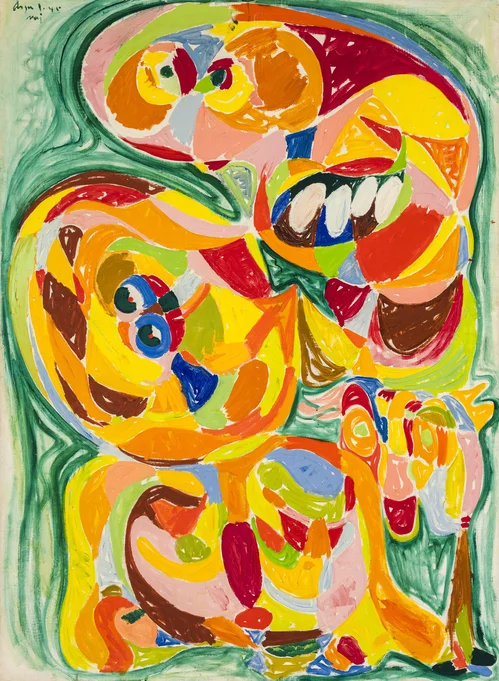
From the late 1930s onward, a new type of expressive painting emerged in reaction to the proliferation of nonfigurative plane geometry. This formed the basis for CoBrA, a loose coalition of artists from Copenhagen, Brussels, and Amsterdam established after World War II. Danish artist Asger Jorn, a founding member, realized the group’s imperatives of spontaneity and “primitiveness” through expressive, naive markmaking drawn from children’s drawings, folk art, and distinctively, Scandinavian myth and medieval Nordic art. These inspirations became even stronger in 1945 when he encountered Munch’s disorderly colorism at the National Gallery in Oslo.
Writing in 1960, Jorn described art as “the invitation to expend energy, with no precise goal other than what spectators themselves can bring to it.” This vitalist principle pushed him from CoBrA’s folk “primitivism” toward the Situationist International, which he co-founded in 1957. His “Modification” series (1959–63) embodies it most fully. Jorn overpainted kitsch flea-market paintings with grotesque faces and violent, gaudy Freudian distortions, gorging and regurgitating rather than erasing the original.
Robert Jacobsen
B. 1912, Denmark. D. 1993
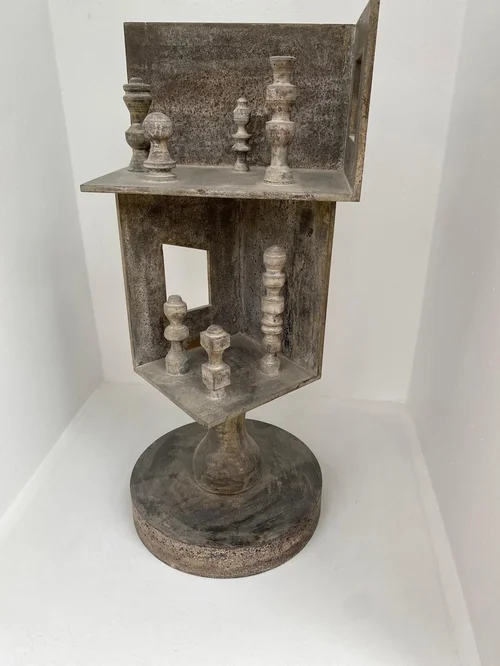

Maison de Tolerance/ The House of Tolerance, 1976
Robert Jacobsen
Michael Agerled Gallery
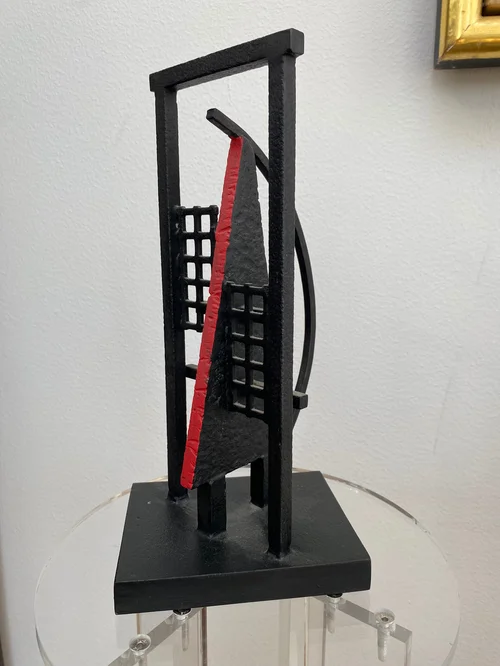
Untiteld, 1912 -1993
Robert Jacobsen
Michael Agerled Gallery
Robert Jacobsen was an autodidact who would become one of the most important Danish sculptors of the 20th century. Early works of his include his “Fabeldyr” (Mythical Creatures), a collection of rough-hewn totemic granite sculptures completed in the 1940s. It’s difficult to identify any defining features in them, though they’re certainly more bestial than human, the squat proportions and bulbous protrusions reminiscent of the strange apparitions in Asger Jorn’s paintings. That’s perhaps unsurprising given that Jacobsen was part of the wider artistic milieu that formed around Jorn during the German occupation of Denmark during WWII.
When Jacobsen moved to Paris in 1947, he shifted from using stone to welded iron, aligning himself with the Constructivism favoured by gallerist Denise René. Working with bike chains, exhaust pipes, cutlery, and gears, he produced two distinct bodies of work. Inspired by the African art he collected, “The Dolls,” as he called them, were small humanoid figures first placed in the homes of friends and family. Arguably more enduring in his legacy were monumental constructivist pieces: tall, iron towers built around a single rigid central pole, from which a curved arch of welded strips sweeps out to one side like a flung limb or sail.
Franciska Clausen
B. 1899, Denmark. D. 1986
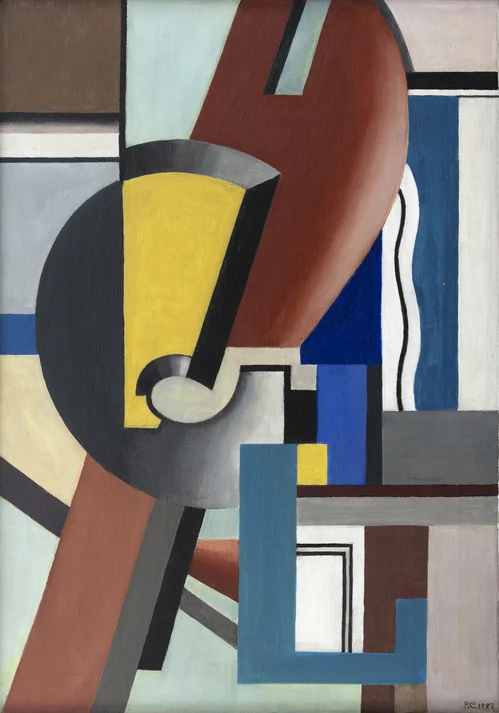

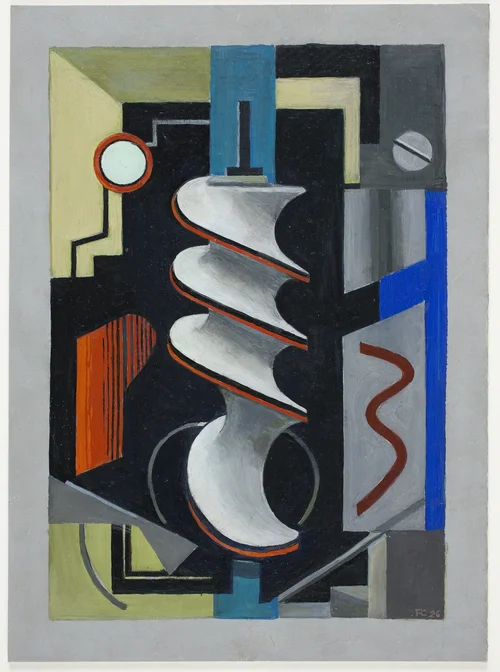

The Screw, 1926-1928
Franciska Clausen
Statens Museum for Kunst
Over the course of the 1920s, a burgeoning art scene sprung up in Paris around Académie Moderne, in which several of the more prominent artists were from the Nordic countries. One of them was Franciska Clausen, who arrived in Paris in 1924 from Åbenrå, Denmark, to study there. Her motivation to enrol was, in part, due to an admiration for the work of the artist and filmmaker Fernand Léger who taught at the academy.
Clausen quickly distinguished herself as one of the most outstanding students in her cohort and was handpicked by the man himself to participate in the opening of “L’Art d’Aujourd’hui” (Today’s Art), the first major international exhibition of avant-garde art after World War I. The exhibition boasted a long list of heavyweights, including Pablo Picasso and Albert Gleizes, as well as Sonia and Robert Delaunay. Early compositions, like Mechanical Element (1926) and The Screw (1926) use the machine aesthetics of Léger’s Cubism but are more tightly constructed in their geometry. Later, an interest in movement and optics would see her commit to the circle as a recurring motif as in Circles and Circles and Verticals (both 1930).


