







“I’ve been living … a great deal in my memories lately,” the Finnish painter Helene Schjerfbeck wrote in 1937.
Hers was a nostalgia perhaps born from relief. That year, the success of Schjerfbeck’s second solo exhibition had won her a loyal gallerist and, at last, a steady income. At the age of 75, she was still busy painting, and her work was on view, not for the first time, in a major Parisian exhibition—this one bearing the ignominious title “The Women Artists of Europe.”
It was still two years before war would force Schjerfbeck out of home, and eventually out of country, and then into the hotel outside Stockholm where she would die of stomach cancer in 1946. For now, for the first time in centuries, Finland was free. Schjerfbeck, for her part, was flush, and despite the toll of decades spent teaching and caregiving, she found her place as the first female artist whose self-portrait graced the walls of the Finnish Art Society. It was a good view from which to look back.
It should not surprise us that an aging artist would live in memory; but the late admission of sentimentality doesn’t quite square with the idea of the “extraordinary Nordic modernist” that the current Schjerfbeck retrospective at the Metropolitan Museum of Art tries to sell us. Nor does it square, it seems, with Schjerfbeck’s own self-image. In a portrait she made the same year, sunken eyes look sidewise from a pinched mask of a face, allowing observation but denying communion. She is spare, edgy, inscrutable, with no desire to meet our eyes, or expectations. Her bearing is cold; her raised chin haughty; her regard unsparing. She is every inch the aloof abstractionist, the avant-garde ice queen.
Helene Schjerfbeck: Self-Portrait, 1912.
Photo Yehia Eweis/Courtesy Finnish National Gallery, Helsinki
IT’S TEMPTING TO SEE Schjerfbeck as a painterly pathbreaker—or, more precisely, a “Breakthrougher,” one of a generation or two of artists from Finland, Norway, Sweden, and Denmark who hauled their national traditions to the forefront of modernism around the turn of the 20th century in the so-called “Nordic Breakthrough.” Though the fortunes of the countries were not always linked—and were, sometimes, in direct competition, with Norway and Finland having long been under the thumb of their neighbors—it is usually considered a regional Renaissance, a time when economic booms and shifting political prospects drove cultural renewal. Said to have broken with the nostalgic Romanticism of their forerunners, this generation, so the story goes, pioneered artistic techniques reflecting both the possibilities and misgivings of a society that was itself in the throes of transformation. Witness Hedda Gabler—playwright Henrik Ibsen’s bored, fascinating, monstrous antiheroine, as shocking in Nia DaCosta’s recent film adaptation, Hedda, as she was when she debuted in 1891. Consider her against the struggle for women’s suffrage—achieved in Finland and Norway long before the rest of Europe.
One might more easily conjure an image of Edvard Munch’s The Scream (1893), now a cliché of the angst and alienation that critics diagnosed as the consequences of lives lived evermore in cities. Even in Hilma af Klint’s candy-colored concoctions, we can see the turn to the occult that was a backlash to the collapse of 19th-century empiricism. If these artists did not always disparage the present, at least they outpaced it, departing from convention with a callous disregard that bears out their generation’s hard-edged sobriquet.


Helene Schjerfbeck: Self-portrait with Palette, 1937.
Courtesy Moderna Museet, Stockholm
BUT THE BREAKTHROUGHERS were not always so flashy, nor were their refusals usually so clear. A recent series of major monographic shows dedicated to the chorus of the movement—to figures less known but arguably more representative—shows that sentimentality hung awkwardly over these supposed Nordic trailblazers. Schjerfbeck’s is only the most recent in a string of major retrospectives dedicated to those painters who, though lauded in their native north, tend to be obscure outside of it. The last two years have seen retrospectives of Anna Ancher at the Dulwich Picture Gallery in London; both Christian Krohg and Harriet Backer at the Musée d’Orsay in Paris; Bruno Liljefors at the Petit Palais, also in Paris; and Akseli Gallen-Kallela at the Belvedere in Vienna, to name just a few. It’s a quiet craze that might raise more than a few eyebrows, especially given the style in which so many of these artists tracked: not Munch’s Symbolism nor af Klint’s abstraction, but instead the ho-hum figuration associated with a style often dismissed as unremarkable: Realism.
Realism tends to have a bad rap in art history. Even if it originated in the scandalous brushes of Manet and Courbet, the style was quickly absorbed into art establishments frequented by expats like Schjerfbeck. That turned out to be a catch-22: institutionally sanctioned, Realism became ubiquitous; ubiquitous, it became watered down and open to charges of conservatism. When it later became associated with the revolutionary politics of communism, critics indicted the style anew—this time, for a bland and unthinking conformism antithetical to the individual creative expression on which modernist myths had already come to rest.
As the prevailing style of the Nordic Breakthroughers, Realism played a tricky role, sentimental as often as it was skewering. It could be a rebuke to the selective nostalgia of beloved midcentury paintings like Bridal Procession on the Hardangerfjord (1848)—an idyllic view that is little more than a capriccio, a dream of bygone days where stave churches overlooked fjords and railways didn’t yet exist. A Realist like Christian Krohg called out that Romanticism as fantasy, and, in his none-too-subtle Struggle for Existence (1889), directed his brush instead toward the deadened eyes and desperate hands of a hungry present.

Anna Ancher: The Harvesters, 1905.
Courtesy Skagens Museum, Denmark
But the same scrutiny could also give propagandistic myths the veneer of veracity. In Leif Eiriksson Discovering America (1893), closely observed details like a hammered gold belt and embroidered tunic are marshalled to give truth to the lie of national sentimentalism. And though Anna Ancher’s Harvesters (1905) wear the pinafores and boating hats of a modern age, her sun-gilt figures still feel less like studies in the harsh realities of agricultural work than elegies for a romanticized idea of rural life that was steadily disappearing, and may never have existed.
SCHJERFBECK IS A SLIPPERY FIGURE within this matrix. If her oeuvre ends in works that call forward to the ruthless vivisections of Francis Bacon, it began in the silvery mists of her teacher Jules Bastien-Lepage. A painter of peasants past and present, Lepage was perhaps the most influential purveyor of Realism—at least for the Nordic community—and in early works we see Schjerfbeck testing its flavors: the sappy historicism of Girl with a Madonna (1881); the understated Orientalism of Fête Juive (1883); the suave, Sargent-like perspicacity of Dance Shoes (1882).
For its part, the Met seems more than a little regretful about Schjerfbeck’s truck with Realism—perhaps because the style so often carried the sentimentality of a Romanticism it professed to reject. A wall text introducing us to Schjerfbeck’s “Early Life” apologizes for “sentimental genre subjects” like the rosy-cheeked invalid of Convalescent (1888) or the child’s-eye View of St. Ives (1887) and redeems them on the promise of an abstraction soon to come. The word recurs with the curious frequency of the repressed. View of St. Ives is described as “playing with scale and perspective, albeit through a sentimental lens”—an apparent contrast on which the object label doubles down. “Though sentimental,” we’re told, the painting “takes certain liberties of space and structure that foretell Schjerfbeck’s loosening hand.”
Maybe that seems natural, to see sentimental subjects and an abstract style in opposition, even to frame the former as a regrettable pitstop en route to the ultimate ambition of the more sophisticated latter—the unfortunate, but all too common, mistake of juvenilia. But that feels like a forced contest, especially in the case of Schjerfbeck, who grew out of her dalliance with mawkish medievalism but never kicked a predilection for homely subjects.
When the artist moved from Helsinki to Hyvinkää in 1902 to care for her ailing mother, she had already tasted the freedoms of bohemian Paris and traveled around Europe—to Florence, Vienna, and St. Petersburg—to copy old masters. It is easy to explain the domestic subjects she began to undertake as the consequence of horizons narrowed by circumstance. But would it be that bad to call them sentimental?
Somewhere along the line, we seem to have forgotten that “sentimentalism” originally meant to be marked by feeling. It’s alleged that Schjerfbeck demanded her models turn away when she painted them, as if she wanted to see them only as blocks of shape and color. But if it’s true that Schjerfbeck liked to picture subjects who do not meet our gaze, that sense of estrangement seems not to register a predilection for painterliness over people so much as an instinct, born from intimacy, that we cannot know what another withholds—and what’s withheld is most of it.
Schjerfbeck’s sentimentality is a steady-eyed Realism of relationships. What she shows us, in a painting like At Home (Mother Sewing), 1903, is that even in the smallest of corners, there is so much we can’t reach. To look at someone who does not look back is not an act of power, but of pain.

A still from Joachim Trier’s film Sentimental Value, 2025.
Courtesy Nordisk Film Distribution, Oslo
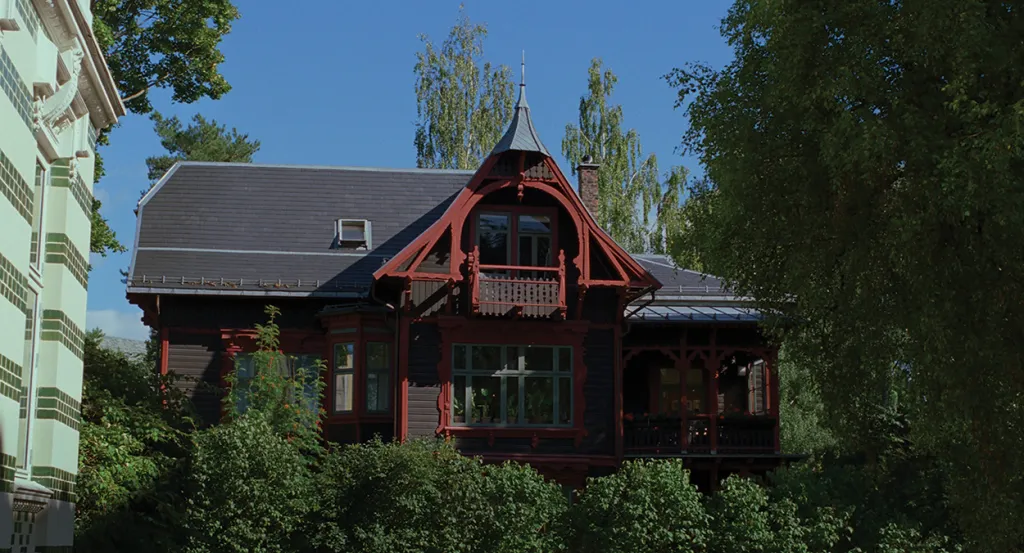
SCHJERFBECK SHARES BOTH LIMELIGHT AND sensibility this season with the scion of another Nordic Breakthrough: Joachim Trier’s Sentimental Value. At the center of the film is a red-gabled house made of wood the shade of burnt gingerbread, which we learn has been in the family for generations, an archive of memories. Its quaint features call up both Grimmsian fairy tales and fantasies of the comfort an oil-funded welfare state can provide.
As a wise Norwegian nonna delivers the voiceover that so often takes Trier’s films from a Realist style to the magically so, we start to sense that this film will be dealing in archetypes: not the ideal family, but the ideally estranged one, and yet one that will be fixed by dint of enough earnest dialogue and severe facial expressions. The house is a billboard for the sort of sentimentalism that Trier thinks will make us squeamish, and that he wants to go to bat for.
Its old-timey style might seem the picture of artlessness, as plainspoken as the actors’ unmade-up faces. But the discerning eye will catch, in the dramatic pitch of the home’s roof, the outline of a medieval stave church; in the curvature of the gables, the swell of a Viking longship. The whimsical architectural pastiche known as Dragestil (Dragon Style), an invention of the late 19th century, was fashioned from a nostalgia for pasts that seemed simpler than the present. It’s not the guileless gambit that Trier’s title promises, but a sentimentalism a shade darker. Perhaps it’s fitting, then, that at the moment his characters reach their inevitable reconciliation, Trier gives up the ruse. We were never really in the house—we were on a set all along.


