







The myth of the samurai gained prominence outside Japan in the early 20th century through films, TV shows, art, and literature. This widespread interest contributed to various misconceptions about them. However, a new exhibition at the British Museum, simply titled “Samurai,” is more comprehensive and dramatic than its name suggests. The show, on view through May 4, dismantles the popular, singular image of the samurai as merely warriors, presenting a nuanced view of the class.
In an interview with ARTnews, lead curator Rosina Buckland said that the show emphasizes that samurai were a complex social class, functioning not just as skilled fighters but also as talented bureaucrats, administrators, and cultural figures that were connected globally.
“This emerging warrior class wrested power from the imperial court. The imperial court survived, but there was this parallel power structure where the samurai men were running the government,” Buckland explained. “They were successful because of being good at jurisprudence. They got their power through warfare, but then kept power through culture and bureaucracy.”
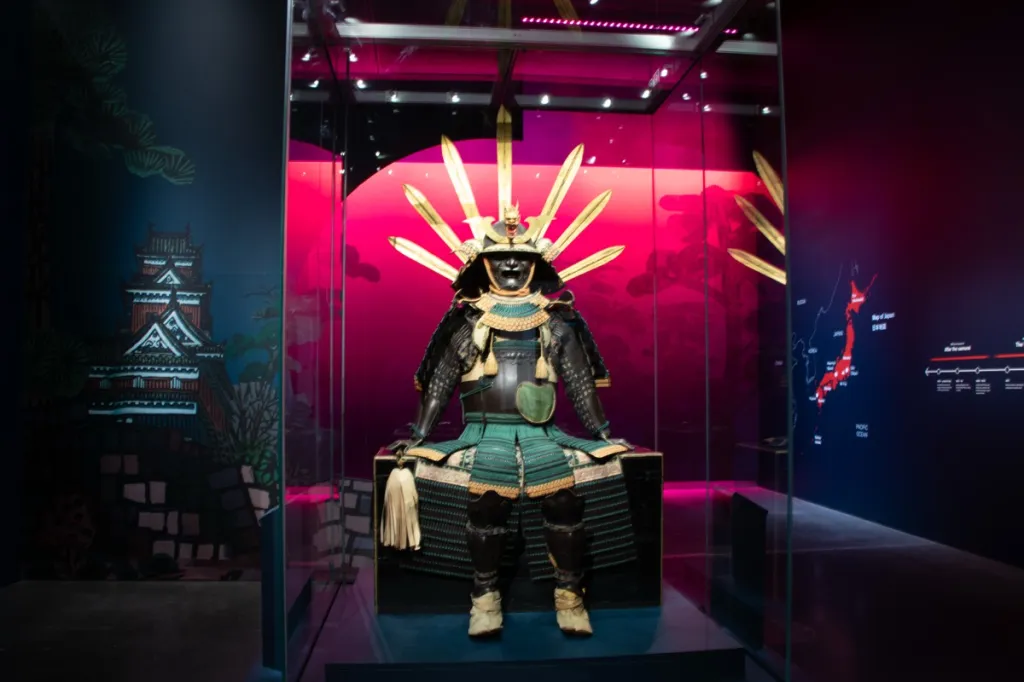
An installation view of “Samurai” at the British Museum.
Another commonly held misconception is corrected in the show: that Japan was in total isolation for 400 years. The exhibition outlines how Japan’s historical border controls were a directed strategy against Western colonization.
While the exhibition has officially been in development since 2022, along with an accompanying publication, the concept, according to Buckland, began nearly a decade ago, as part of an “international research project called Global Samurai which informed the development of the exhibition.”
The central historiography of the “Samurai” asserts that this class was defined not only by combat activities or warrior spirit, but also by legislative governance, symbolic service to feudal lords, and land administration. Although samurai were historically brutal in battle, popular media—particularly modern interpretations—frequently depicts them as honor-bound, highly stylized, and hyper-violent fighters. The curation presents a case against this common narrative through wall texts and various non-violent objects and their descriptions, with a strong focus on the Edo period (1603–1868), a time of prolonged stability in contrast to the Sengoku era (1467–1603), which was marked by over 100 years of continuous civil war and bloody territorial expansion.
The show roughly follows a chronological arc, beginning with the rise of the samurai in 800 CE. There, the exhibition details how samurai began as mercenaries for the imperial court and evolved into the rural gentry. A key figure from that time is the warlord Tokugawa Ieyasu, whose life served as the inspiration for Lord Yoshii Toranaga of the 1975 novel and 2024 television series Shogun. (A two-minute clip of the show, featuring Hiroyuki Sanada as Toranaga, plays in the room.) Also on view are scroll paintings on silk that showcase powerful samurai in governmental roles, alongside a glass display of Japanese swords and helmets made for high-ranking warriors. There’s an illustrated anthropomorphized tale of a tea ceremony titled “Tale of the Monkeys” (1570s) and a gift of a suit of armor sent by Tokugawa Hidetada to King James VI and I, signaling Japan’s maritime strength against foreign invasion. The influence of European art is represented by a large oil portrait of the Christian samurai Hasekura Tsunenaga, who led a diplomatic mission to the Vatican. By the time he returned to Japan in 1620, Christianity had been banned.
The largest part of the exhibition, titled “The Long Peace,” discusses the samurai’s role in peaceful times. An installation of wooden frames with hanging sheets resembles a traditional Japanese town, while displays highlight samurai as bureaucrats, scholars, and participants in pleasurable pursuits, depicted through scroll paintings of erotic encounters. Regional lords had to travel to Edo (modern-day Tokyo) each year for the shogun to monitor them closely for any plotting. As a result, Edo became known as the “city of bachelors” because of the brothel district created to entertain visiting samurai away from their families.
During this period, sexuality and gender were fluid in Japan. Male prostitution was common and it was accepted for older men to be with younger men, a practice akin to pederasty in ancient Greece. However, as Buckland notes, these paintings often depict fantasies that obscure a darker reality. Many girls and women were trafficked and sold to these brothels to pay off family debts. Even those who rose to the rank of high-class courtesans lived in a gilded cage at the mercy of men.
“It’s quite difficult to deal with this material because of its troubling social history. But the paintings and prints are beautiful, and that’s the contradiction,” Buckland said.


Utagawa Kuniyoshi, The Night Attack in Chûshingura, 1851–2.
Courtesy Trustees of the British Museum
An important aspect of the exhibition is the often-overlooked presence of women who made up half of the samurai class. They emerged in the 17th century during the 250-year peace that established the samurai as a standing army rather than warriors, transforming them into the elite class. While the women didn’t participate in battles, they had vital roles in their communities. Often, women were tasked with managing the household, which could be a large operation involving 40–50 people, as well as hosting complex events and supervising their children’s education.
“In times of conflict, especially if the lord of the house was away, they might also command the troops and help with the defence of the fortified residence,” Buckland explained.
Among the exhibits is a red ceremonial robe and hat adorned with detailed gold stitching traditionally worn by the head of a women’s samurai firefighting brigade—a significant position in Japanese society.
The imagery of the samurai spread worldwide long before samurai films took over Hollywood, thanks to artists retelling their tales through prints and paintings. Hokusai, who lived from 1760 to 1849, for example, created numerous works featuring samurai, while kabuki theatre from the same period staged stories of their conflicts and love affairs, characterizing both the good and bad.
A notable true story is the forty-seven rōnin, or the Akō vendetta, which occurred on the night of January 31, 1703. This tale of bloody revenge and loyalty follows 47 samurai who avenged their feudal lord, Asano Naganori, after he was forced to commit seppuku (ritual suicide) for attacking corrupt court official Kira Yoshinaka. They secretly planned their revenge for two years, as private vendettas were banned in Edo-period Japan. Public support led authorities to allow the rōnin to commit seppuku instead of facing execution as criminals for their murderous act.
“There was much debate about whether their actions were justified,” Buckland said. “Some viewed the ronin as rebels against the shogunate and also Confucian teachings, while others hailed them as heroes.”
The event looms large in Japanese history. Long before it was adapted into countless films and television shows, it was depicted in woodblock prints on display in the exhibition, such as Treasury of the Loyal Retainers: Picture of the Night Attack (1851–52) by Utagawa Kuniyoshi.

An installation view of the final room of the exhibition, depicting the decline of the samurai.
Courtesy Trustees of the British Museum
The final room depicts the decline of the samurai as Japan faced increasing threats from abroad, particularly from America’s armored steamships demanding trade. Public frustration with the shogun’s response further led to a growing sentiment that the samurai had no use in the changing society. Their gradual decline culminated in the Meiji Government issuing several edicts abolishing samurai privileges in the 1860s and 1870s. Colorful woodblock prints, such as Record of the Punitive Campaign at Kagoshima, Satsuma Province (1877), illustrate this transition. The new Meiji government moved quickly to modernize Japan and transfer power from the shogun to the emperor. The government elected officials on merit rather than nepotism or dynastic family ties, which were the norm in the days of the samurai.
Elsewhere, at the turn of the 19th century, Europeans held an orientalized view of samurai culture, romanticizing it, as seen in the silk scroll painting Portrait of Henry of Bourbon, Count of Bardi (1887), depicting the subject costumed in Japanese armor.
Although the image of the samurai was initially rejected in the modern era, nostalgia for their society grew during Japan’s violent militaristic expansions in Asia during World War II, including in China and Korea. This imagery was also used for fascist propaganda by the Axis powers, such as Gino Boccasile’s 1941 poster “Japanese Samurai Destroying the American Fleet During the Battle of Pearl Harbor.”
In global contemporary visual culture, the mythology of the samurai has greatly influenced various media, and far beyond the classic samurai films of Akira Kurosawa. George Lucas famously drew on samurai stories, particularly The Hidden Fortress (1958), to create the Star Wars saga. (Darth Vader’s iconic costume is even inspired by samurai armor.) Video games like Assassin’s Creed: Shadows and Ghost of Tsushima have continued the popular fascination, as have many Japanese sports teams, like Samurai Japan, the country’s national baseball team.
Ultimately, Buckland hopes visitors gain an understanding that samurai were ordinary people with diverse roles and identities. Their stories are more complex than the idealized, often fictionalized image of the warriors. “Samurai” brilliantly illuminates their multifaceted past.
“The history is much richer than people understand. The beautiful objects on display from across Japanese history help tell that tale,” she said.


