





It’s been two years since I last made the trek to Miami Beach in December. Despite the Miami edition of Art Basel being the only art fair to carry a scarlet letter for being “as much about the parties as the art,” it remains the most important fair in the US. And, if we’re being honest, every fair week—from Paris to Los Angeles to Hong Kong—is packed with events and openings, dinners, parties, and after-parties. You can’t make it to everything, especially in Miami. But for you, dear reader, I tried.
My week kicked off Monday night, when I touched down at Miami International at 9:30pm—just a half hour delayed. Untitled Art was throwing its party for exhibitors at The Moore, a private social club and boutique hotel in the Design District. Like any sane person in town for Art Week, I booked a hotel on Miami Beach. With the party scheduled to end at 10pm, my only choice was to take a cab directly to the party and hope The Moore had a very generous coat check. Just after I arrived, I spotted art dealer Lindsey Jarvis at the bar chatting with a charming Canadian collector. Perhaps predictably, our conversation turned to apocryphal stories about the ethics—or is it tactics?—of shipping art across state and international borders.
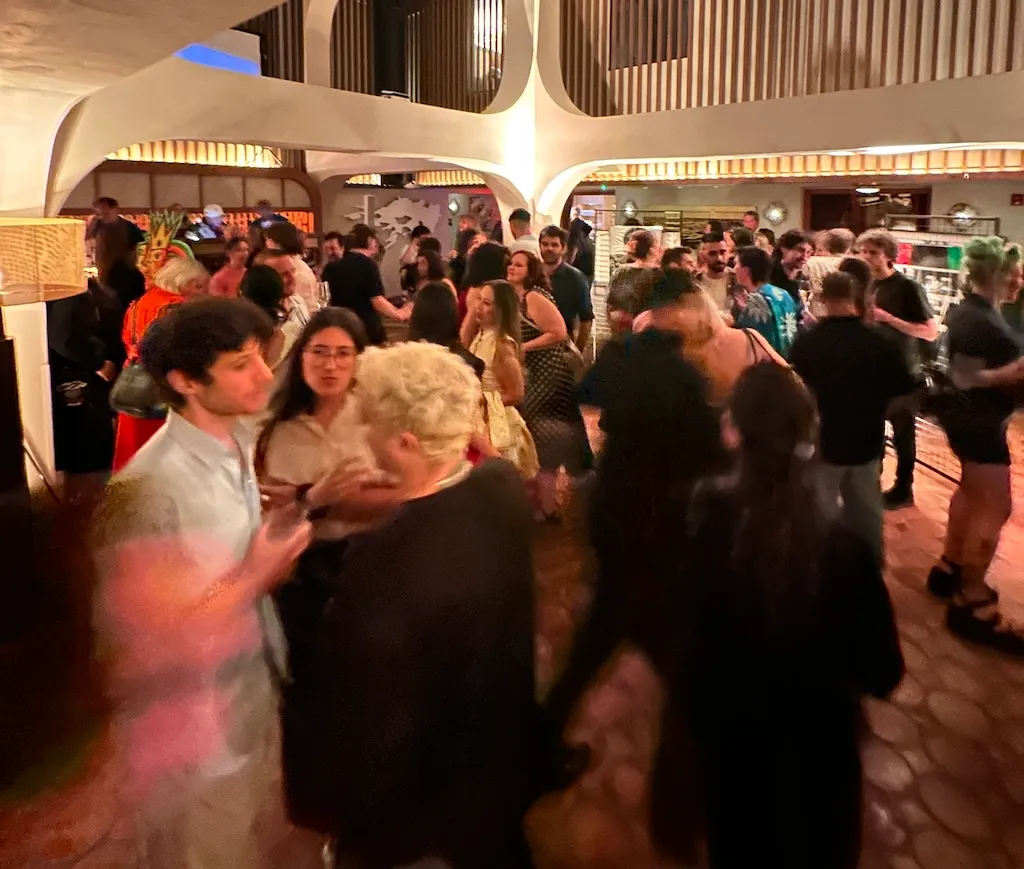
But the bar was not the venue for Untitled’s party. That was up a sweeping stairway that appeared ripped from Gone With the Wind. At the top, salsa and merengue blasted through the speakers. Danny Baez, cofounder of nonprofit ArtNoir, hyped the crowd, while Jonny Tanna, founder and director of London’s Harlesden High Street and curator of the fair’s Nest section this year, held court in the back. It was impossible not to dance, and, channeling my Cuban roots, I did.
The exterior of Joe’s Stone Crab in Miami Beach. Photo Getty Images
TNS
The night before Art Basel’s VIP preview is always the most packed, no matter the city, and Tuesday
night in Miami was no different. The only rational way to approach such an evening is to pick your itinerary and stick to your guns. I’m confident I chose wisely. Tribeca art dealer Rob Dimin held a sparkling dinner at—where else?—Joe’s Stone Crab, in a private room in honor of his first-ever participation in Art Basel’s Miami edition, as well as a stunning monumental work by the gallery’s Justine Hill in the fair’s Meridians sector. Joe’s is where the real action happens in Miami. Every year, more million-dollar deals are sealed over crab legs and coconut shrimp than at Basel proper. If you are lucky enough to snag a table, order the fried chicken. It’s miles above anything in New York, and there wasn’t a person within arms reach who didn’t ask for a bite.
My next stop of the evening was Gagosian’s party at Mr. Chow, which was as chic and star-studded as one might expect. Among the attendees I spotted: actor Olivier Widmaier Picasso, painter Lucy de Kooning Villeneuve, Top 200 collector Beth DeWoody, Art Production Fund cofounder Yvonne Force, Christie’s Colette Thiebaud, billionaire investor Nicolas Berggruen, and dealer Carlye Packer , among others. Unlike most Miami parties, the music was fantastic, thanks to Lovie, who was behind the decks spinning soul and R&B all evening. (The world needs more Roberta Flack, don’t you think?) Around 11pm I met a powerful group of dealers for a martini and an off-the-record conversation at Casa Tua before wrapping up the night at Mac’s Club Deuce.
Side note: at least four people I know were relieved of their phones that evening, so keep your valuables close.


The scene at the Deuce on Tuesday night, where sticky fingers and seedy characters mingled with the recently arrived art world. Photo Daniel Cassady/ARTnews
Art fair weeks don’t obey the natural laws of the universe. Time moves both slowly and quickly at the same time. After a long day of sales reporting on Wednesday , I met Tribeca’s Cristin Tierney for a gallery dinner at Mediterranean restaurant Amalia. The crowd included artists Dred Scott, Julian V.L. Gaines, and Tim Youd, as well as Amy Gilman, director of Wisconsin’s Chazen Museum of Art, and collectors Sandra and David Joy. The food was excellent—hanger steak, salmon, beef ragù—and the conversation graciously sidestepped the usual sales talk. Everyone left full of good food, new ideas, and just a few nuggets of gossip.
The night ended at an off-the-grid dive bar disguised as a brewery called the Abbey with some artists and curators, including René Morales, who is now with Bakehouse and spent time at both the Pérez Art Museum Miami and MCA Chicago; ICA Miami’s Gean Moreno; Spanish art fair impresarios Sergio Sancho and Sara Coriat; and artists Peter Gronquist, Malia Jensen, and Margaux Ogden. Sometimes the best place to relax is the one with grimy floors and ’90s music blaring through the speakers.
While I didn’t make it to that night’s headline soirée—the Hauser & Wirth × David Zwirner party at Casa Tua—I wasn’t the only one. A certain high-powered dealer and his new girlfriend were, according to my sources, turned away at the door. (If you desperately need to know who Mr. Wrong was, we can trade tip-for-tip. My DMs are, as they say, open.)

Cynthia Daignault embraces destruction on Miami Beach. Photo Daniel Cassady/ARTnews
Thursday night started on a meditative note. With an impossibly bright supermoon hanging over the beach, Night Gallery and Olney Gleason brought together a group of fifty to watch artist Cynthia Daignault destroy the second painting in a series of five works. The first one was set on fire a decade ago in what sounded like a raucous event on a boat during that year’s Miami Art Week.
This time Daignault, kneeling on the sand, read the poem “Not Dying” by Mark Strand and peacefully cut the painting to shreds with a pair of shears. The five pictures, each a still life with a decreasing number of flowers in a vase, were made to be destroyed—one every decade. The first one had five flowers, this one had four, and so on. The destruction is as much a part of the work as the paint, both figuratively and legally: every collector who owns one has signed a contract guaranteeing that, when that painting’s number is up, it will leave this world in whatever way Daignault sees fit. But where there is death, there is always life. Daignault placed the remaining bits of canvas in a bowl and let the assembled crowd take home fragments as a memento of the occasion. “I’m glad I didn’t burn this one,” she said after the destruction was over. “I can use the frame for a new painting.”
Drinks at the Esmé Hotel’s Bamboo Room followed and, by the relatively reasonable 11pm, everyone was on their way to wherever the moon would lead them. It led me back to my hotel on Collins Avenue and straight to my keyboard.
And as I type this, bleary-eyed, mildly frazzled, and only slightly exhausted from the business of reporting on art fairs, my phone is vibrating. Twist? Medium Good? Back to the Deuce? Silencio? They were all options. But maybe a quick nap first.