






“I don’t think that anybody ever starts with a clear plan to sunset, but nor did I think that this would necessarily institutionalize in a way that would make it exist forever,” artist and Chloë Bass told ARTnews in a recent interview about Social Practice CUNY, the initiative she has co-directed for the past five years. “Somewhere in between those two things comes the decision to sunset.”
Social Practice CUNY will sunset in February 2027, with its 2025–26 fellowship cohort being its last. Housed at the CUNY Graduate Center, the program provided fellowships to graduate students and faculty at any of the 25 campuses of the City University of New York. In addition to the funds it created, Social Practice CUNY has helped foster a network and community between its fellows.
The decision, which they described as “the result of a very intentional process,” comes partially from changes within the personal lives of Bass and her co-director Greg Sholette. Bass stepped away from a full-time teaching job at Queens College at the end of the 2024–25 academic year to focus on her art practice, and with Sholette, also an artist and professor at Queens College, retired from teaching.
Bass added, “Although Social Practice CUNY has behaved like an institution, it’s really an artist-run project.”
Social Practice CUNY grew out of Social Practice Queens (SPQ), which Sholette had cofounded at Queens College as a partnership between the school’s MFA program and the Queens Museum. Through SPQ, Sholette and Bass edited a book called Art as Social Action: An Introduction to the Principles and Practices of Teaching Social Practice Art that aimed to be a practical textbook on how to teach social practice.
Nora Almeida, Last Street End Series & Land Use Intervention Library, 2022.
Photo Gaby López Dena/Courtesy the artist
Bass and Sholette also wanted to think about how social practice manifests both of outside their classrooms and “the ways in which this work takes place far outside the way that the art world presents it,” Bass said. “That can include the ways that the art world presents it, but I think that that has put a lot of limitations on the understanding of what social practice can be, how it can function, and how it can even manifest as a project.”
Bass suggested expanding SPQ’s purview to include all 25 of CUNY’s campuses as a way “to connect people who are working at the intersection of art and social justice throughout the CUNY system, regardless of their academic background or what department they’re working in,” she said. “Socially engaged practice is inspired by and comes from so many different disciplines, but the way that we often teach or learn in a university setting can be very siloed.”
The fellows dealt with disciplines ranging from social work, nursing and public health, geography, architecture, performance studies, and art. In doing so, Social Practice CUNY fostered a community that “wouldn’t have happened in a regular classroom situation,” Sholette said. “This was really our dream to get people to talk to each other and create networks of people who were already engaged in this kind of work.” Bass added, “It was a lot of different people, and that points to the hunger for this.”


Artist Suzanne Lacy with the 2021 SPCUNY Cohort at the Queens Museum.
Photo Gregory Sholette/Courtesy Social Practice CUNY.
Social Practice CUNY launched in 2021, with a $530,000, three-year grant from the Mellon Foundation in December 2020 as its seed funding. (The Mellon Foundation gave the program another $600,000 over two years in September 2023.) The goal was to support the social practice work that grantees were already doing, which Bass said is rare in within academic funding.
Over the past five years, Social Practice CUNY has awarded $535,000 in direct support to 129 fellows, who are free to use the funds toward their work as they see fit. In addition to direct support, it also organized a series of workshops under the title “How to Survive as an Artist” and produced a podcast called Part of the Practice that highlighted its fellows.
With its Mellon Foundation funding now having been complete, Social Practice CUNY would have needed to be able to secure funding from additional sources, which Bass and Sholette said can be difficult during a leadership transition, especially one in which both founders are departing. (The program had recently secured some additional funding from the Eugene Lang Foundation.)
They had also thought of having the program, officially an initiative within the Graduate Center, become formalized within the CUNY system as an institute or a center, but those plans ultimately did not materialize, even with support from leadership, like CUNY Graduate Center president Joshua Brumberg.
“Given what’s facing higher ed at large, there is real scrutiny on how anything is being managed, particularly things that have a bit more autonomy,” Bass said, noting that CUNY had begun limiting the number of centers it houses.

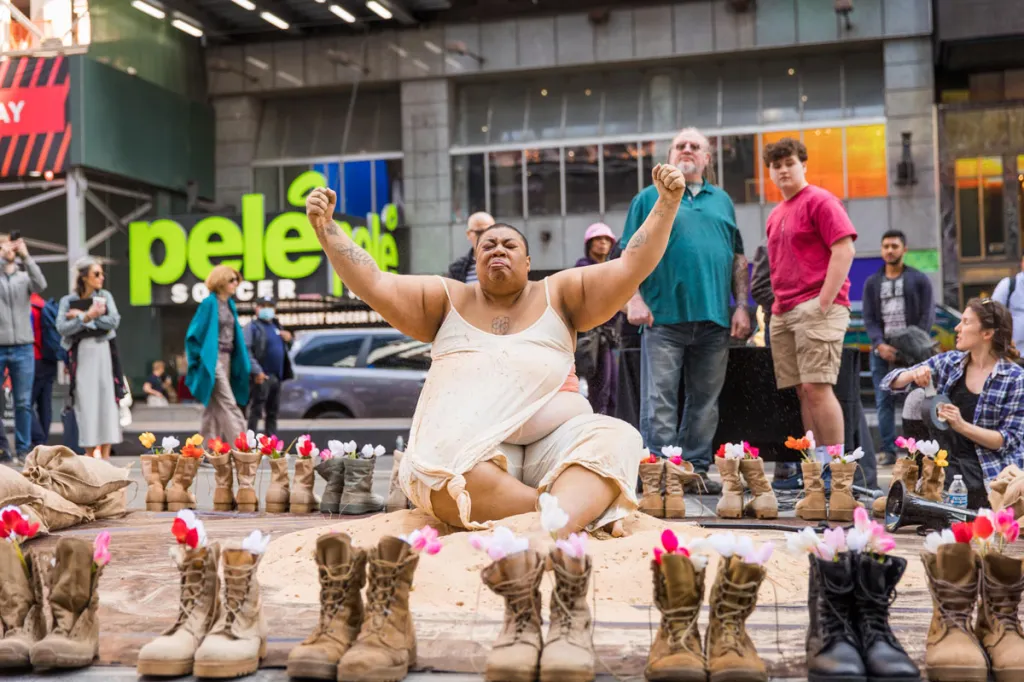
Kerosene Jones, Blue Lightning Ghost Train: Inpatient Program 1, 2025.
Courtesy the artist
Even still, Bass and Sholette believe that Social Practice CUNY can serve as a model that others can follow. “It’s a small project, when you get down to it,” Sholette said, “but we presented a model or a case study for interdisciplinary social practice being in higher education.”
Bass added that she sees the model as one that can extend even beyond the confines of academia. “The model of Social Practice CUNY—as a nimble, cross disciplinary, supportive, communicative project generator that connects people for both short- and long-term purposes—is what we will need as an organizing model,” she said. “Taking up that work of making these spaces of communication and actual engagement is more relevant now than prior. It was always important that now it’s urgent.”
Sholette added, “We’re both hoping that someone will come along, in the not too distant future, and be able to utilize the groundwork that we laid, the materials we’ve developed, the networks we’ve established, and rethink the model and relaunch it in its own in a different way for the appropriate moment. We’re not seeing this as the sort of sunsetting and goodbye. We’re seeing this as a successful experiment carried out, leaving behind an archive of important potential resources for the next persons or generations or collective to come along and activate it again.”


