







American universities facing financial crunches come under fire when they either close their art museums or sell paintings from their collections to narrow a budget gap. Just in the last few years, Chicago’s DePaul University, Indiana’s Valparaiso University, and Pennsylvania’s Albright College have alienated donors and their respective school communitues in this fashion. Professional organizations like the Association of Art Museum Directors (AAMD), the American Alliance of Museums (AAM), and the Association of Academic Museums and Galleries (AAMG) restrict museums from using the proceeds from art sales for anything apart from future acquisitions or direct care of collections.
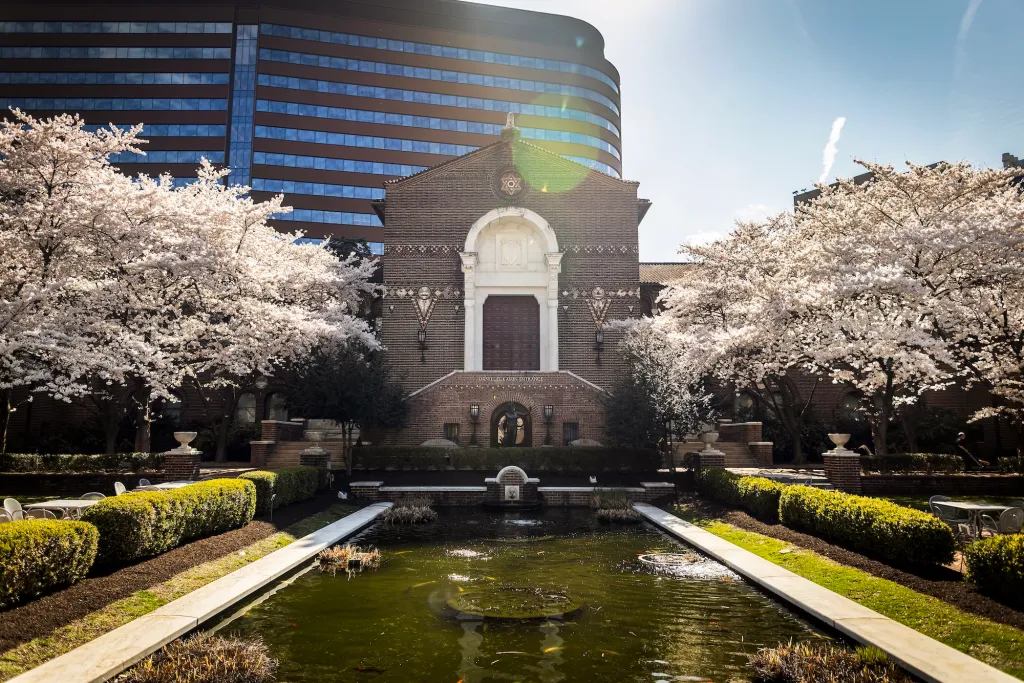
Now, the Penn Museum, on the Philadelphia campus of the University of Pennsylvania, is offering at auction a painting that forms a cornerstone of the museum’s history—but because it is not an object that was formally added to the museum’s collection in a process called accessioning, the customary rules don’t apply. And in any event, the painting is being sold to establish a permanent endowment for the long-term care of the Penn Museum’s collection, which spans some 10,000 years of history, with objects from Africa, ancient Egypt and Nubia, Asia, the Eastern Mediterranean, Europe, Mexico and Central America, the Middle East, and indigenous communities in North America.
The 1891 painting by Ottoman artist Osman Hamdi Bey, Cami Kapisinda (At the Mosque Door), will lead Bonhams’ 19th-century paintings and British Impressionist art sale on March 25 in London. The Penn Museum bought the painting, which stands nearly seven feet high, directly from the artist in 1895 for the then-considerable sum of 6,000 francs. It comes to the auction block with an estimate of £2 to £3 million ($2.7 to $4 million).
Bonhams London had tremendous success with a Bey painting in 2019. Young Woman Reading (1880) bore a high estimate under $1 million but fetched £6.6 million ($7.8 million), establishing a new auction record for the artist. According to data from art market analytics firm ARTDAI, only two other Bey paintings have sold for more than $4 million, the high estimate on At the Mosque Door.
Osman Hamdi Bey, Cami Kapisinda (At the Mosque Door) (1891).
courtesy Bonhams
After its 1895 purchase, At the Mosque Door was literally rolled up and placed in storage, Emily Neumeier, an assistant professor of art history at Philadelphia’s Tyler University, told ARTnews. While the painting was known to exist, according to Neumeier, who specializes in the Ottoman Empire, its location was listed as unknown in various publications, including a comprehensive catalogue of the artist’s work. It was rediscovered only in 2007, after which the school brought Neumeier on to research the painting’s history.
UPenn has seen some financial challenges, especially under the Trump administration. In February 2025, the National Institutes of Health implemented funding cuts that stood to cost the university some $240 million, resulting in threats to hundreds of jobs and a reduction in graduate program cohort sizes.
But some observers are unhappy about the sale.
“At the very least, this situation should open up a larger and more serious discussion about unaccessioned objects in museum collections and how they should be handled when they fall outside typical ‘deaccession’ procedures and decisions,” Christiane Gruber, professor of Islamic art at the University of Michigan, told ARTnews in an email. “The nebulousness allows a lack of public scrutiny and accountability.”
“I think it’s a shame and a missed opportunity,” Neumeier added in an email.
The Penn Museum declined a request for an interview for this article.
The Artist Held the Key to Western Archaeological Research
The Ottoman artist, who was appointed to a high position in his country’s government, found himself in an exceptionally powerful position to exert control over Western archaeological expeditions in the Ottoman empire, including one at Nippur by the Penn Museum. And in fact, At the Mosque Door itself proved to play an essential role in the early development of the collection of the Penn, which was founded in 1887 and now housing over a million “extraordinary artifacts and archaeological finds.”
Bey was informally trained in Paris by French Academic artist Gustave Boulanger and was influenced by the Orientalist work of Jean-Léon Gérome. Bonhams describes him as “one of the first Ottoman artists to bridge the artistic worlds of Turkey and France.” He returned to Turkey in 1868 and became that country’s director of foreigners issues in Iraq until 1871, after which he returned to Constantinople in 1871 and resumed his artistic career. Ten years later he would be appointed head of the city’s newly formed Archaeology Museum and successfully got a law passed that forbade the export of archaeological finds, ensuring a strong collection for the country; he also pushed through legislation that gave him the authority to give the thumbs-up or -down to Western powers’ requests to conduct digs, Neumeier points out.
In Neumeier’s view, Bey was a “fascinating individual” and a Renaissance man. “He comes from a family of bureaucrats and diplomats,” she said. “His father wanted him to be a lawyer but he went off to France to study and decided he wanted to be a painter, to his family’s great alarm.”
The painting has a fascinating life story, as Neumeier uncovered, bound up in the history of archaeology and the meeting of East and West. At the Mosque Door was first shown at the International Art Exposition in Berlin in 1891, along with two other of Bey’s paintings, one of which the French state bought in a move Bonhams describes as likely aiming to curry favor with the artist so it could continue to excavate in Ottoman lands.
The towering canvas then traveled to the World’s Columbian Exposition, aka the Chicago World’s Fair, in 1893. The recently formed Penn Museum bought it directly from the artist two years later, again in a play for favor, as noted in the minutes of museum meetings, says Neumeier—in this case to ensure that the school’s ongoing excavations at Nippur would be allowed to continue. Indeed, Bey would later give the museum a collection of important cuneiform tablets. The canvas then disappeared, until it was rediscovered just a few years ago.
Since then it has had a busy few years. In 2010–11, it hung at the Penn Museum in the show “Archaeologists and Travelers in Ottoman Lands,” for which Neumeier was part of the curatorial team. The following year it was featured in “Osman Hamdi Bey and the Americans: Archaeology, Diplomacy, Art,” at Istanbul’s Pera Museum, and then in 2018 at Philadelphia’s Arthur Ross Gallery in “The World on View: Objects from Universal Expositions.” Now it heads to the auction block, possibly to disappear into private hands forevermore.
The painting shows the main entrance to the Muradiye Mosque at Bursa, but seems to depict an imaginary scene. The painting has “all the expected intense colors and key Orientalist tropes,” says Bonhams, including women in feraces, a typical 19th-century overcoat. The artist signed his name in Arabic script on the spine of a book shown on the canvas, and painted himself into the scene no less than three times: as a cross-legged beggar, the turbaned man standing next to him, and as a man in the foreground, rolling up his sleeve.
A Gray Area in Museum Ethics?
For museums to sell artworks, they typically have to demonstrate that they are redundant, or of inferior quality, or outside the scope of the institution’s collection. Proceeds can be used only to acquire more artwork or for the “direct care” of existing collections. Going outside these guidelines incurs penalties from organizations like AAMD and AAM, with museums possibly losing accreditation or the possibility of borrowing artworks from other member institutions. Donors, it is widely thought, may be less likely to consider giving their treasures to museums if they are concerned they will be liquidated in a cash crunch, even a severe one. In an informative guide, the AAM writes that “The collections aren’t there to preserve the museum; the museum is there to preserve the collections.”


The Sphinx Gallery at Penn Museum in Philadelphia.
Penn Museum
Professional organizations offered differing statements to ARTnews about the sale.
“AAMD’s professional practices deals with accessioned works of art and not property held by a museum or its governing body (like a university),” said AAMD spokesperson Sascha D. Freudenheim in an email, and AAM “does not have any guidelines on selling works that have not been formally accessioned by a museum,” said a spokesperson. But Kristina Durocher, president of the executive committee of the Association of Academic Museums and galleries, weighed in by email, saying, “It is regrettable the Penn Museum would sell a significant work of art that embodies its institutional history—AAMG maintains that works of art held by academic institutions should not be treated as fungible assets regardless of their status nor should the proceeds from the sale of works of art be used to fund university operations.”
For Neumeier, the academic who researched the painting’s provenance, the situation has echoes of another local deaccessioning story, when the Thomas Jefferson University board voted in 2006 to sell Philadelphia artist Thomas Eakins’ painting The Gross Clinic (1875) to the National Gallery of Art in Washington, D.C. and the Crystal Bridges Museum of American Art, then under construction in Bentonville, Arkansas, for $68 million, a record price for a pre–World War II American artwork. Public outcry resulted, and local organizations and Wachovia Bank raised money to match that amount and purchase the work in order to keep it in Philadelphia, where it is co-owned by the Philadelphia Museum of Art and the Pennsylvania Academy of Fine Arts.
It may be true that the painting falls outside of the Penn Museum’s purview of “artifacts and archaeological finds,” as its collection is described on its website, but, says Neuemier, “The painting was foundational to the establishment of the museum, which was founded to house materials excavated from Nippur.”
Even though she was the expert called in to research the painting’s history, which Bonhams now touts in promoting the work, Neuemier only recently learned of the sale. She finds the move unfortunate, especially in view of the painting’s historical importance.
“The story of the painting shows the entangled history and the birth of modern archaeology,” she says. “It’s a key work in telling that story.”
“This would be an easy win,” she continued. “The museum could exhibit it and put it front and center and make it about the foundation of the museum. The story also shows the agency of Osman Hamdi Bey. It nuances the idea of Western archaeologists in Ottoman lands. In the purchase of this painting, Bey very much has the upper hand, and they’re scrambling to curry favor with him. This is not a straightforward story about Western people exploiting the people of Western Asia.
“There was a really nice quote from Bey reported in a letter to the museum, when he decided to gift the tablets,” pointed out Neumeier: “You could get these objects from me by force [but] you have decided to use persuasion,” Bey wrote. “Persuasion works always better with me than force, which I resist.”


