







New light has been shed on the working methods—and attention to detail—of Ancient Egyptian craftspeople, after researchers at the Fitzwilliam Museum in Cambridge, UK, discovered what has been described as a very old form of “Tipp-Ex”. Analysis of a papyrus from an approximately 3,300 year-old Book of the Dead showed a whiteish fluid had been used to make the figure of a jackal slimmer.
The discovery was made as part of ongoing work around the Fitzwilliam’s exhibition Made in Ancient Egypt (until 12 April), by a research team including Fitzwilliam conservators and the exhibition’s curator, Helen Strudwick.
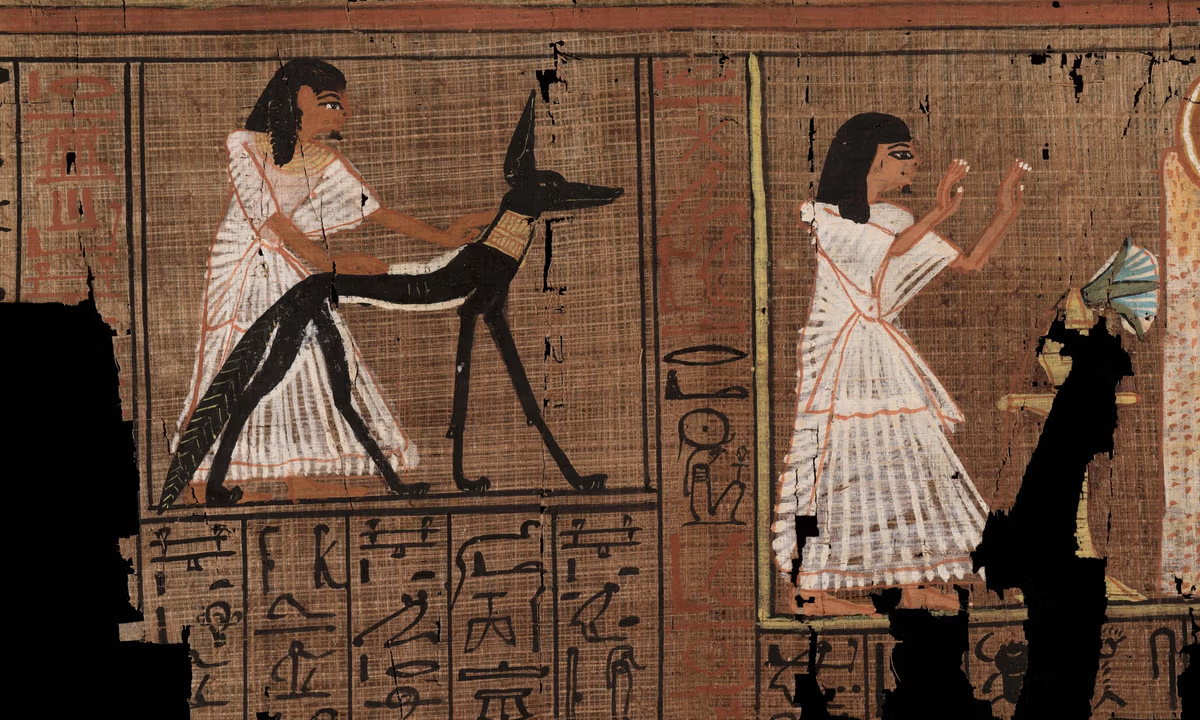
The group had been studying a scene from a copy of the Book of the Dead—an anthology of magical spells placed in tombs, and believed to help the person buried there reach the afterlife, collected in the Ancient Egyptian New Kingdom— that was produced in around 1290 BC for an individual named Ramose, the supervisor of royal archives. The scene features the scribe with his hands on a jackal-headed god, most likely Wepwawet. Thick white lines appear on either side of the jackal’s body and on the front of the thighs of its back legs, and the team had “been using different analytical techniques to work out what this white paint is made of”, said Strudwick, a senior Egyptologist at the Fitzwilliam, in a statement.
The corrective fluid analysed using light infrared photography
Photo: © The Fitzwilliam Museum, University of Cambridge
Results suggest that the paint is made up of “a mixture of huntite and calcite”, while “images made using a 3D digital microscope show that there also are flecks of yellow orpiment, probably to make it blend in better with the fresh papyrus, which would have originally been pale cream in colour,” Strudwick continued, noting that this differs from the white paint used on Ramose’s robe, which is only made of huntite.
The research team analysed the vignette—depicting Spell 117—further using light infrared photography. This showed that the white lines around the jackal were painted over parts of the jackal’s figure, altering its shape. “It’s as if someone saw the original way the jackal was painted and said “it’s too fat; make it thinner”, so the artist has made a kind of ancient Egyptian ‘tippex’ – also known as ‘Wite-out’ or ‘Liquid Paper’ – to fix it’,” said Strudwick.
Speaking to The Art Newspaper, Strudwick says she is not aware of any symbolic reason for the use of the overpaint. “If there were, I would expect to see other examples in illustrations of this spell, which is not the case,“ she says. “To me, the original jackal looks pretty good, but jackals are scavengers and probably fairly scrawny in comparison to domestic dogs, so maybe a senior artist (or maybe the original painter) reviewed this image and thought that this jackal looked too dog-like and needed to be thinned down.”

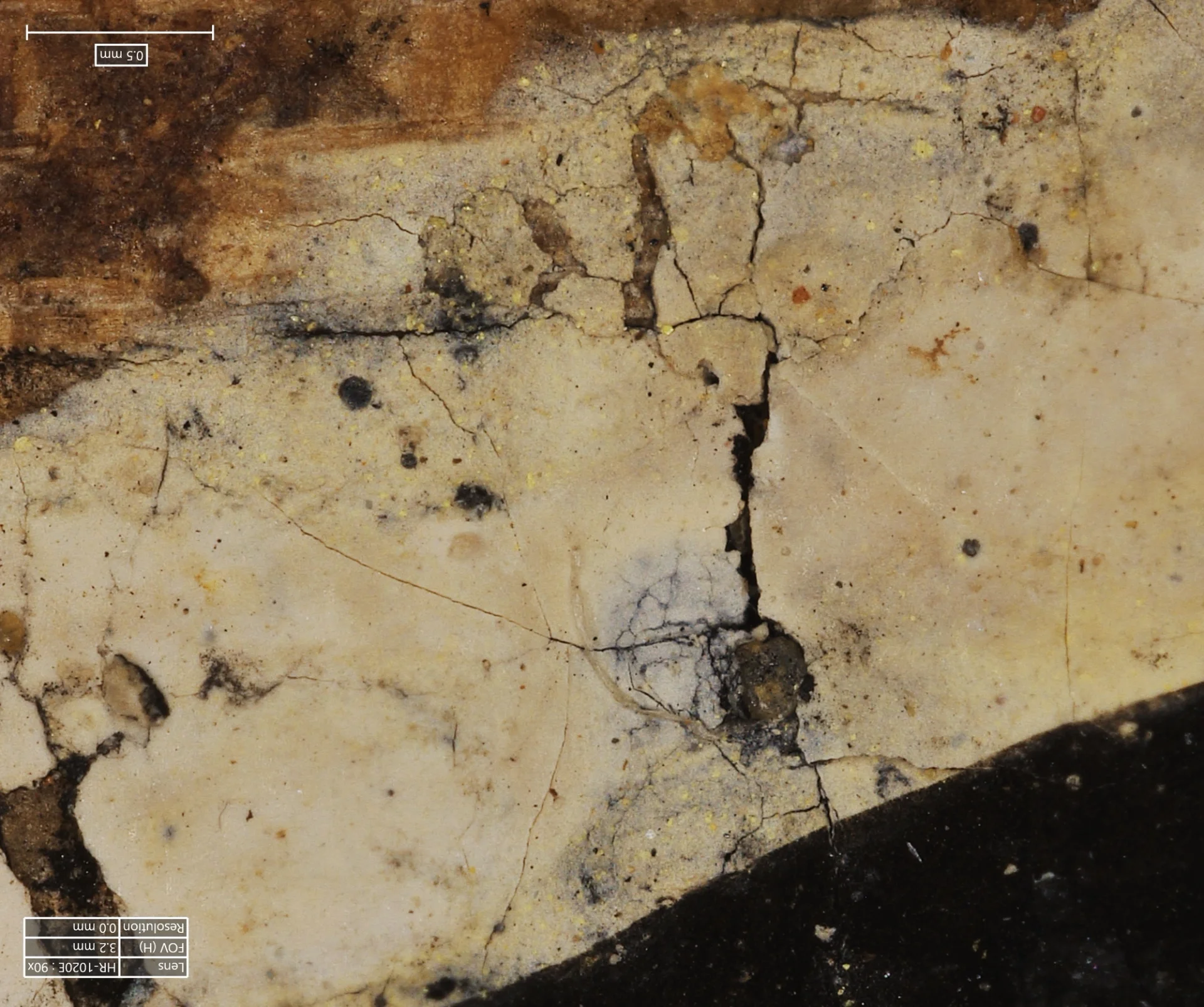
A detail of the back of the jackal magnified 90 times, made using a 3D digital microscope, shows how the white paint overlies the black of the animal’s body. Flecks of yellow orpiment can be seen where the white paint is slightly thinner
Photo: ©The Fitzwilliam Museum, University of Cambridge
Strudwick says that she has noticed other examples of the “Tipp-Ex” being used on papryi in other UK museum collections, including the the Book of the Dead of Nakht at the British Museum and Egyptian Museum in Cairo’s the papyrus of Yuya. “I am not aware that anyone has ever noticed it before,” she says, “and therefore it has not been analysed before as far as I know.“
‘When I have pointed them out to curators [at museums with objects featuring the fluid], they’ve been astonished,” she added in the statement.
The correction fluid is not the first discovery as part of work on Made in Ancient Egypt, which explores the lives and techniques of Egyptian craftspeople working millennia ago. In July 2025, the Fitzwilliam revealed that its researchers had discovered a handprint on a “soul house” dating back around 4,000 years. It is believed that “soul houses” were used as places to leave offerings of food—such as bread or an ox’s head—or as sanctuaries for the deceased person’s soul.
“I have never seen such a complete handprint on an Egyptian object before,” Strudwick said at the time. “You can just imagine the person who made this, picking it up to move it out of the workshop to dry before firing.”
She tells The Art Newspaper in the wake of this latest discovery: “We certainly have a huge amount to learn about the makers of the fantastic objects we see in museums (and on site in Egypt too, of course). Working at the Fitzwilliam, I am surrounded by brilliant and enthusiastic colleagues who are always keen to help with unpicking research questions like: ‘what’s this white stuff doing here and what’s it made from?’”
Parts of papyrus of Ramose, originally discovered in 1922 in a tomb at Sedment, Egypt by the archaeologist William Flinders Petrie, are now on display in the Made in Ancient Egypt exhibition.


