








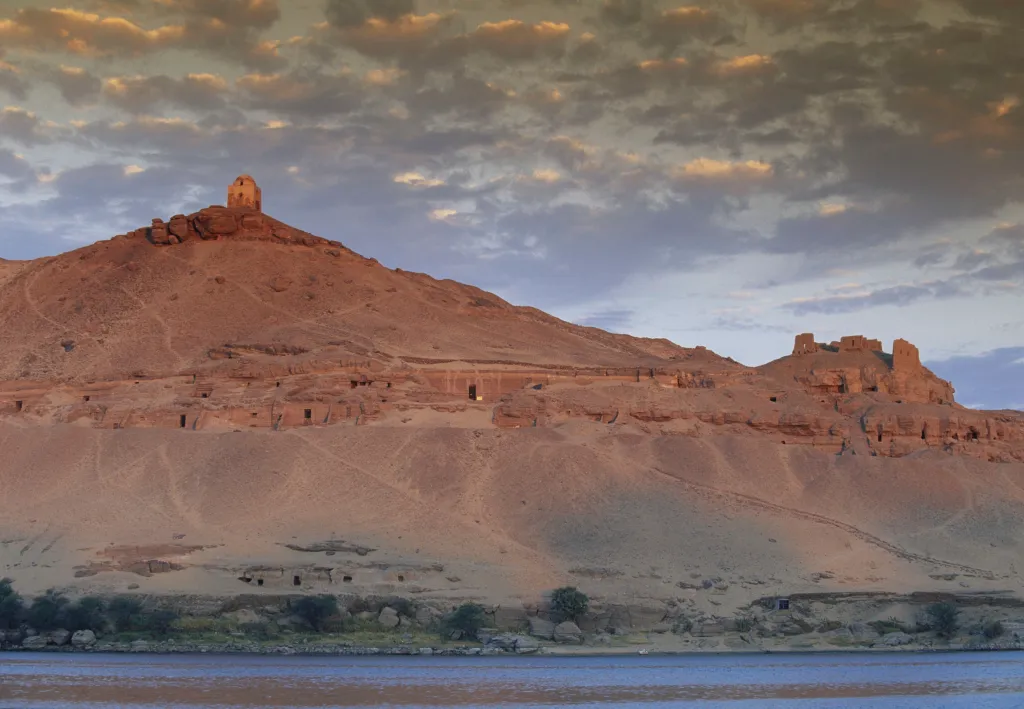
A research team from Egypt’s Supreme Council of Antiquities (SCA) has announced new discoveries at Qubbet Al-Hawa, a well-known archaeological site in southeast Egypt, near the city of Aswan. The Upper Egyptian site is known for its sprawling necropolis.
This latest mission, as reported in Ahram, focused on rock-cut burial shafts and chambers, most notably two chambers full of 160 pottery vessels, many of which are covered with text, that are believed to have been used to store grain and liquids. Many of these artifacts, in various shapes and sizes, are very well preserved.
Another tomb’s outer courtyard was filled with bronze mirrors, kohl containers, beaded necklaces, and other jewelry items from the Middle Kingdom. Archaeological evidence suggests that the tomb complex was used by ancient Egyptians across centuries, starting during the Old Kingdom (ca. 2700–2200 BCE).
Hisham El-Leithy, secretary general of the SCA, noted that the council will continue to study these rock-cut tombs to learn more about how they were used and reused across time.
Qubbet Al-Hawa lies on the west bank of the Nile and was first excavated in the late 1880s. It features approximately 100 tombs cut into the rocky faces of cliffs, which were constructed for local governors, dignitaries, and priests. It remained an active burial site from the Old Kingdom through the Roman period. Recent discoveries include 10 mummified crocodiles in 2019, six flat-roofed mud-brick graves in 2020, and three Old Kingdom tombs with human remains in 2025.
In late 2015, the Egyptian Museum an Papyrus Collection in Berlin partnered with the Aswan Inspectorate, a division of the Egyptian Ministry of Tourism and Antiquities, on a mission to document and conserve a newly discovered necropolis about a mile north of Qubbet el-Hawa. The ongoing project has so far uncovered nine tombs around the nearly 300,000-square-foot burial complex.


