





Ariana Papademetropoulos’s latest exhibition, titled “Glass Slipper,” is more than a fairy tale. Currently on view through April 11 at Thaddaeus Ropac’s space in Paris, the show features paintings from two different series—one hyper-realistically depicts dresses in dry cleaning bags, the other chairs floating in different landscapes—as well as an installation consisting of a fish tank and mattress in which visitors are invited to lay on and don some headphones to listen to a commissioned soundtrack. The artist wanted to transform the gallery into a ritualized space, where water, portals, and invisible forces create an immersive encounter. Below, Papademetropoulos describes how she conceived of the exhibition, her various influences, and what she thinks keeps art alive.
Ariana Papademetropoulos, The Mistress, 2026.
Photo Nicolas Brasseur/©Ariana Papademetropoulos/Courtesy Thaddaeus Ropac, London · Paris · Salzburg · Milan · Seoul
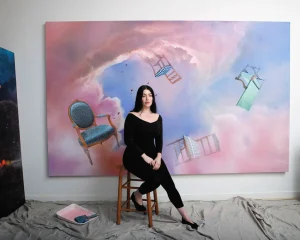
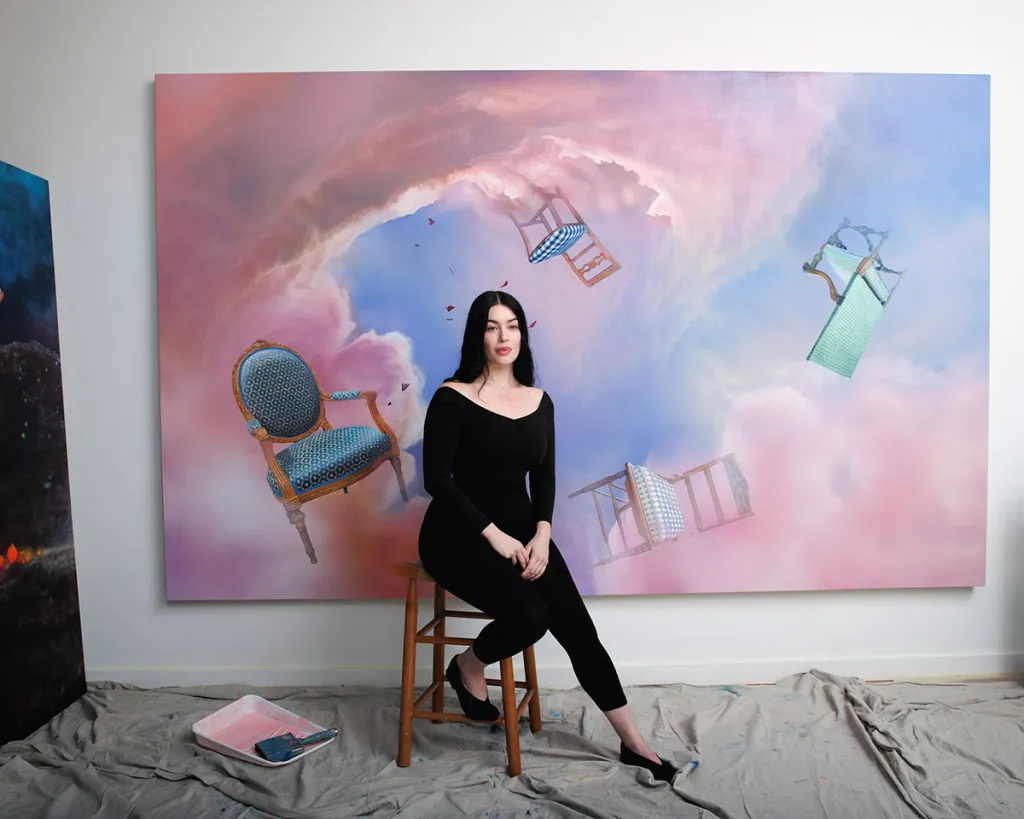
Thaddaeus Ropac’s Paris space looks a bit like a church, with high ceilings. I wanted to build the exhibition as a journey, letting the work guide you through it. I painted dry-cleaned dresses to greet you. (One dress I already had, the other I rented for the painting.) They are devoid of figures, yet you can feel them. You can almost hear them. There’s a thread running throughout the show of presence through absence. As you step into the nave-like gallery, a glass coffin occupies the center, surrounded by large canvases that emulate Roman trompe-l’œil. Chairs are directional; they show you where you’re meant to sit. The chairs in my paintings take the place of figures. Floating in the air, it’s impossible to tell whether they are rising or descending. The same ambiguity applies to the rainbow in Gravity’s Rainbow (2026). Is it springing out or delving into the water? Interestingly, the first painting I produced, Jupiter and Io (2026), concludes the show on the second floor, while the last work I made, the aquarium, takes center stage downstairs.


Ariana Papademetropoulos, Jupiter and Io, 2026.
Photo Nicolas Brasseur/©Ariana Papademetropoulos/Courtesy Thaddaeus Ropac, London · Paris · Salzburg · Milan · Seoul
I think art is supposed to make you meditate. That’s why we go to museums. With the aquarium, I thought I could take it another step further. It is filled with 150 fresh-water kissing fish. They dominate each other through their kissing. I’m waiting for them to start, but so far they keep kissing the glass. They’re very cartoon-like, almost unreal. I wished for 1,000 of them, but was told 150 was the limit for this kind of fish tank. I wanted the viewer to be immersed, to feel they could coexist with another species. Air, one of my favorite bands, asked me to do the art for their upcoming album. In return, I asked them to compose a three-minute track for the aquarium. I gave them many references, including their own work from the movie Virgin Suicides, as well as ambient ’70s soundtracks. The music is meant to convey the feeling of going deeper into the ocean: starting at the surface and descending as the track progresses. I feel their music completes the work. Is it Snow White’s casket? The Pope’s coffin? I love that people have their own interpretations. I built the aquarium as an ultimate therapy device, inspired by Korean spa rituals. Visitors become avatar versions of themselves, observers being observed, immersed in this play on gaze. Ice, fog, steam—through water we cleanse, renew, and transform.

Ariana Papademetropoulos, Water Based Treatment, 2026.
Photo Nicolas Brasseur/©Ariana Papademetropoulos/Courtesy Thaddaeus Ropac, London · Paris · Salzburg · Milan · Seoul
The title of the show, “Glass Slipper,” references Cinderella. I like that it evokes a fairy tale, but it’s also quite violent. There’s a tension in it—you’re protected, yet that protection can break. The title carries these dualities. I thought of the glass slipper as a kind of vessel, echoing the theme of other vessels in the show: the microwave, the dry cleaning, and ultimately the aquarium. I curated the exhibition around an esoteric version of The Wizard of Oz. Frank Baum, who wrote the novel that the film is based on, was a theosophist, and I love where Hollywood meets the new age—my work reflects that. To me, The Wizard of Oz is the ultimate story, the best movie ever made. Certain films you see as a child—in my case Jean Cocteau’s Beauty and the Beast and Roger Vadim’s Barbarella—embed themselves in your mind. These stories stay alive and continue to inform the imagination.

Ariana Papademetropoulos, Psychic specific (intellectual property) 1, 2026.
Photo Nicolas Brasseur/©Ariana Papademetropoulos/Courtesy Thaddaeus Ropac, London · Paris · Salzburg · Milan · Seoul
The vintage phone booths on the second floor are the only works I had already made before this show. I thought they could act as portals, much like my paintings. Each is framed by a shell, which can also serve as a portal to the ocean. It’s such a beautiful moment when you lift the receiver and hear the ocean. It connects all of us. For the recordings, I had been working with a medium in Los Angeles for six years, but we ran into disputes over intellectual property. I then found another incredible psychic, recommended by artist Pol Taburet.
The psychic, Yaguel Didier, is 83 and very well known in France. Her house is filled with paintings by Pablo Picasso and Henri Matisse. She has the warmest voice. I don’t speak French, so someone from the gallery translated her readings, allowing me to isolate three extracts for each phone booth. (Those excerpts are less about my personal life.) Keeping her voice in French adds an invisible layer, a passing-through-language effect. Her visions—rose petals falling in a swirl, fish surrounding you, things flying in the air—often echoed my work. She didn’t know anything about it, yet her images aligned perfectly with the exhibition.
Installation view of “Ariana Papademetropoulos: Glass Slipper,” 2026, at Thaddaeus Ropac, Paris.
Photo Nicolas Brasseur/©Ariana Papademetropoulos/Courtesy Thaddaeus Ropac, London · Paris · Salzburg · Milan · Seoul
Much of my practice is an investigation into the invisible. I’m fascinated by where the psychic field meets the quantum field, where science meets magic. Anything I don’t understand makes me think. I love movies with unknown endings—they stay alive. That’s why I love David Lynch or the Mona Lisa: we don’t know why she’s smiling. Mystery keeps art alive. The things we can’t fully grasp always seem to take on a life of their own. —As told to Sarah Belmont


