





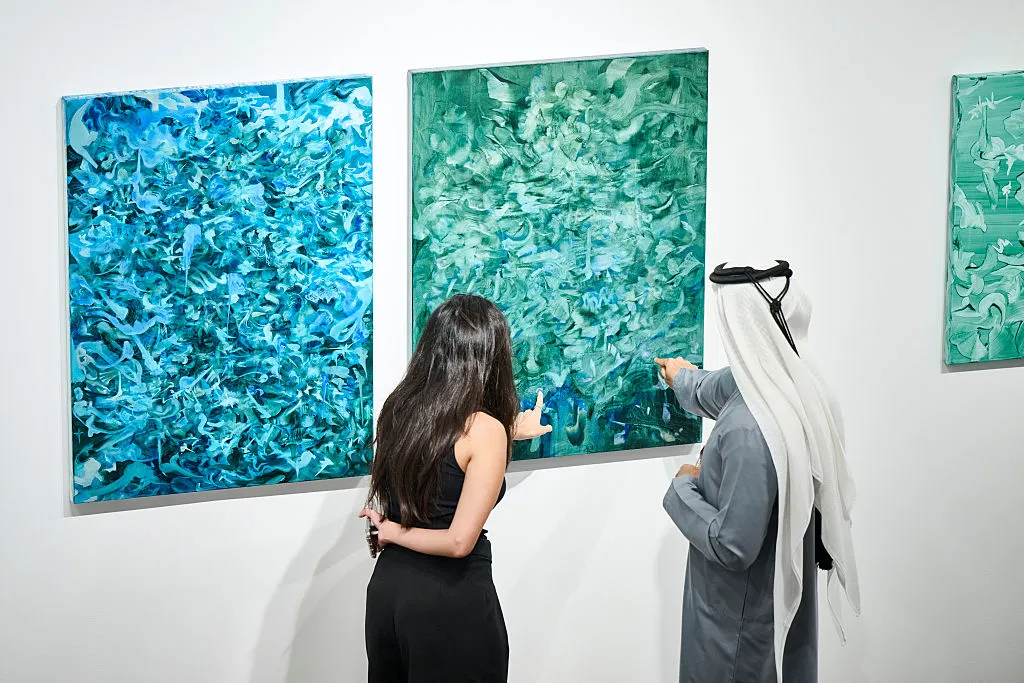
Art Dubai has released the exhibitor list for its 2026 “special edition,” a scaled-back fair that will run May 15–17 at Madinat Jumeirah, with a VIP preview on May 14, bringing together roughly 75 presentations across galleries, institutions, and partners.
The revised format, announced amid ongoing regional instability and rising costs across the fair circuit, places a tighter focus on galleries with longstanding ties to the region: roughly 60 percent of participants in this edition hail from the Gulf and Southwest Asia, alongside a smaller contingent of international players.
The exhibitor list reflects that balance. Regional mainstays such as The Third Line, Lawrie Shabibi, Carbon 12, Ayyam Gallery, and Tabari Artspace will be joined by international galleries including Perrotin, Galleria Continua, Waddington Custot, and Galerie Frank Elbaz.
In contrast to the larger editions that have defined the fair in recent years, this version is deliberately compact. Organizers have emphasized a more “focused program” with presentations ranging from contemporary, modern, and digital practices, alongside a broader mix of institutional collaborations and commissioned works.
The programming component is doing more work than usual. The fair will include large-scale installations and new commissions by artists such as Khalid Al Banna, Hashel Al Lamki, and Sudarshan Shetty, as well as partnerships with major regional institutions including Alserkal Avenue, Art Jameel, and the Sharjah Art Foundation.
One notable shift is economic. In response to mounting pressure on galleries, Art Dubai is introducing a risk-sharing model in which booth costs are tied to sales performance—a rare move in the art fair ecosystem and one that signals how much strain the traditional model is under.
The result is a fair that looks less like a global marketplace chasing scale and more like a regional platform consolidating its base. If previous editions positioned Dubai as a crossroads between East and West, this one leans into a different idea: resilience through concentration.
That recalibration comes at a moment when fairs worldwide are grappling with rising costs, uneven sales, and collector hesitation. In that sense, Art Dubai’s special edition may be an early example of where the fair model is headed—smaller, more regional, and more dependent on institutional scaffolding to hold it together.
| Gallery | Location(s) |
| Ab-Anbar Gallery | London |
| Agial Art Gallery | Beirut |
| Aisha Alabbar | Dubai |
| Art Fungible | Hong Kong |
| Athr | Jeddah / Riyadh / AlUla |
| Galerie Atiss Dakar | Dakar |
| AWL | Girona / Al Ain / Los Angeles |
| Ayyam Gallery | Dubai |
| Saleh Barakat Gallery | Beirut |
| Bluerose | Beirut |
| Carbon 12 | Dubai |
| Pedro Cera | Lisbon / Madrid |
| Galleria Continua | San Gimignano / Beijing / Les Moulins / Havana / São Paulo / Rome / Paris |
| Dirimart | Istanbul / London |
| Dom Art Projects | Dubai |
| Efie Gallery | Dubai |
| Galerie Frank Elbaz | Paris |
| Foundry | Dubai |
| Taymour Grahne Projects | Dubai / London |
| GVCC | Casablanca / Paris |
| Mark Hachem | Lebanon / Paris / New York |
| Hafez Gallery | Jeddah |
| Leila Heller Gallery | Dubai / New York |
| Hunna Art Gallery | Kuwait |
| Iragui | Paris |
| Iregular | Montreal |
| Iris Projects | Abu Dhabi |
| Gallery Isabelle | Dubai |
| Labor | Mexico City |
| Lawrie Shabibi | Dubai |
| JD Malat Gallery | London / Dubai |
| John Martin Gallery | London |
| Meem Gallery | Dubai |
| Nika Project Space | Dubai / Paris |
| Galleria Franco Noero | Turin |
| Gallery One | Ramallah |
| Perrotin | Paris / Hong Kong / New York / Seoul / Tokyo / Shanghai / Los Angeles / London / Dubai |
| Pinksummer | Genoa |
| Iyad Qanazea Gallery | Abu Dhabi |
| Rarares Gallery | Dubai |
| Rizq Art Initiative | Abu Dhabi |
| The Rooster Gallery | Vilnius |
| Lilia Ben Salah | Paris |
| Shankay | Porto / Dubai |
| Solo | Bucharest |
| SSK | Ukkel |
| Tabari Artspace | Dubai |
| The Third Line | Dubai |
| Waddington Custot | Dubai / Paris / London |
| Zawyeh Gallery | Dubai / Ramallah |


