








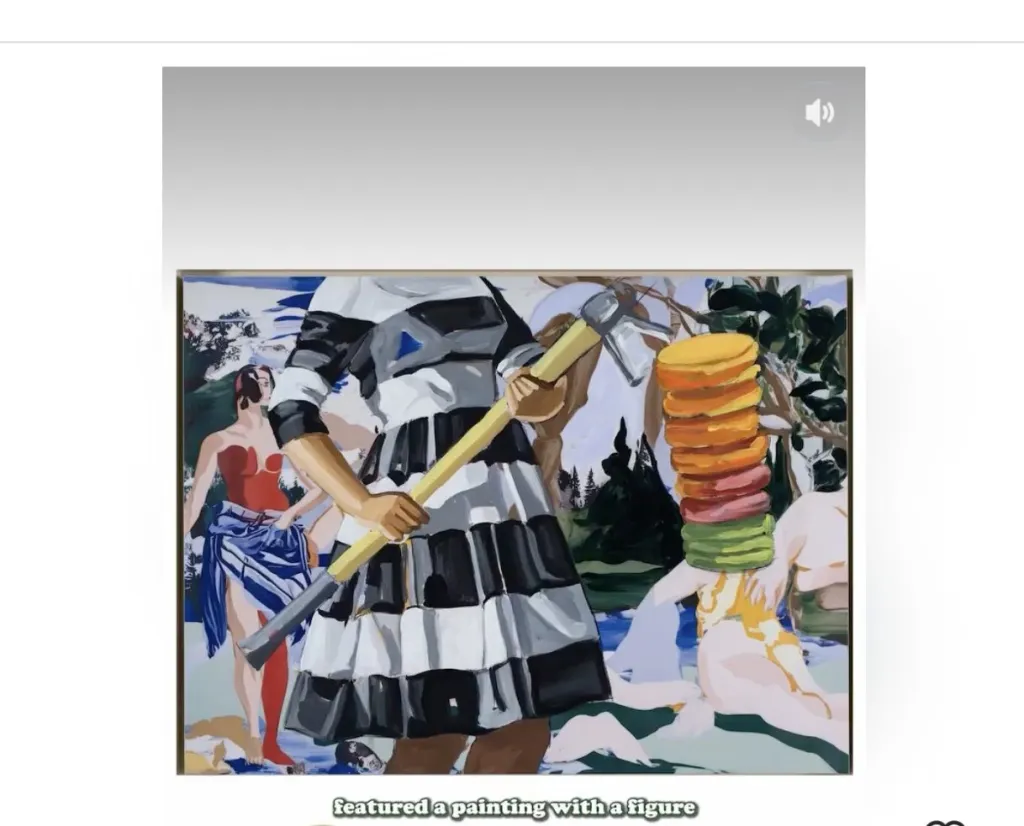
Artist Kelly Reemtsen filed a copyright lawsuit last month against David Salle, alleging that his 2025 painting Hatchet—which first attracted plagiarism allegations in March—copied protected elements from two of her works. The complaint seeks damages, profits from the allegedly infringing work, and an injunction preventing Hatchet from being sold or exhibited, while also requesting that the painting either be turned over to Reemtsen or destroyed.
The lawsuit, filed June 22 in the US District Court for the Central District of California, alleges that Hatchet is “strikingly similar” to two of Reemtsen’s works: Impact, which depicts a woman in a black-and-white striped dress holding a sledgehammer, and It’s All Black and White, which similarly depicts a woman in a striped dress brandishing an axe. The complaint says Salle’s 2025 painting shares the works’ pose, perspective, clothing, and overall visual impression, differing chiefly in that its subject holds an axe instead of a sledgehammer.
Hatchet first appeared publicly in “My Frankenstein,” a new exhibition of Salle’s work that opened at Sprüth Magers Los Angeles on February 24. The oil-and-acrylic painting was created, in part, with the aid of artificial intelligence.
In recent years, Salle has collaborated with an engineer to develop a generative AI model trained on his own oeuvre. By feeding it curated selections of past works, he prompts the model to generate new image configurations.
Social media users were quick to compare the painting to Reemtsen’s Impact (2021), with one widely circulated video outright asking: “Did Salle steal this woman’s idea, or is it just harmless appropriation?”
Speaking to ARTnews via email at the time, dealers Monika Sprüth and Philomene Magers framed that appropriation as a hallmark of Salle’s practice. Salle is a leading figure of the Pictures Generation—a loose cohort of American artists that emerged in the late 1970s and early ‘80s, including Robert Longo, Richard Prince, and Cindy Sherman, who freely scavenged images from mass media to challenge conventional ideas of authorship.
According to the dealers, Salle “has historically borrowed images from popular culture, advertising, art, his own photographs, and other sources to create his own interpretations on canvas, continuing a long tradition of artists drawing from the past and from one another. In turn, his works have been used by other artists without his permission.”
The dealers added that Salle acknowledged his use of Reemtsen’s image had “restarted a decades-long dialogue about authorship for new audiences” and said Hatchet had been removed from view “out of respect to both artists.”
A central piece of Reemtsen’s lawsuit is an email Salle allegedly sent Reemtsen in March, following media coverage of the controversy. In it, he wrote that there had been “internet chatter” about a painting of his “that incorporates an image from one of yours,” adding that he had discovered her work online and “admired it very much.” Reemtsen claims that the email is an admission that Salle copied her work.
The complaint further alleges that the controversy “was both harmful to her existing professional relationships in the art world, and took energy and focus away from her own professional obligations,” adding that the resulting exposure “substantially and materially harmed her existing relationships with her own clients.”
In a statement, Reemtsen’s attorney, Matthew Swanlund, described the lawsuit as an effort “to protect the integrity of Kelly Reemtsen’s original artworks and the rights granted to artists under federal copyright law.” Swanlund said Reemtsen “takes the protection of her rights very seriously” and that litigation became necessary only after the dispute “could not be resolved in a manner that adequately protected” her artworks and legal rights.
Salle did not respond to a request for comment by the time of publication. Sprüth Magers, which is not a defendant in the lawsuit, declined to comment, noting that the lawsuit was still pending.


