







Text messaging has become the most common form of communication. Factor in the increased social alienation proffered by social media, and most relationships with friends, family, colleagues and romantic partners are maintained (at least to some degree) by texting. This is where connection strikes, love is found, deals are made and, simultaneously, where all may be lost.
So texters (ie everyone)—often with the help of friends and colleagues—can spend hours or even days analysing what a given message might mean and how best to reply, while drafting and redrafting their own response before finally hitting “send”. But what if it was easier to say exactly what you mean with greater clarity and confidence? The conceptual artist Jennifer Rubell wants to help texters do just that.
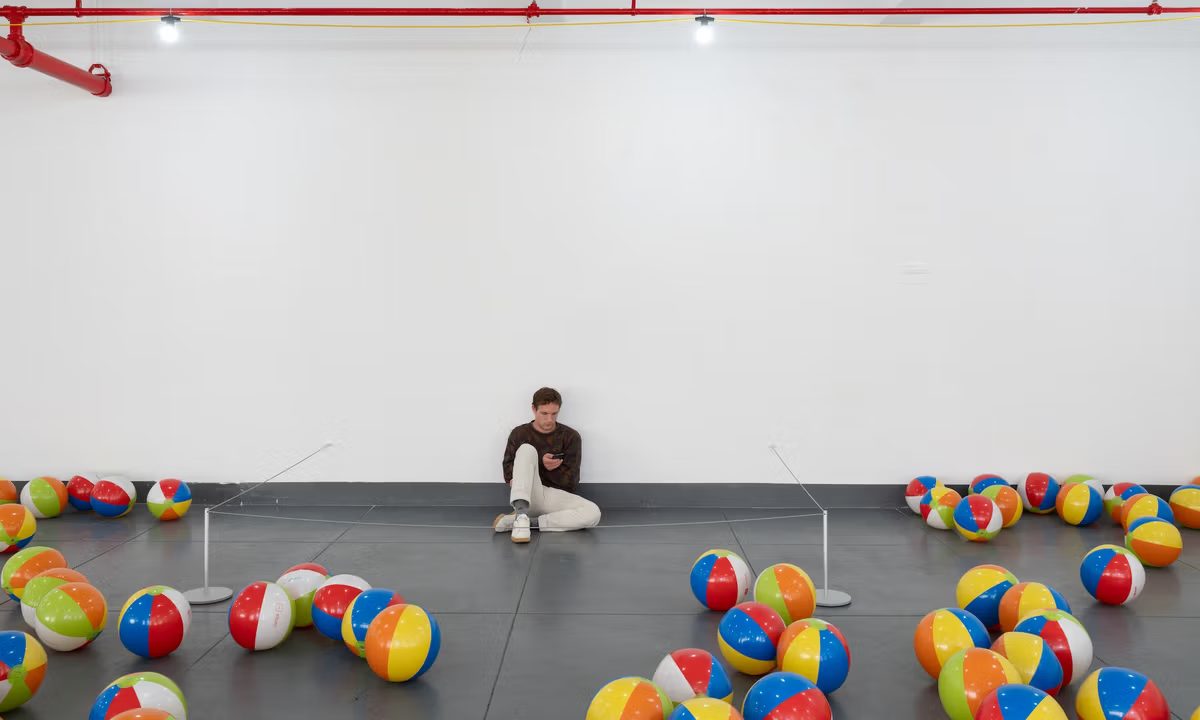
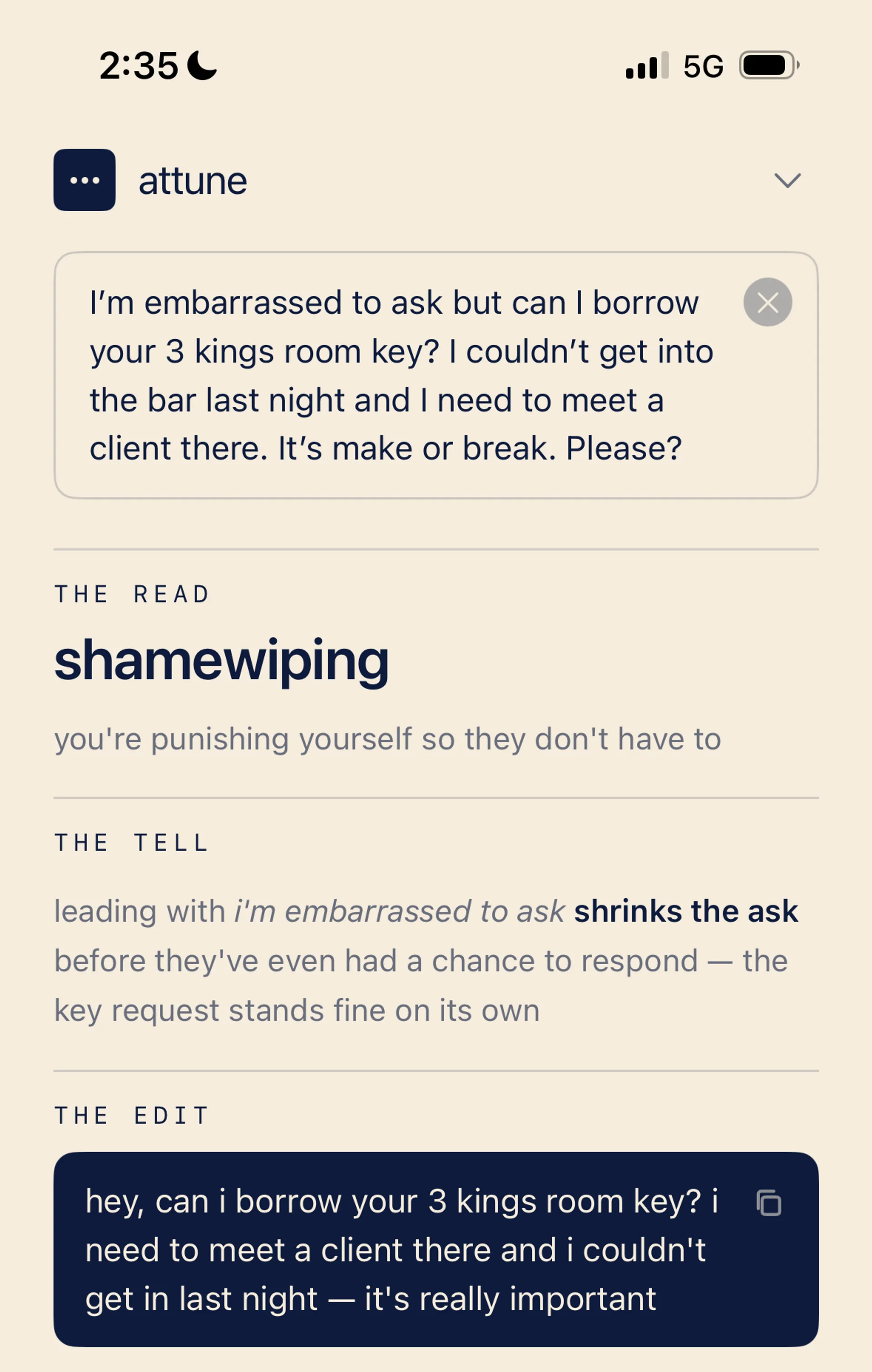
In her current exhibition in New York at Meredith Rosen Gallery (until 26 June)—among a sea of beach balls stamped with the word “baller”, a painting with a QR code offering a one-month free trial and a young man leaning against the wall while on his phone in what Rubell calls a “readymade portrait of our time” (you can text him, but he may not answer you in a frustratingly intoxicating performance of indifference)—Rubell has launched an artificial intelligence (AI) app called Attune. It is designed to diagnose what is not landing quite right in a given text message and rephrase it for you in your own voice.
Attune offers text message feedback Courtesy Meredith Rosen Gallery
Perhaps you are “flashing” (showing vulnerability then covering it up with a question), “momifying” (performing independence instead of naming the ask) or “toe dipping” (asking for clearance before owning the feeling). Whatever the case may be, Attune will tell you—even if the answer is “something you might not want to hear”, Rubell tells The Art Newspaper.
This is precisely what differentiates Attune from other AI models, which learn from user input to echo what users want to hear and hold their attention. “I see a lot of value in subverting that,” Rubell says, “and offering you an engagement with AI where it doesn’t come from wanting you to like it. It comes from helping you to be better.”
The diagnoses offered by Attune are informed by Rubell’s own analyses and feedback from beta testers, who often want to retain some level of softness in their messages to be comfortable sending them. Consequently, the goal of Attune is to “find ways to soften without undermining yourself”, Rubell says. “At the top of our agenda is figuring out what tools people can use to do that, because most of those tools are self-defeating, self-deprecating, overly self-questioning.”

Attune offers text message feedback Courtesy Meredith Rosen Gallery
When asked if this is a particularly gendered issue, since women are generally perceived as doing more of the heavy lifting in interpersonal communication and softening their language more than men, Rubell says: “There’s this idea that the labour that women do in communication is kind of decorative or frivolous, and I think it’s anything but. I think it’s extremely important.” That said, she adds: “I would also push back against this idea that women are the only ones who are obsessing over their texts. When the text really counts, [everyone] really cares.”
Attune is not a rarified, conceptual gesture for art-world audiences but a mass-market product (a monthly subscription costs $12.99) for “people who are sensitive to words”, Rubell says, “people whose words really matter, people who feel that their texting is really consequential to their lives and, frankly, to people who are anxious about and invest a lot of time and thought in their texts”.
In providing such people with a new “kind of superpower”, as Rubell puts it, Attune “does what art always does, which is show you yourself in a way that might feel comfortable and might not feel comfortable—in a way that you might not even understand until later”.
- Jennifer Rubell: Attune Official, until 26 June, Meredith Rosen Gallery, New York


