


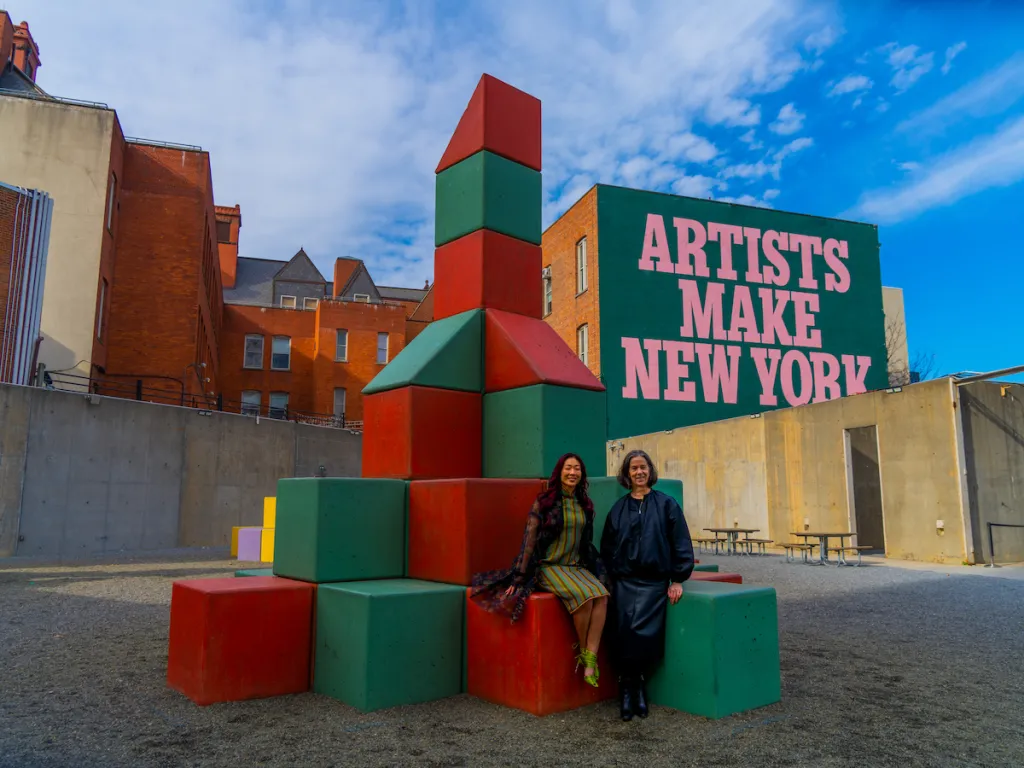
While other institutions across the United States raise their ticketing prices to $30—and, in a few cases, even higher—New York’s MoMA PS1 will stop charging admission fees altogether for the next three years.
Supported by a gift from Sonya Yu, a creative strategist who appears on the ARTnews Top 200 Collectors list, the plan will go into effect at the start of 2026 on the occasion of the museum’s 50th anniversary year. While MoMA PS1 had already offered free admission to New Yorkers, the museum will now expand the plan to include all visitors.
The hope is that the new plan will significantly expand PS1’s audience, said the museum’s director, Connie Butler. “If you look at our history, we were founded very much for artists, by artists, as a kind of outpost here, and whoever came, that was fine,” she said in an interview. “But now I think, of course, we’re in a different world.”
She continued, “We know that contemporary art on its own is not going to necessarily always bring in the numbers, but over time, this will welcome people. We want people to bring their strollers on the weekend and come into the museum without any barriers. We want to them to come into the courtyard, begin to experience our programs, and then make their way into the building and experience the art.”
Yu said that her decision to provide funding for the change in ticketing policy was in part inspired with her own experiences in museums.
“As a Chinese immigrant, none of these places felt accessible to me, especially when I was younger,” she said. “How can we break down those barriers? Well, a cultural institution is a touch point for the representation of what America is and has to offer. That is a responsibility of a cultural institution, that kind of welcoming.”
The move is set to make PS1 one of the select few New York institutions to offer free admission, with the Bronx Museum already in that small class of museums. At least one New York museum, El Museo del Barrio, also offers pay-what-you-wish pricing. Across the country, the Museum of Contemporary Art’s Grand Avenue location has been admission free since 2019, though special exhibitions at its Geffen Contemporary in LA’s Little Tokyo neighborhood are ticketed.
Most other arts institutions charge amounts that are only increasing. The Metropolitan Museum of Art, for example, raised its admission to $30 in 2022, a move that was soon mirrored at the Guggenheim Museum and the Museum of Modern Art, PS1’s sister institution. (PS1, by contrast, currently charges a modest $10 for adult admission, though it is much smaller than those museums.) The trend is also noticeable outside New York, with the Museum of Fine Arts, Boston costing $30 for all visitors, and the Art Institute of Chicago raising its price for out-of-state visitors to $32 in 2023.
Debates about whether it should cost anything at all to enter museums have long pervaded the American art world: In 2006, well before the days of $30 admission, New York Times art critic Roberta Smith wrote that US museums “should get serious about expanding both their free times and the categories of people who are granted free admission.” As a reasoning for the rising costs of admission, museums sometimes claim they need the money to support their own costs, though in many cases, money brought in through admissions only accounts for a fraction of a given institution’s annual revenue.
Butler said that Yu’s gift “really does help our bottom line,” but she said the temporary change in admissions policy was less about revenue than overall strategy. She specifically noted that PS1 decided not to offer a pay-what-you-wish admission structure because she felt it could be confusing for some.
“I’ve always found that actually kind of paralyzing, the guilt of what you should pay versus what you can pay,” Butler said. “Should I pay? I’m a museum worker. All these barriers that are in some ways invisible are actually real.”
The change in admission structure marks the realization of one of Butler’s main objectives since becoming director of PS1 in 2023. “Since I came [here], it has been a goal of mine to go completely free,” she said. “I didn’t think it would happen so soon.”
Asked about the future of the pricing structure after the end of the three-year period, she said, “I’m very optimistic we’ll be able to continue.”
