






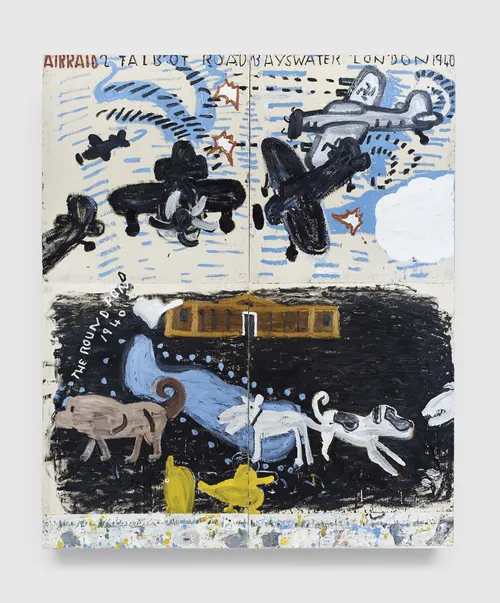

In Rose Wylie’s 2017 painting Park Dogs and Air Raid, warplanes hover over the Serpentine Galleries while dogs frolic in the brushy black foreground. With a graphic, childlike style, the artist deploys a limited palette of blue, black, white, and brown. A splash of yellow depicts a duck. Past and present merge in the work: The artist drew on her childhood memories of World War II bombing raids in London and took inspiration from an invitation to exhibit at the gallery. The work’s unexpected juxtapositions of past and present, light and dark, are emblematic of her extraordinary, utterly unique oeuvre.
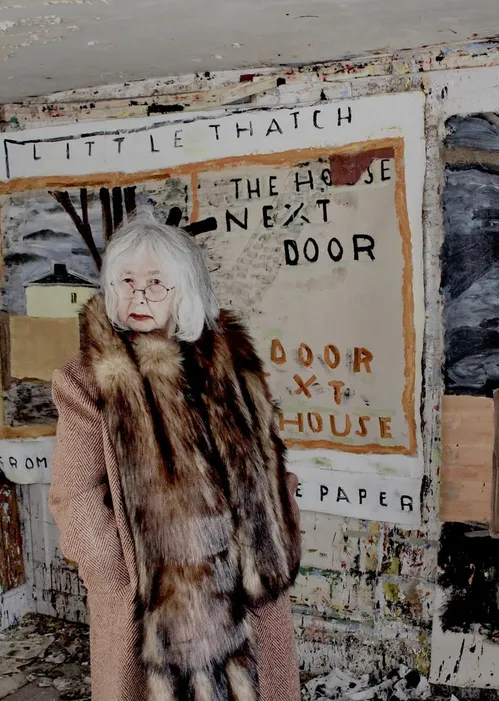
Wylie, 91, is the archetypal late bloomer. Feminist scholar Germaine Greer dubbed her “Britain’s hottest new artist” in 2010 when Wylie was a mere 76 years old. She has since become a bona fide art world star. “Rose Wylie: The Picture Comes First” at London’s Royal Academy, on view through April 19th, is her biggest show to date. It also makes her the first British woman artist to enjoy a solo exhibition in the historic institution’s main galleries.

Themes in Rose Wylie’s paintings
Wylie’s bold, colorful paintings reference everything from art history, cinema, and celebrities to the flowers in her garden and what she had for breakfast. The subject matter is always of secondary concern to the visual details that initially captured Wylie’s vivid imagination.
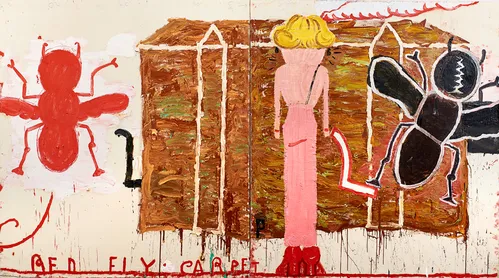
Black Strap (Red Fly) (2012) is a prime example. It’s one of a series of paintings inspired by an image of Nicole Kidman on the red carpet in a backless dress, but it’s resolutely not a portrait. “She didn’t wake up and think ‘I want to paint Nicole Kidman,’” curator Katharine Stout told Artsy. “She happened across an image of a woman standing on the red carpet in a backless dress that was particularly striking who happened to be Nicole Kidman.”
As if to emphasize the point, Kidman is flanked by two large flies that hover on either side of her. Wylie often unites elements from different times and places simply because “they feel to her like they might sit well together,” Stout said. “She likes not being obvious.”

Rose Wylie’s artistic process
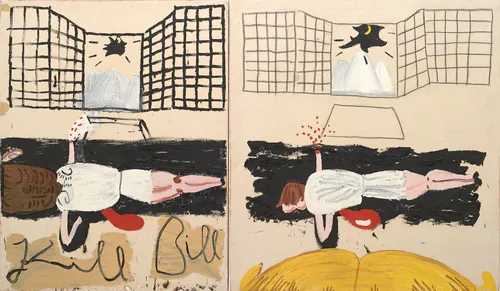
Although celebrities themselves hold little interest for Wylie, movies are a great passion. Her “Film Notes” series, in which she reimagines specific shots, are undoubted highlights of the exhibition. Their compositions often mirror the action of a camera, zooming in for a close-up or capturing the same scene from different perspectives, as in Kill Bill (Film Notes) (2007).
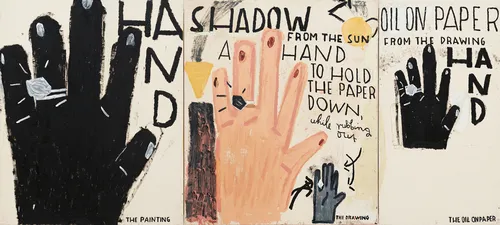
Wylie often repeats subject matter across multiple canvases. In HAND, Drawing as Central (2022), a series of three hands and accompanying text reveal how the artist transforms initial sketches into paintings; daily drawing is key to her iterative practice. “It’s a way of capturing things that visually intrigue her, whether that’s from film or something that she’s seen in a newspaper, and that becomes a mining ground for the paintings,” Stout said. “In the process of looking at a drawing and turning it into a painting, she will adapt it. The paintings are often distilling its essential qualities.”

Wylie’s pared-back approach to imagery shares an affinity with that of Philip Guston. Just as the mid-century painter has occasionally been labelled “crude,” Wylie’s work has been designated “naïve.” For Stout, this description misses the point, as Wylie’s approach “comes from a very knowing place in the sense that she’s very well versed in different art styles.”
Early career
Wylie had a traditional art school education at the Folkestone and Dover School of Art in the 1950s. Yet she found artists such as Fernand Léger, Giorgio de Chirico, and Henri Matisse more enticing than the post-war British romantic artists that her tutors revered. Wylie then trained to be a teacher at Goldsmiths and met artist Roy Oxlade, who she married in 1957. Her creative practice took a back seat while she concentrated on raising their three children. Even then, she visited exhibitions, read widely, and built up the vast stack of memories and inspirations which later fueled her work.
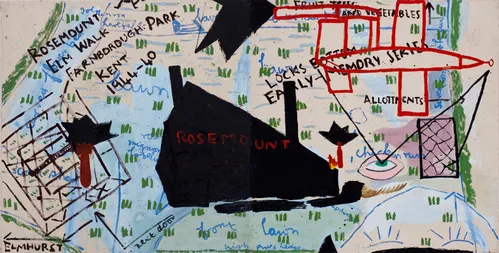

When Wylie’s children left home, she converted a room in her Kent, England, house into a studio, where she still works today. She also became an art student once more, enrolling in an MA degree program at the Royal College of Art in 1979 and doing a dissertation on drawing. Then, just like all recent graduates, she plugged away until she got her big break.
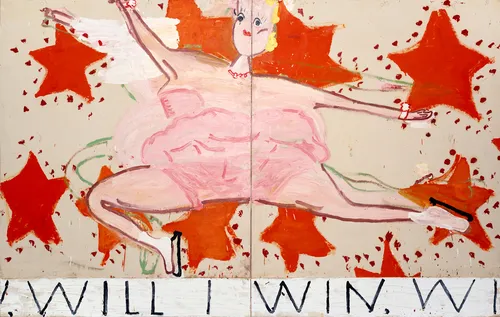
In Wylie’s case, this was her “Room Project” series (2003–04), four large-scale works that Stout compares to an installation. “I liken it to medieval tapestry, creating its own world,” she said. And it’s a delightfully playful world, featuring cats, paper dolls, Olympic swimmers, and even the artist herself wearing a favorite checked skirt. The paintings were selected for East International at Norwich Gallery, where they gained significant art world attention and dramatically boosted her career.

Wylie’s later career
Over the next few years, Wylie mounted solo shows at galleries in New York and London. In 2014, she was elected a Royal Academician and won the John Moores Painting Prize, after years of trying, for PV Windows and Floorboards (2014). The work was inspired by gallerist Jake Miller’s description of the Victorian floorboards and windows in his London gallery.
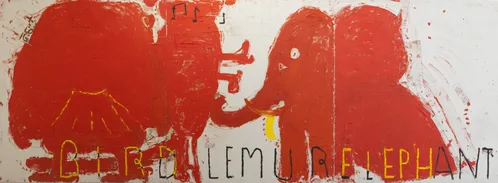

Wylie’s fluid practice still leaves room to explore the sheer joy of creation. In 2015 and 2016, she created a series of animal paintings derived simply from imagination. She showed some of them in her first solo exhibition with David Zwirner in 2016, and the gallery announced their representation of the artist the next year. “There’s always that sense of the process of painting and what happens in the painting determines when it’s finished,” said Stout. “With those works it is quite different, because she abandoned the paintbrush and used her hands, and you can feel that energy and tactile quality in the paintings themselves.”
The Royal Academy show makes clear that Wylie shows no signs of stopping such explorations. The works on view confirm her as one of Britain’s most uncompromising talents.


