
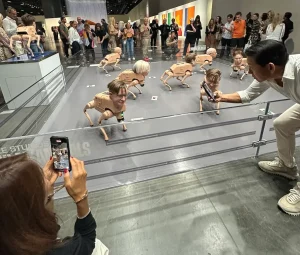





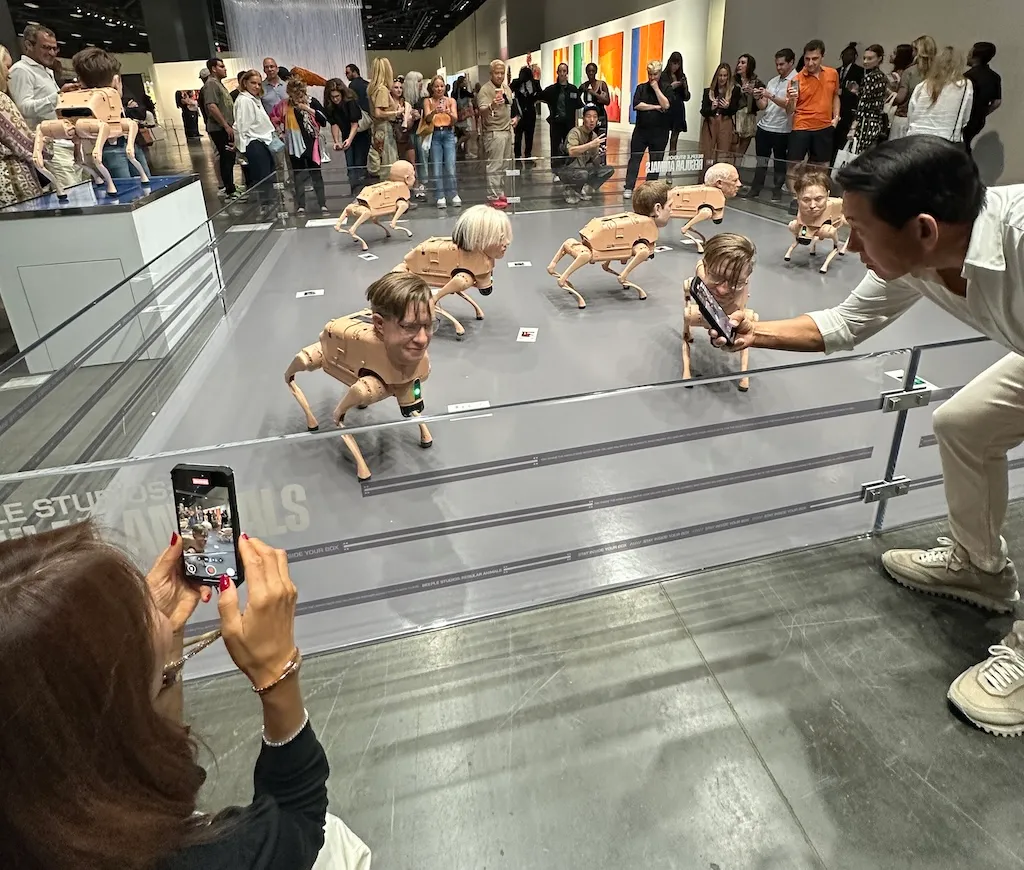
It seems Art Basel Miami Beach has perfected the art of the scroll-by spectacle. This year, the collective gasp was at the new Zero10 digital art section, and it happened every time one of about a half-dozen robot dogs “went.”
The installation, Regular Animals by Beeple (a.k.a. Mike Winkelmann), is part satire, part dystopia, part slapstick theater. In it, a pen of robot dogs (or is it pigs?) have been fitted with grotesquely lifelike heads of Elon Musk, Mark Zuckerberg, Pablo Picasso, Andy Warhol, Jeff Bezos, and Beeple himself. They wander, they twitch, they clash—and then, at intervals likely engineered for maximum dramatic tension, they tip backward and eject a printed image from their backsides.
Call it the most unlikely of crowd-pleasers. Or perhaps the most accurate.
Beeple, whose practice often makes the symbolic embarrassingly literal, has built a working model of our algorithmic present: machines that see the world through tiny cameras, reinterpret it instantly, and spit out the results as if meaning were just another form of waste management. Kept in a thick plexiglass pen, the robots continuously capture their surroundings and output images in the style of the head they wear, mirroring the way digital platforms nudge billions toward seeing reality through curated lenses. (For example, the Warhol dog spits out Warhol-esque images, and the same goes for Picasso. Though I never did see what a Muskian or Zuckergian image looked like.)
Surveillance meets celebrity meets cosplay. The whole installation plays like a Philip K. Dick fever dream. But the real drama is in the faces of the people watching. Among them was Courtney Karnez, a visitor who had rushed to see the installation after glimpsing it on Instagram. She found herself glued to the pen’s perimeter, transfixed by the uncanny liveness of the things. Even as we spoke, she couldn’t take her eyes off the flesh-colored quadrupeds. “The jiggle of the skin when they move—it’s robot meets human. It’s such a trip,” she said.
When the Zuckerberg dog finally produced an image, the crowd reacted with something close to ecstasy. Karnez called the moment a “guilty pleasure,” a burst of communal delight that startled her. “It was the collective satisfaction of a photo being shot out of a robot body,” she said, still half-laughing. “Who knew that’s what we wanted?”
In a year steeped in fears about AI, automation, and the creeping power of the platforms that shape our reality, Beeple has seemingly produced a pressure valve for that cultural anxiety. But what are the crowds actually looking at? Most of the people who have crowded around the pen are only looking at the creatures through their phones. Is that part of the gag?
One dealer, who asked to remain anonymous, described the work as decadent—not in the caviar or chocolate cake way, but in the way that signifies moral and cultural decline. Its spectacle panders to the crowd, they said, dodges complexity, and disguises thin ideas behind technological bombast.
“This is the clearest example of the lack of scholarship in the industry. Sure, it’s nice that people care about it, but this whole project tramples on the history of digital and video art and makes it a bit,” they said. “It’s kind of sad.”
The market, of course, loved it. According to several outlets, every edition of the robots had sold by the end of the first VIP day for $100,000 a pop. The Zero10 section, Basel’s new digital initiative, pulsed with the kind of attention the rest of the fair could only envy. Whether it’s a sign of digital art’s durability or just another instance of Basel chasing buzz hardly matters; the room had a pulse, and Beeple was at the center of it.
If the future is arriving faster than anyone would like, this was the rare artwork that let people greet it with a laugh. Sometimes, to understand the machines reshaping the world, you really do have to watch one poop.