







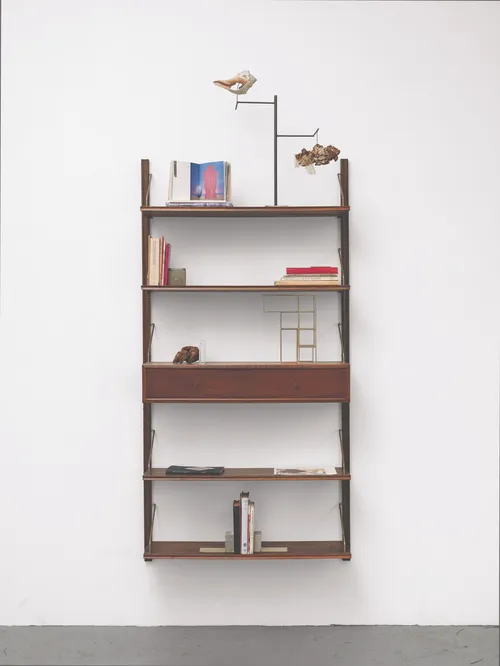
One of the earliest works in Carol Bove’s first-ever retrospective, which opened at the Guggenheim Museum on March 5th, looks more suited to a domestic setting than to Frank Lloyd Wright’s grand rotunda. The sculpture, How People Get Power (2002), comprises a small mid-century modern shelving unit that displays books from the late 1960s and early ’70s. Si Kahn’s titular 1970 guide for community organizers appears alongside Sol LeWitt’s 1976 artist book Modular Drawings and a book about nonviolent resistance and social change. Accompanying these volumes are a few ambiguous objects—a prism made of wood and string and a cube wrapped in brown paper—that quietly nod to the principles exemplified by LeWitt’s work, and to the ethos of Minimalism at large.
Senior curator of contemporary art Katherine Brinson has organized the show, which is on view through August 2nd, in reverse chronology around the museum’s rotunda; it crescendos with the artist’s earliest work in the sunny oculus. Here, Bove’s bookshelf installations like How People Get Power embody the forces that have galvanized the artist’s practice for the last 25 years: She has examined the countercultural movements that shaped her own childhood; subverted the sculptural tropes of 1960s minimalism; and reoriented the relationship between viewers and the exhibition space.

Early life
Bove was born in Geneva, while her American parents were living abroad. She grew up in the Bay Area of the 1970s and ’80s, just after the region’s radical approach to activism, sexuality, drugs, art, and family reshaped American norms. Bove’s father was a house painter and her mother an unpublished poet, and the artist has synthesized both mediums throughout her career via a poetic, playful approach to color, space, and form: at first to better understand the dissipating haze of her parents’ cultural milieu, and later in the monumental metal and wood sculptures for which she has become known.
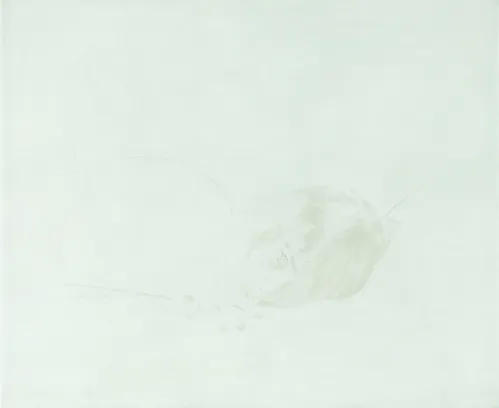
After dropping out of Berkeley High School, Bove worked in restaurants and took odd jobs before she enrolled, in her late twenties, in a BFA program at New York University. After graduation, she turned to imagery in the Playboy magazines she’d discovered beneath her parents’ bed as a child—each of which included a rejection note her mother had received for her poetry submissions. Bove was overcome by the models’ impenetrable gazes throughout the pages, and she drew their faces in very pale shades of ink. Her resulting works, including Tomorrow Never Knows (2002) and Twiggy (2004), are among her most delicate and ethereal pieces. These drawings formed her first full body of adult work.


Bove’s style takes inspiration from minimalism
Bove’s bookshelf sculptures grew out of her desire to understand the cultural context, Brinson explains, of “those women that [Bove] was communing with across time in the drawings.” As Bove recontextualized domestic objects like the bookshelves, she also reworked the minimalist tropes of her predecessors. Composition with my Mother’s Spiritual Manual (2002) replaces LeWitt-style cubes with Knoll tables, while Touching (2001) replaces the bricks in Carl Andre’s austere floor arrangements with books, infusing minimalism’s arrangements of raw materials and basic shapes with content.
The artist also makes more literal art historical references throughout the show, as artworks from the Guggenheim’s collection and others appear alongside her own. Bove has included paintings, drawings, and sculptures by Agnes Martin, Édouard Vuillard, Lionel Ziprin, Bruce Conner, and Arnaldo Pomodoro, as well as a permanent but rarely revealed installation by Joan Miró and Josep Llorens Artigas. With this gesture, the artist acknowledges the fact that artistic practice doesn’t exist in a vacuum, but in continual dialogue with art history.
One of the works comes from Bove’s personal collection. As a child, she was so transfixed by Richard Berger’s My Couch (1976)—a ghostly sculpture of a tufted couch created by precisely hung beaded threads—at the Berkeley Art Museum, that she later tracked down the artist to acquire the work herself. It hangs near the top of the Guggenheim. It’s echoed by an identical couch that Bove made for visitors to take a seat on a lower ramp.

By attending to viewers’ bodies in this and other seating arrangements throughout the museum, Bove upends traditional exhibition models. She pushes against the dictates of modernism—that require eyes to see without the presence of a body—and what some critics have described as the overly confrontational, even hostile nature of minimal art. By instead creating moments of pause and reflection, Bove’s site-specific furniture interventions further blur the boundaries between the art objects on view, the museum’s systems of display, and the trappings of domestic interiors.
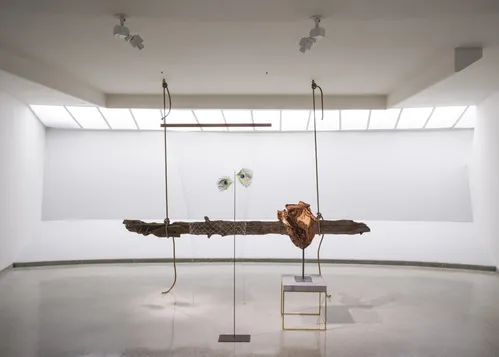
Like the bookshelf sculptures, Bove’s intimately scaled found-object arrangements—made of seashells, feathers, driftwood, metal, and more—similarly suggest visual poems. The Oracle (2010), for example, features a selection of seashells ornamented with spikes and curlicues on a metal armature, while Figure (2009) attaches the ends of two peacock feathers to a tall metal rod, such that two piercing eyes stare at passersby.
“The language of support and display, which [as a curator] you usually want to disappear and not distract from the object, becomes part of the sculpture itself,” Brinson notes. “It’s a very simple act, but it’s weirdly radical in its simplicity.” In works like Peel’s foe, not a set animal, laminates a tone of sleep (2013), sculpture and base become one and the same. Bove inset a concrete plinth with hollow brass cubes, evoking both a model for a brutalist building and a sculpture by LeWitt.

Bove’s later career and crushed metal sculptures
During this time in the mid-2010s, and about halfway down the Guggenheim’s ramp, the artist began to create much larger sculptures and installations. Her works grew heavier as she bent and crushed multi-ton pieces of found and fabricated metal. These sculptures, which defy material expectations, became emblematic of Bove’s practice and earned her international attention. In 2013, she mounted a commission on New York’s High Line and enjoyed concurrent solo exhibitions at Macarrone Gallery and the Museum of Modern Art. These shows led Brinson to start considering a retrospective. In the over 10 years that followed, Bove’s practice has grown considerably, alongside her playful reconfigurations of modernist sculpture.
In 10 Hours (2019), one of the artist’s characteristic crumpled beams, coated in bright yellow urethane paint, appears casually draped over two sheets of weathered steel that are propped against one another like a Richard Serra sculpture. Such compositions strike a delicate balance and appear to defy gravity.
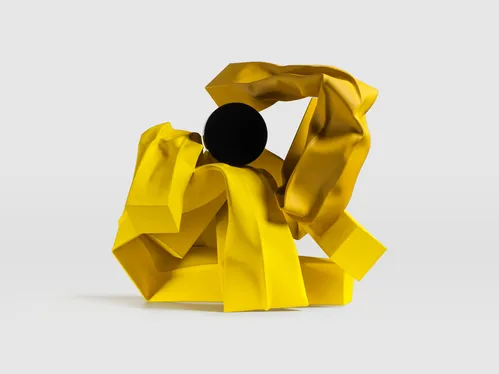

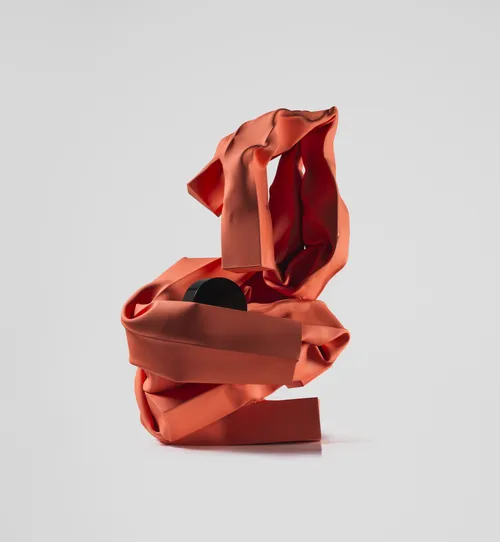
In these works, Bove often sources her palette from art history: yellow from Willem de Kooning, red from Alexander Calder, pale purple from Monet. She works at Serra’s grand scale, with John Chamberlain’s aptitude for compression, and invokes John McCracken’s “finish fetish.” The resulting works communicate in a language of abstraction that shares certain etymological roots with traditional modernism. Yet Bove’s uncanny juxtapositions destabilize our ideas about physics and the world we know, creating a unique vocabulary all their own.
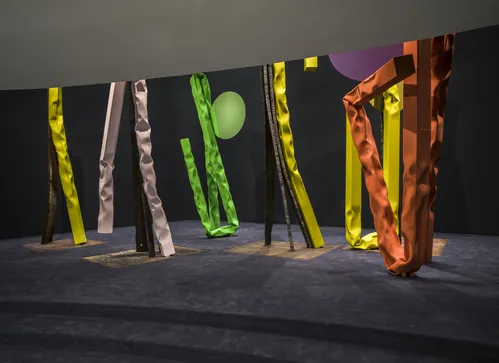
The exhibition begins, or you might say ends, with Sweet Charity (2026), an installation conceived specifically for the Guggenheim’s High Gallery. Within this dense forest of 20-foot crumpled beams in ocher, chartreuse, orange, and verdant green, viewers become ensconced in a meditative moment of quiet wonder. Here, and in the artist’s new anodized aluminum wall works—which feature arrangements of circles, squares, and diamonds in ever-intoxicating colors and punctuate the entirety of the exhibition—Bove allows your eye to rest on something not surprising or subversive but soothing. She strikes the simple harmony of a major chord.


