






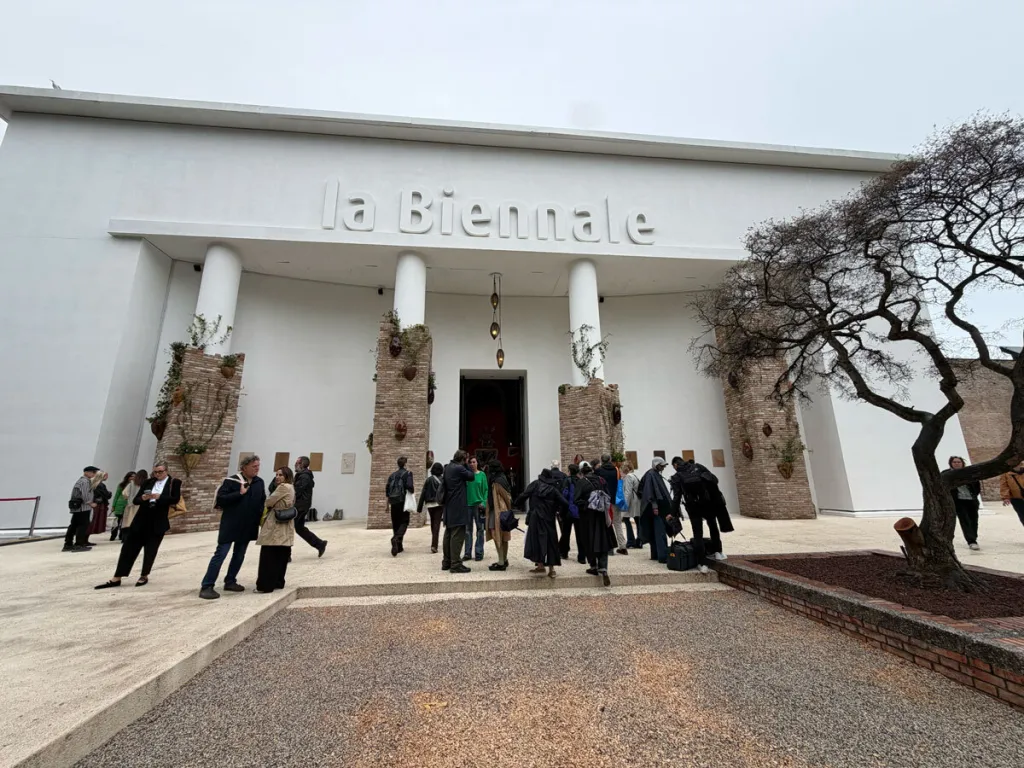
To say that just one aspect of this Venice Biennale is unprecedented would be to understate all that circumstance has dealt this edition of the international art festival. While controversies surrounding several national pavilions—Israel, Russia, the US, South Africa, and Australia, to name a few—loom large, the unexpected death of the central exhibition’s curator, Koyo Kouoh, one year ago looms largest. Before her death, Kouoh had defined the exhibition, titled “In Minor Keys,” and written its curatorial text, as well as appointed a team of five advisers—Gabe Beckhurst Feijoo, Siddhartha Mitter, Marie Hélène Pereira, Rasha Salti, and Rory Tsapayi, referred to in the catalog as La Squadra di Koyo—to carry forward her vision.
The 110 artists and collectives whose work is spread between the Giardini’s Central Pavilion and the Arsenale and the venues’ outdoor spaces show disparate ways of making art in a time when contemporary life feels surreal and magically real, where beauty and aesthetics coincide with the constant onslaught of geopolitical events. The exhibition, as Kouoh writes, “intends neither a litany of commentary on world events, nor an inattention or escape from compounding and continuous intersecting crises.”
But the artists here make both visible, often in compelling ways. In their essay, La Squadra writes of Toni Morrison’s Beloved and Gabriel García Márquez’s One Hundred Years of Solitude as “touchstones” that “connect in their evocation of thresholds between lifeworlds and temporalities” and where “magical realism deepens an emotional register.” This is borne out by one of the exhibition’s major themes—the landscape, places with lush gardens that can be equally scarred and made harsh, yet continue to survive. In these moments of survival, it’s important to look at artists whose work teaches us resilience and who made work at the margins because it was life-sustaining, while also combing the archives and seeing what’s there, what’s not there, and whether we should fill in those gaps or not. And we must never forget that celebration is key to our survival.
Below a look at the most important themes in Kouoh’s final exhibition.


