

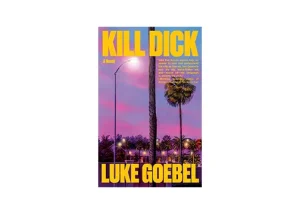






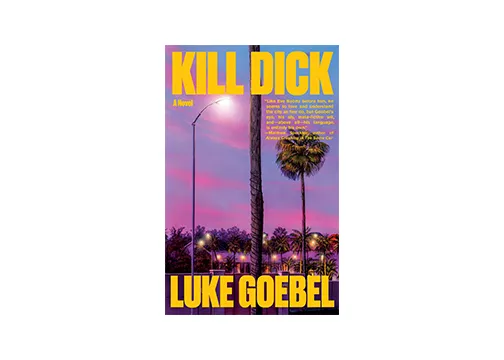
Before you even begin reading Luke Goebel’s Kill Dick, there are clues that it’s going to be a wild ride. Blurbs on the back cover are attributed to Anna Delvey, the socialite-scammer, and to Ottessa Moshfegh of My Year of Rest and Relaxation fame—also, the author’s wife. Moshfegh says, “If this book were any better, I’d cut my own head off.”
The novel satirizes the art world and its thorny relationship to the Sackler family, those opioid-peddling philanthropists described here, in fictional form, as “genocidal maniacs” and “art snobs.” Its titular antagonist, Dick Sickler, is effectively the Sackler patriarch. The book opens with not one but three epigraphs from The Wonderful Wizard of Oz, and its title reads as a rejoinder to Chris Kraus’s art-novel sensation I Love Dick.
Ding dong, now Dick is dead.
Imagine a novel written in the style of Vice magazine. That’s Kill Dick: every sentence strains to shock with its edginess or searing, cooler-than-you cultural critique. It drops the names of fashion brands and hot young L.A. artists—Jill Mulleady, Tala Madani—that you’re expected to recognize, or else this book is not for you. It swings from dad-joke one-liners (“Society was curing homeliness if not homelessness”) to teen-boy humor (“Her pussy probably tasted like Diet Coke”).
When so many salacious sentences pile up—detailed descriptions of opioid-induced constipation, nihilistic wisecracks—you might feel inundated, but soon you’re inured. Chaos accumulates so consistently that it becomes baseline. The style mirrors the narrator’s emotional state: Susie, our protagonist, is addicted to Oxy and numb to the world. Her sentences are blunt because she’s emotionally blunted. Chapters switch between first and third person as she dissociates, or else when she decides that the confessional mode is so earnest that it’s cringe.
Susie is numbing herself not just to her own life but to the chaos that is America in the 21st century. The climate is collapsing, addicts are dying on Skid Row, and an election looms. It is 2016, and an Orange Candidate is facing off against a woman (this novel’s veil is thin). Like the chaotic sentences, political turmoil is so constant as to feel unremarkable. “There was so much that needed protesting in America,” Susie thinks, “that people had gone numb, and posting online was about as effective as talking to yourself in the shower.” She is “anti-liberal, anti-conservative, anti-end-stage-capitalist—even as a child of fortune—but mostly anti-labels.”
More than anything, Susie hates her dad—Dick Sickler’s lawyer, the one who helped him get away with murder and made big money doing it. Together, Dick and daddy targeted “coal miners and poverty slaves [with] tablets of heroin,” later hooking white-collar workers with back pain and expensive ergonomic chairs. Susie’s father convinced the courts that the Sicklers hadn’t known Oxy was addictive until it was too late, even though his own wife—Susie’s Mom—had been addicted at the time. Now, mom is in a sex cult, the Church of the White Illumination, along with Dick. Their masked balls are pulled straight out of Eyes Wide Shut.
What is the ultimate rich-girl rebellion when your dad is Dick Sickler’s lawyer? Getting hooked on Oxy, obviously. Dad dismisses over half a million opioid deaths as “useless drug addicts… losers who would have merely found something else to kill them,” and Susie hates him for his lack of remorse, for being a loser who doesn’t know “the difference between Ray Charles and Charles Ray.” She’s a vegan who would “never hurt a living creature”—except her dad, emotionally.
Susie also takes pills with a professor—Phil Krolik, a decent guy—before dropping out of NYU. Both are disillusioned with New York’s careerism and liberal groupthink and wind up drifting to LA. Susie can’t be bothered to clamor and stress for what, an internship at PS1? Instead she seeks profundity by doing drugs by the pool after her roommate is found dead of an overdose, her hair chopped off and strewn around the room. High on a lounge chair, she recalls Phil’s professorial profundities, but they segue into stoner thoughts. She finds she can’t quite remember whether a particular bit of wisdom is attributable to Einstein or Epstein.
Phil, meanwhile, grows tired of lecturing about Marxism and melting ice caps to bored, wealthy undergrads who are staring at their phones. He wants to actually do something—something more than applying Rogaine and retinol to stave off his midlife crisis. He opens a rehab clinic that functions more like housing, since residents are hardly detoxing, but instead cycling between red pills and blue pills, a wink to Matrix-inspired party politics internet speak.
There is something strange about the opioid deaths of late: addicts on both coasts turn up not just dead but dismembered. It gets freakier than Susie’s roommate’s posthumous haircut: sometimes eyelids are swapped with nipples. The culprit earns the nickname “the Pain Killer,” but it’s unclear whether they’re a murderer or a vigilante. Plausibly, the addicts overdosed all on their own and the Pain Killer intervened only to make sure their death made the news.
Kill Dick is a book about performative politics, virtue signaling, and image obsession. Royal-Lee, the drug dealer, parodies Gen Z: obsessed with looking sexy, disturbed by actual sex. Both Susie and Phil confuse political action with family drama: Phil hopes his rehab will help him find his twin brother, who became addicted to opiods after breaking his back in basic training and eventually went MIA. Susie decides to declare war on Big Pharma—but really, on her dad. Drugs insulate Susie and Phil emotionally; wealth insulates them materially. Neither votes, dismissing it as pointless, citing the “illusion of power” granted by the electoral college.
Instead of voting, Susie comes up with an idea for an art project: she turns Skid Row into an installation, tagging tents to make it look like the Sacklers are its corporate sponsors. The crass maneuver makes her famous—or at least, gets her press. She’s proud to be in the paper alongside news of protests at the Dakota pipelines, of Obama’s $38 billion deal with Netanyahu, of Angelina Jolie’s divorce. A dead body winds up in one of the tents; she didn’t put it there, but she’s not mad about how it makes the project feel so much more real, more transgressive. Soon, she’s imagining not changed lives but a glamorous future in the art world—dinners with Alex Israel and China Chow.
The art world is the epitome of confusing symbolic grandstanding for actual change. But it is hardly the only guilty party. There’s also, for instance, the Democratic party—which Goebel describes as “loser liberals, distracted by race, gender, sexuality—any category of victimhood the DNC could weaponize—while the party kept dodging holding pharma responsible, ending genocidal war…”
Still, Kill Dick’s main target is the low hanging fruit that is art-washed hypocrisy—which the Sacklers symbolize, funding loosely lefty art exhibitions with blood money. But the book leaves out the part of the art world Sackler story that involved effective organizing, mentioning the photographer and activist Nan Goldin briefly but only as “an enemy of The Church” (Referring to the sex cult, not a Christian congregation). It’s worth remembering, lest Kill Dick’s nihilism get you down, that when Goldin and her group P.A.I.N. staged die-ins art institutions, they succeeded in getting the Sackler name removed from many museum walls and bringing plenty of shame to the family name, leaving the pill-peddling philanthropists largely cut off from the forces that once laundered their reputation. While Goebel understandably struggles to imagine what meaningful action would look like, Goldin has in fact already shown us—even if the acknowledgements were too little too late.
This familiar posture plagues art world satire: It’s easy to turn up your nose at all of art’s issues, but fail to deal honestly with why you’re drawn to art at all despite them. It is easy to say what you are against, and harder to say what you are for, if anything.
And it’s always odd when a work of art is guilty of the precise thing that it critiques. Our narrator disses “ironic wannabe edgelords,” which is also how I’d describe Kill Dick. Like Phil’s lectures and Susie’s artworks, the novel is ostensibly “about” politics, yet proves most adept at cloying for attention. And it’s hard to look away from the trainwreck that is Kill Dick, though its hypocrisy does grate.
While the novel spends most of its pages avoiding earnestness and sincerity like the plague—“Better a Tim Hawkinson than an Anselm Kiefer,” Goebel quips—the ending allows a sliver of something like hope to surface, Luigi Mangione-style. I won’t spoil it. All I’ll say is that the book falls squarely in the category of “chaotic neutral” in every way.


