








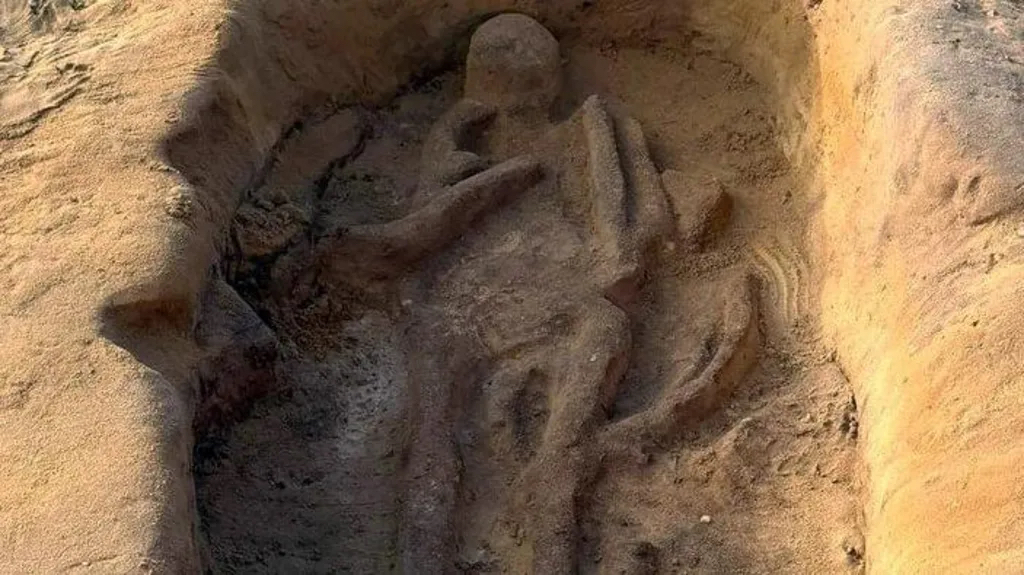
Archaeologists in England unearthed the remains of two people buried alongside a fully harnessed horse bearing weapons in a discovery characterized as being of “national importance.”
As reported by GB News, the findings—excavated during preparatory work for a nuclear-power station in Suffolk—date back to a time between the 6th and 7th centuries. “The sandy Suffolk soil means that, instead of preserved bones, the acidic ground left behind what archaeologists call ‘sand silhouettes,’ which capture the outlines of the bodies in striking detail,” GB News wrote of the discovery of at least 11 burial mounds.
The two people whose remains were found with a decorated horse were described as “high-status” and “princely.” Len Middleton, a project officer for Oxford Cotswold Archaeology, said, “Discoveries like this are of national importance because they deepen our understanding of power, belief, and identity in early medieval England, and how those ideas were expressed along the East Anglian coast.”
Weapons, jewelry, vessels, and a horde of more than 300 silver coins are among the objects found at 70 different sites being worked on by more than 200 archaeologists—an undertaking described “the largest and most complex archaeological project of a generation.” Other finds include a neanderthal hand axe, arrowheads from 4,000 BCE, and an Iron Age oak ladder, as well as an unopened bottle of beer from the years around World War II.
Debbie Richards, the Suffolk County Council’s deputy cabinet member for archaeology, said, “Suffolk continues to reveal its stunning past, and the magnitude of these discoveries should not be underestimated.”


