






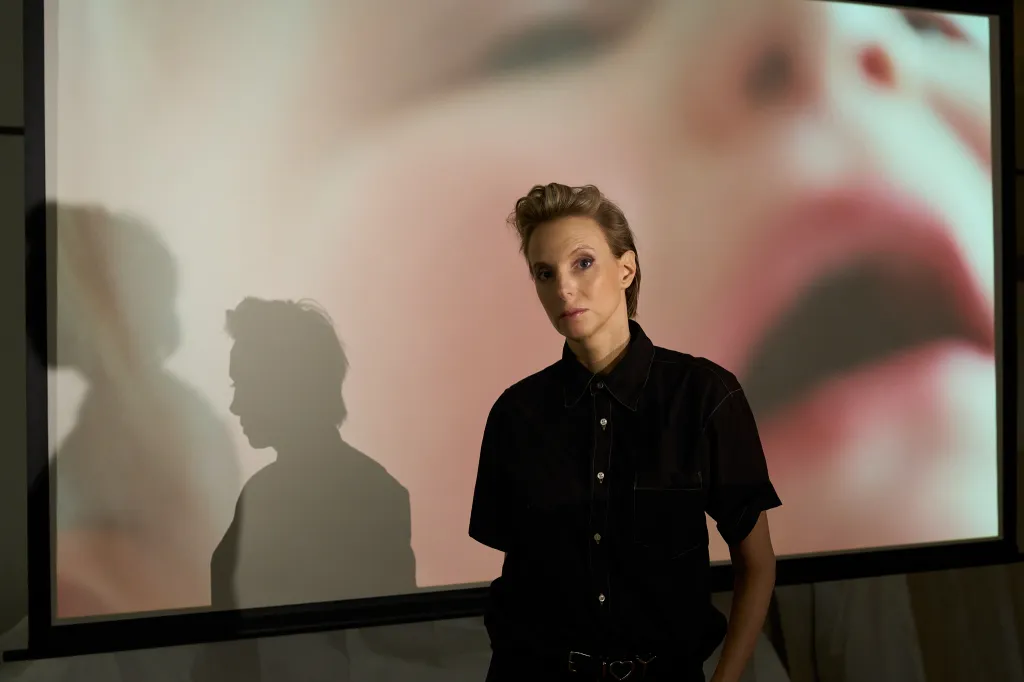
Camille Henrot’s breakout film Grosse Fatigue (2013) was a tour-de-force: it won her the Silver Lion at the Venice Biennale, and ranked on two lists—ARTnews’s and Frieze’s—of the 21st century’s best artworks.
But it’s been nearly a decade since she’s shown a new film: her last was Saturday (2017). This week, that’s changing: Henrot is premiering her new, hotly anticipated In the Veins (2026) at the reopened New Museum, as part of the sprawling exhibition “New Humans.” She’s been working on the 35-minute piece for over five years. This summer, European readers will have a chance to see it, too, at both Luma Arles and Copenhagen Contemporary.
Ahead of the New Museum reopening, Henrot screened the film for me in her studio—and reader, it was worth the wait. In part, it’s a film about caretaking of all kinds during the climate crisis: scenes show wildlife being cared for in clinics, spliced among footage of children growing older and clocks counting down. But what makes it sing is Henrot’s signature editing style—associative, peppy, and highly visual—which here, is by turns surrealist and sobering. The film’s tender acts of care that only accentuate all the pervasive precarity: birds attempt flying again after injury or illness, with the help of a human hand as children are read animal-laden bedtime stories. Soon, you start to see seismic shifts at an everyday scale: when the kids’ bathwater—in one scene, dyed red—spirals down the drain, that water feels like our collective future.
Henrot talked to me about parenting amid climate grief, the new work, and the difference a decade makes.
Art in America: What prompted the idea for this film?
Camille Henrot: I noticed something epic and beautiful in the hand gestures that come with caring for a newborn. It reminded me of creative work: like crafting and polishing, or how painting is also a lot of cleaning. I noticed there were parts of the experience of having children that I’d never seen onscreen: parent-child stories are usually told from the adults’ point of view, and there’s almost always some drama. I wanted to focus on physical acts of care and handwork—and how epic daily tasks can be, like feeding and bathing.
Reading my kids bedtime stories, we’d get to things “J for jaguar” or “P for polar bear”, and I’d think: these animals are actually endangered. I couldn’t help but feeling like a liar. There was some hypocrisy, and there was no way to resolve it.
I became drawn to this cognitive dissonance between all the animal representation that is everywhere in childhood, but that completely disappears for most adults as we age. Yes, Grosse Fatigue dealt a lot with our relationship to nature, but having children made me more intensely and emotionally connected to it. So in the end, it became a film about daily life amid the reality of the climate crisis, mass extinction and nature degradation.
I wanted to understand these mixed feelings, and that’s where I discovered Jennifer Atkinson, who’s been studying climate grief and climate trauma, especially among young people. A lot of young people are extremely depressed because of the climate crisis: they don’t see a future.
That’s one way in which it reminds me of Grosse Fatigue: both are about how knowledge feels.
It’s such a heavy topic, and I didn’t want to do something didactic or judgmental or cheesy. While reading children’s books with my kids, I was thinking about how things are presented to us, and how knowledge is constructed. Animals are often portrayed as cute or beautiful or perfectly healthy when in actuality, they’re at risk. This is how I came to the idea of filming at wildlife rehabilitation centers—most of us don’t see or face the consequences of human society on animals in a direct way. I filmed a mother sloth who had lost her arm and her baby while climbing on an electrical cable and an owl intoxicated by rat poison. These rehabilitation centers show us that it’s possible to extend the love we have for a cat or a dog or a child to other species—a squirrel, an alligator, a sloth.
The voiceover is a mix of a dialog I had with Dr. Atkinson, excerpts from a New York Times article that frames the climate crisis a communications problem, and my child doing his reading homework. They combine into this kind of surrealist sonic collage.
What’s it like to show a new film after all this time?
I’m really excited and very happy. I might have shown it earlier had the film been easier to fund, but it’s also been good to have a long time to think about it. Especially since I filmed my own children, which is a kind of inflammable topic. Every time you put children into a project, you face the possibility of harsh judgment, because everybody feels entitled to have an opinion about how children are raised. So I knew I was walking on a very thin line, and I had to think about it carefully. For me, the climate crisis and mass extinctions have made the feminist slogan ‘the personal is political’ more relevant than ever.
The editing feels so central: you have this very associative, visual way of putting things together until they tell a story. You’re accumulating a lot. How does it work, in your process?
I make maps of concepts—one map of emotions, one map of ideas, and a third map that connects both together. Working with my longtime film editor, Yann Chapotel, I felt it was important to accentuate rhythm and repetition. Repetition is central to care-giving, but also, I think one of the biggest adversaries to ecological action is the privileging of linear over cyclical time.
For me, the effect is that when you cut between acts of caretaking for wildlife, and then for small children, you feel their shared sense of precarity and vulnerability.
Yes, totally. And there’s a shared sense of messiness: the dog escapes the bath, the children are dirty, and nothing happens as planned. I watched many films with children in them, and often they’re portraying the sweetness of children; how cute and charming and curious they are. But children are also messy and kind of punk.
And you filmed them over the course of five years—so they look and act quite differently throughout—but we don’t exactly watch them mature in a linear way.
Yes; the film is edited similarly to the way that classical music is composed. The soundtrack, composed by my husband Mauro Hertig, has the theme of the night (winter) and the theme of the morning (spring). The themes alternate two or three times, and then both themes start to merge. In classical music, themes start to build toward a resolution. When that happens, onscreen I decided to show a medley of different children’s birthday parties, arranged like a countdown. From that moment in the film, the editing becomes completely non-chronological—more symbolic and visceral, dealing with the emotions of stress and relief.
Has showing painting and sculpture over the past years influenced the way you work in film?
As I was starting this film in 2020, I also began a series of paintings—a commission from the Anna Polke Foundation—called “Dos and Don’ts.” Some techniques I developed for that series wound up in the film, indirectly. I was working on “Dos and Don’ts” while my arm was broken, so I started drawing on the computer using a tablet and stylus. With the film, it felt important to stay connected to the experience of childhood, which is erratic and playful. In some transitions between scenes, a hand-drawn line appears and you watch it erase one scene to reveal another, underneath. Because of the accident, when I started using digital tools more, I was using my left hand. I felt very frustrated and almost like a child, because I was basically learning how to draw magain. For me, the drawings in the film have the clumsiness and erraticness of a line that doesn’t know what it’s doing.
One of my favorite scenes shows one of your kids pretending to draw with a finger while lying in bed and looking at the ceiling. You make the imaginary lines come to life with your editing; it feels magical.
The effect is also a bit inspired by that scene, too. Most of my films are both extremely carefully constructed and also total improvisations. I often edit in three different chapters so that I always have time to go back and shoot more. Not everything is written and then executed—which feels really nice, but it’s also complicated, especially when working with a team.
I could imagine it being hard to switch between feeling free and feeling disciplined!
It was a definitely part of the privilege of having five years to work on the same project.
When we published our list of the 100 best artworks of the 21st century, six of the 10 were videos (one was yours!). And yet, every video artist I know complains that it’s so hard to get support for moving image work.
I’ve had that exact same sentence in my mouth so many times while working on the film. It makes me sad. Recently, I saw someone commenting about the current art market crisis, suggesting that what sells now is experiences, and also works that are easy to transport. I was like, wait! I have your medium! Film! But there are basically zero films being shown in art fairs. At Frieze London last year, I nominated Ilana Harris-Babou for a solo booth, and she was the only artist showing film in the whole fair.
I wish that surprised me! To me, your films thrive in an art context in part because they communicate so visually, and the sense of narrative is built through such associative editing. I think for too long, video art was relying on didactic voiceovers to do all the communicating, in an effort at being research art in the most literal sense.
The narrative power of collage and the juxtaposition of ideas is one of the most precious characteristics of film for me.
I wanted to use the sound of my son practicing his reading lessons in part because I think we are all, in a sense, children in the face of climate crisis. We have such a hard time grasping something so enormous and complex. But also, we are all acting very childish. It can feel like a problem that is just too big for us—so it’s as if we respond: let me read celebrity gossip and watch Netflix, then maybe when I’m an adult, I’ll deal with it.
I could imagine that having children would make it all feel more urgent: you have a personal investment in the next generation.
For sure. At the same time, there are a lot of activists who don’t have children who are the most dedicated to the cause, in part because parenting can really claim your life and your time. I also read many articles about how having children can compromise your engagement toward nature in the sense that the best thing that we can do as humans is not reproduce. I was a bit haunted by this idea, which Meehan Crist addresses and also debunks in the essay titled “Is It Okay to Have a Child?”
So in the work, there’s maybe also a sense of guilt: guilt over having children, but also guilt over delivering a world that is on the verge of destruction to children. This is also the reason why many young people decide not to have kids—which is another conversation I had with Dr. Atkinson. The responsibility of the destruction of the world shouldn’t be attributed to child-bearing people, to us as individuals or as families. In the end, projecting society’s guilt on the one character in society who feels guilt most easily—mothers—is a distraction.
Society likes to sweep unresolved problems like these under the rug, and that’s where I like to go digging.


