








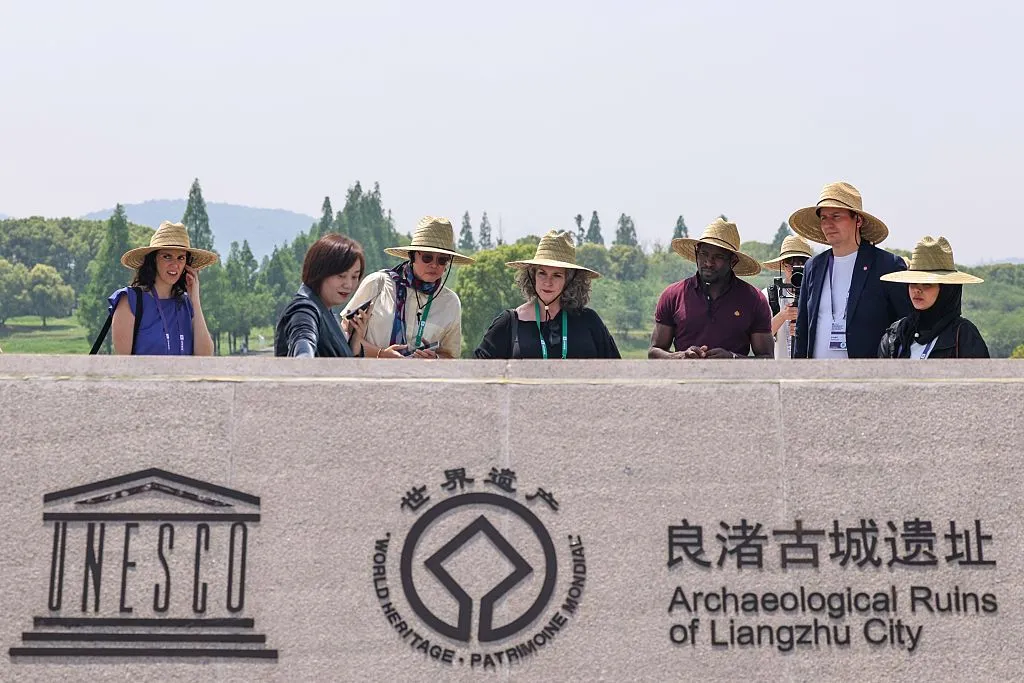
Liu Bin, the Chinese archaeologist widely known for his work at the ancient city at Liangzhu, the so-called Venice of the Stone Age, pleaded guilty on May 20 to charges of taking bribes and embezzling research funds, Caixin Global reports.
In the trial, which took place at Suichang County People’s Court in Zhejiang Province, Liu was accused of accepting more than 4.65 million yuan (about $690,000) in bribes and embezzling 300,000 yuan (about $45,000) from a research project related to the civilization at Liangzhu, reports Caixin, noting that he was detained by the authorities in December 2025 and arrested in February.
No penalty has been announced.
After studying archaeology at Jilin University, Liu joined the Zhejiang Provincial Institute of Cultural Relics and Archaeology in 1985, later becoming deputy director and then director. He oversaw the excavation of Tomb No. 12 at Liangzhu in 1986 and then discovered the ruins of the city in 2007. China has argued, based on that find, that the lower Yangtze region was home to one of the earliest urban civilizations on Earth. He also participated in the bid to have Liangzhu recognized as a UNESCO World Heritage site. His efforts earned him national recognition, notes Caixin.
Liu joined Zhejiang University in 2020 as a humanities scholar, later serving as professor at the School of Art and Archaeology, director of the school’s Museum of Art and Archaeology, and head of its Institute of Cultural Heritage. He left the latter post in 2020.
For more than a decade, from 2009 to 2021, Liu accepted the 4.65 million yuan in cash and and other goods in return for helping applicants get approval for cultural relic protection and archaeological exploration projects.
He also awarded Shaanxi Longteng Cultural Relics Protection Company an exploration project extending over nearly three square miles outside the ancient city as early as 2008. Wang Lin, a relative of a university classmate of Liu’s, is a shareholder and the court alleged that Wang paid Liu more than 1.4 million yuan in “thank-you fees.” The company was also awarded an exploration assignment at the ancient site of Longshan, in Anji county, in 2016, notes Caixin. Wang also controls another company that Liu granted a contract to undertake a digital information collection project related to Liangzhu, also in return for a payoff. Liu used the funds as a down payment on a home for his daughter, per sources speaking with Caixin.
The attorney representing Liu argued that the 2.2 million yuan that came from Wang was received after Liu had left public office, saying that public officials can be charged with bribery only in the case of an agreement made while in office. He argued that a 200,000 yuan wedding gift from Wang should be handled in a disciplinary procedure and not a criminal court, per Caixin.


