







For a few days in March, Christie’s Rockefeller Center galleries felt less like an auction house than a public exhibition of 20th-century mythmaking. Fans came to see Kurt Cobain’s guitar, Jerry Garcia’s “Tiger,” and John Lennon’s piano from “Sgt. Pepper” and Ringo Starr’s “Ed Sullivan” drum kit up close. Then the sales began, and what had been a museum-like display turned into something louder, faster, and far more competitive.
Across four sales, the Jim Irsay Collection brought in $94.5 million, making it the highest-grossing memorabilia auction ever staged. Every lot sold, with the cumulative take totaling nearly four times the low estimate. The series also set 28 world records.
Many of those records clustered at the top end, where instruments and manuscripts tied to canonical figures in music and literature continue to define the category. David Gilmour’s “Black Strat” led the sale at $14.55 million, setting a new benchmark for any guitar at auction. Jerry Garcia’s custom-built “Tiger” followed at $11.56 million, while Kurt Cobain’s Fender Mustang from the “Smells Like Teen Spirit” video reached $6.9 million. Together, the results gave Christie’s the top three highest guitar prices ever achieved at auction.
Installation view of guitars owned buy Prince (left) and Kurt Cobain (right) from the Jim Israel collection at Christie’s.
Filip Wolak
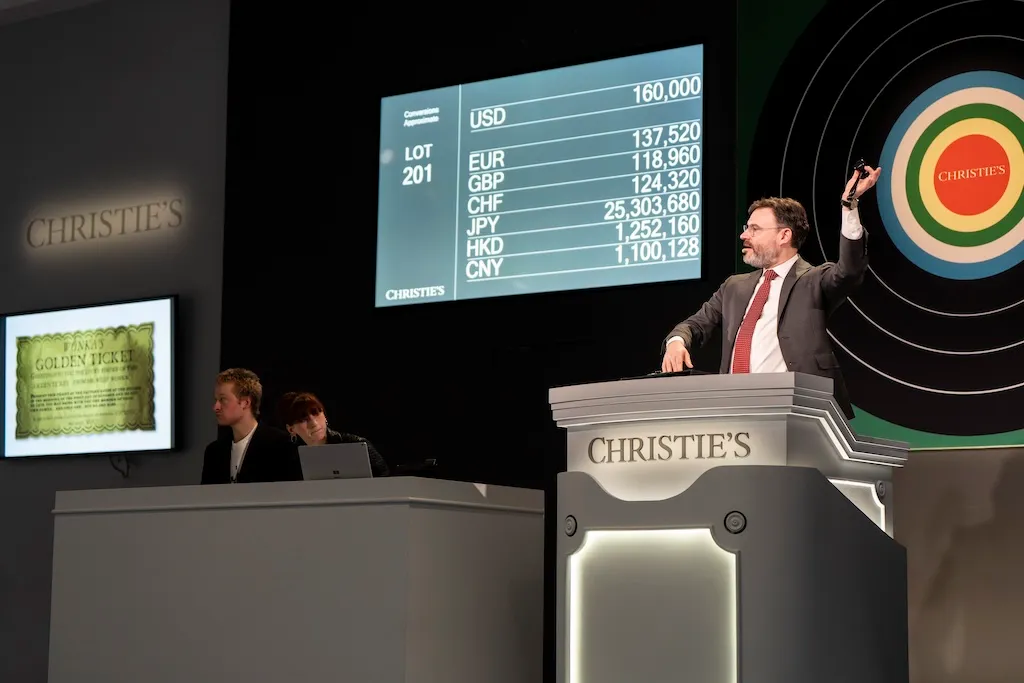
The records extended beyond music. Jack Kerouac’s original typescript scroll for On the Road sold for $12.1 million, the most ever paid for a literary manuscript. John Lennon’s upright piano used during the Sgt. Pepper-era brought $3.2 million, while Bob Dylan’s handwritten lyrics for “The Times They Are a-Changin’” reached $2.5 million. Even outside the cultural canon, benchmarks fell: the saddle used in Secretariat’s 1973 Triple Crown run sold for $1.52 million, a record for a horseracing object. Muhammad Ali’s robe from the Ali–Liston era also drew strong bidding, part of a broader run on sports history that included pieces associated with Jackie Robinson and Wayne Gretzky, and the red Mead notebook in which Sylester Stallone scribbled ideas, plot points, and dialogue for the first “Rocky” movie. They even had an original golden ticket from the 1971 children’s epic Willy Wonka & the Chocolate Factory. (It sold for $203,000; the estimate was $60,000 to $120,000.)


A drum kit owned by Ringo Starr, part of the Jim Isray collection at Christie’s.
Max Touhey | www.metouhey.com
Part of what distinguished the sale was the way that many of the objects have continued to circulate quickly after the hammer falls. Within hours of Garcia’s “Tiger” selling, the guitar was back onstage at the Beacon Theatre, played live by Derek Trucks during a Tedeschi Trucks Band performance, a reminder that at least some buyers see these works less as relics than as instruments with a second life.
The atmosphere in the room reportedly reflected that energy. Applause followed major bids. Some lots drew extended bidding battles well past the 10-minute mark. The sale leaned into the fact that these objects carry stories that are already widely known, but still powerful when attached to the thing itself.
That may be the clearest takeaway: At a moment when other parts of the market are preoccupied with what is new, this sale showed the enduring pull of what is already established. The Irsay Collection did not ask buyers to speculate. It offered them artifacts tied to moments that for decades have been woven into our cultural history, and the response suggested that, for many collectors, that kind of certainty still demands a premium.


