







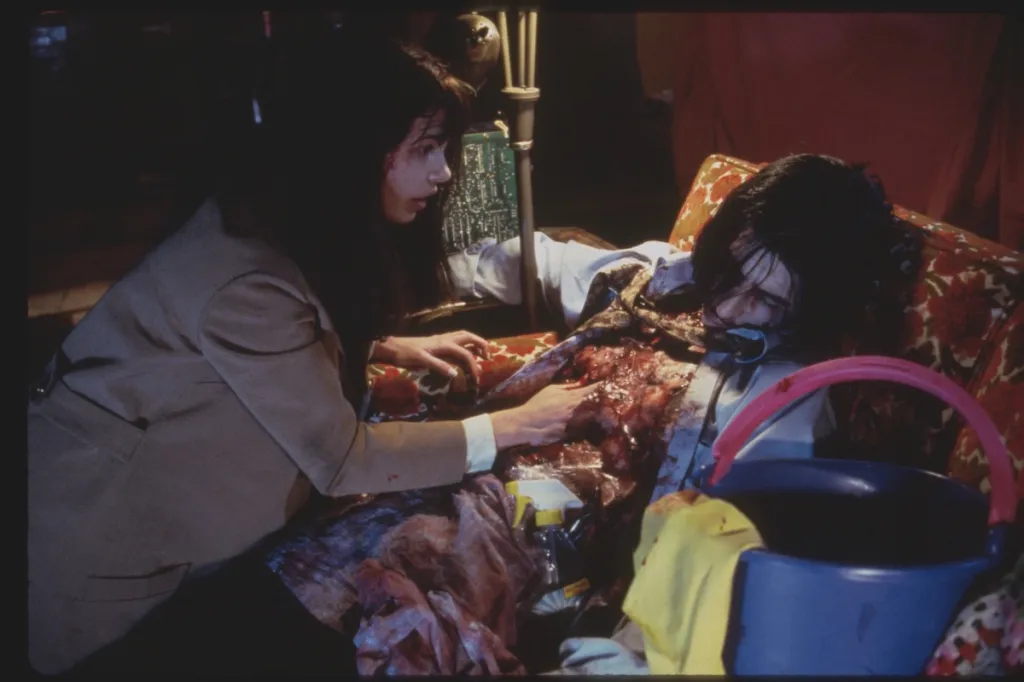
Photographer Cindy Sherman has made just one feature film to date—Office Killer, a 1997 box-office flop that was unloved by critics, such as the New York Times’s Stephen Holden, who called the movie “sadly inept” and “crude.” I agree, at least, on the “crude” part: in one scene, the film’s star Carol Kane plays with a violated corpse’s guts. Once she’s smeared them around the corpse’s opened chest cavity for long enough, she then tries to stick them back into place using Scotch Tape. It’s gross, but that’s the point.
Before Office Killer, Sherman was better-known for her “Untitled Film Stills,” a series of photographs from ’70s in which the artist poses in settings that appear to be excerpted from B-movies and pulp fiction. The year before the film was released, MoMA paid $1 million for a full set of the black-and-white pictures, which remain her most famous pieces. But during the ’80s and ’90s, Sherman spent much of her time making pictures that looked quite unlike her iconic work: they were filled with vomit, mold, and dismembered limbs (belonging to anatomical dolls, not humans, thankfully).
Notably missing from many of these later works was Sherman herself. In 2012, speaking of her “Disasters” and “Sex Pictures” series, Sherman recalled wanting to see if potential buyers would be willing to “put this above their couch.” Most collectors declined, and by and large, critics didn’t care for them either.
The “Disasters” and “Sex Pictures” still don’t get exhibited nearly as often as the “Untitled Film Stills,” probably because they remain every bit as disgusting. I suspect it’s also why Office Killer doesn’t get the respect it deserves, either. The movie was mentioned just a few times in the catalog for Sherman’s 2012 MoMA retrospective, and one of those instances was in an interview with the fellow abject filmmaker John Waters, who expressed deep admiration for this film—no surprise there. This month provides a good opportunity to get on Waters’s wavelength: Vinegar Syndrome is releasing Office Killer on 4K UHD and Blu-Ray for the first time ever, and through the distributor’s fresh restoration of the film, you can see Sherman’s gore with new clarity.
Unlike most of the other cult classics put out by Vinegar Syndrome, Office Killer can’t be watched for the plot. It does have a vague semblance of narrative: Kane plays Dorine, a meek editor at a fictional publication called Constant Consumer, whose downsizing efforts cause her to become homicidal. (Sherman cooked up the genius idea herself and was pushed to develop it into a feature by Todd Haynes, Elise MacAdam, and Tom Kalin, but only MacAdam and Kalin took screenwriting credits.) Yet there’s no tension as characters played by Jeanne Tripplehorn, Barbara Sukowa, and Michael Imperioli are picked off one by one. Molly Ringwald is on hand as a judgmental coworker who becomes—spoiler alert—the final girl, but whether she lives or dies feels beside the point.
Instead, the film seems designed to stimulate by presenting one horror after another: lopped-off hands, bodiless heads, bleeding torsos, death by butane, attempted strangulation, slain kids, a mutilated mom, fingers lodged in places they don’t belong (all evoked through campy prosthetics). And that’s to say nothing of an even creepier subplot involving Dorine’s incestuous father (Eric Bogosian), who, in one childhood flashback, caresses her bare legs.
Any of this might be regarded as cheap thrills in another filmmaker’s hands, but the fact is that Office Killer was made by Cindy Sherman. It was released, too, at the tail end of a burst of abject art embodying all that “disturbs identity, system, order” and “does not respect borders, positions, rules,” as theorist Julia Kristeva wrote in an influential 1980 book. For a range of ’90s artists, this looked like everything from Paul McCarthy’s videos and sculptures engaging vomit, piss, shit, and vomit, to Pope.L’s performances subjecting himself to unpleasant circumstances as a comment on individuals cast out of society. For Sherman, this meant unleashing the violence stowed away as subtext in much of her prior work on women in film.
Office Killer makes that subtext explicit with its final scene, in which Dorine flees town while wearing a blonde wig and a noirish get-up—one that recalls outfits worn by Sherman in the “Untitled Film Stills.” Sherman’s camera crawls around the roof of Dorine’s car to reveal a surprise passenger: the decapitated head of Dorine’s office manager, riding shotgun in a duffel bag. For a second there, just before Dorine stares back at herself using a rearview mirror, you might mistake Kane for Sherman herself.


