







Few contemporary public art projects have simultaneously stirred such artistic, theological, and political controversy as Notre-Dame Cathedral’s new stained glass windows. It’s no surprise, then, that the artist awarded the commission in 2024, the French figurative painter Claire Tabouret, has faced extraordinary scrutiny.
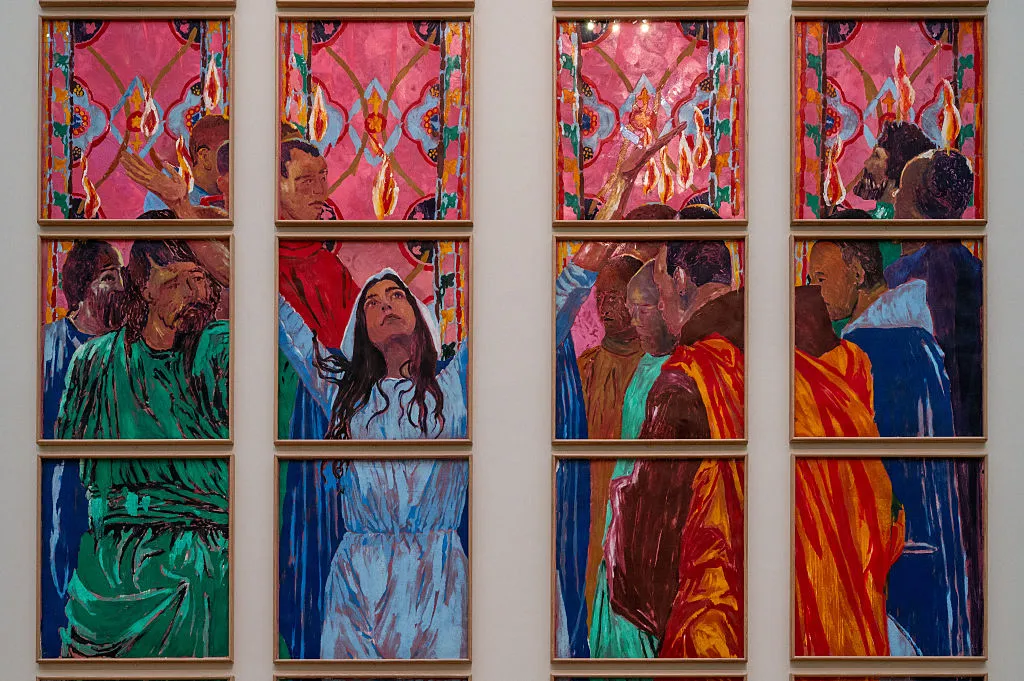
In December, the public finally encountered the artist’s vision in “Claire Tabouret: In a Single Breath” at the Grand Palais, which featured life-sized maquettes of the six stained-glass windows slated to replace the 19th-century works of Eugène Viollet-le-Duc and Jean-Baptiste Lassus. Tabouret, known for her vividly colored, tautly emotional portraiture, has imagined a multiethnic, multigenerational array of worshipers prostrated during Pentecost.
The French President, Emmanuel Macron, and Paris’s archbishop, Laurent Ulrich, chose Tabouret from a pool of 110 candidates, following explicit instructions from the Catholic Church that the winner be a figurative artist. The French Ministry of Culture commissioned the replacements for the windows in six chapels on the structure’s southern aisle in the wake of the 2019 blaze that damaged the roof and spire of the Gothic landmark.
The plan swiftly drew criticism as an act of vanity, given that Viollet-le-Duc and Lassus’s windows survived the fire, and for possibly violating the 1964 Venice Charter and cultural heritage guidelines, which call for preserving original elements unless this is impossible.
Tabouret, 44, has since publicly addressed her detractors. “These are people who hate the project, no matter what,” she told the Guardian upon the opening of her solo exhibition at Museum Voorlinden outside The Hague, which coincides with her Paris presentation. “They didn’t even really look at the designs. They go on their computers to spread hate, but you can see from the messages they write that they don’t really know what it’s about. And I’m also receiving a lot of love, which is very nice.”
Macron, too, has been undeterred by criticism, having vowed to completely rebuild the cathedral within five years with a “contemporary gesture.” The concept of contemporaneity itself became the subject of debate, with some asking: Should a monument meant to be timeless be tethered to the aesthetics of a single moment, with all its political and personal baggage?
Others, however, have pointed out that it is the very passage of time that elevates the contemporary into the canonical. After all, while the seven-meter-high windows are commonly considered “original,” they were installed during a major mid-19th century renovation—long after the cathedral’s founding in 1163.
Tabouret, formerly a resident of Los Angeles, moved back to France last year and now lives outside Paris. She’s working with Simon-Marq Storied Glass Studio in Reims, renowned for its post–World War II cathedral restorations. Founded in 1640, the studio has counted among its clients artists such as Joan Miró and Marc Chagall, and more recently, German sculptor Imi Knoebel.
“When you live in a country with so much history, so much architecture and heritage you cannot just freeze time,” Tabouret said. “The question is, how do we create a harmonious dialogue between new layers in buildings like Notre Dame that are made of layers? If you stop those layers, it makes no sense in my opinion.”


