





At Coachella 2026, the landscape itself becomes part of the lineup. This year’s art program unveils new immersive works by Dutch artist Sabine Marcelis, London architect Kyriakos Chatziparaskevas, and The Los Angeles Design Group ( LADG), ranging from glowing mazes to towering sculptural forms. The festival takes place across two weekends, April 10th to 12th and April 17th to 19th.
The 2026 art program is organized by Raffi Lehrer of large-scale art producers Public Art Company and Paul Clemente of Goldenvoice, a California music event operator. “What unites [the artworks] is a shared generosity; each piece is designed to be entered, sat beneath, wandered through, and genuinely felt. We’re curating for the body as much as the eye,” Lehrer said in a press statement. “The best festival art doesn’t just occupy space—it transforms it.”
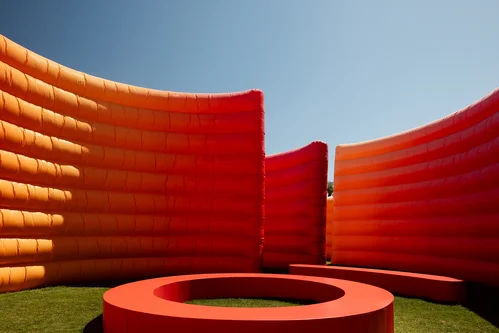

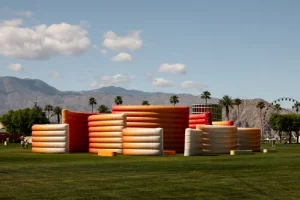
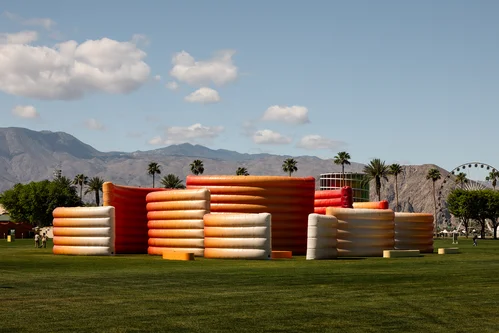
Marcelis’s Maze (2026) is a labyrinth constructed out of inflated, curving arcs. The artist took inspiration from the surrounding Coachella Valley, imagining the maze like a mirage against the desert landscape. The artist and festival organizers will encourage guests to explore the maze, particularly at night, when the installation’s inflatable structures will glow.
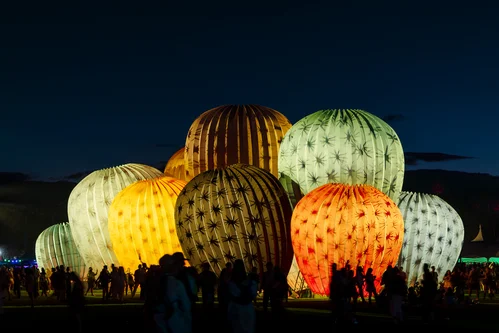
Meanwhile, Chatziparaskevas has designed several towering geometric forms with Starry Eyes (2026). These brightly colored sculptures are meant to evoke the barrel cactus, an oval-shaped and prickly plant native to the region. Some of these works are nearly 40 feet tall. Festivalgoers will be able to go inside these fake cacti, where they will find star-shaped skylights. At night, these will light up, similar to Marcelis’s Maze, transforming into a field of color.
Lastly, the festival unveiled Visage Brut (2026) by the LADG, which is led by Andrew Holder and Claus Benjamin Freyinger. The sculpture is a totemic tower comprising modular boxes. At night, the idiosyncratic geometric tower glows green against the desert sky.
The Coachella art program will continue after the festival. Several of the sculptures from previous years have found permanent placements in an effort to support public art in nearby communities. For instance, Canadian designer Stephanie Lin’s Taffy (2025), a series of colorful towers that debuted at last year’s festival, will be placed in Palm Desert Park later this year.


