





Conflicts today occur so quickly and with such ferocity, it is difficult to express dissent or outrage at a particular trespass fast enough for the reaction to still be relevant. Not even our tweets can keep up with the onslaught of chaos, and I often wonder how this moment in time will be marked visually, in terms of cultural history. Perhaps in an attempt to generate a timely visual response, almost everyone seems to have embraced the absurd aesthetic that is taking over all facets of communication: artificial intelligence (AI) slop.
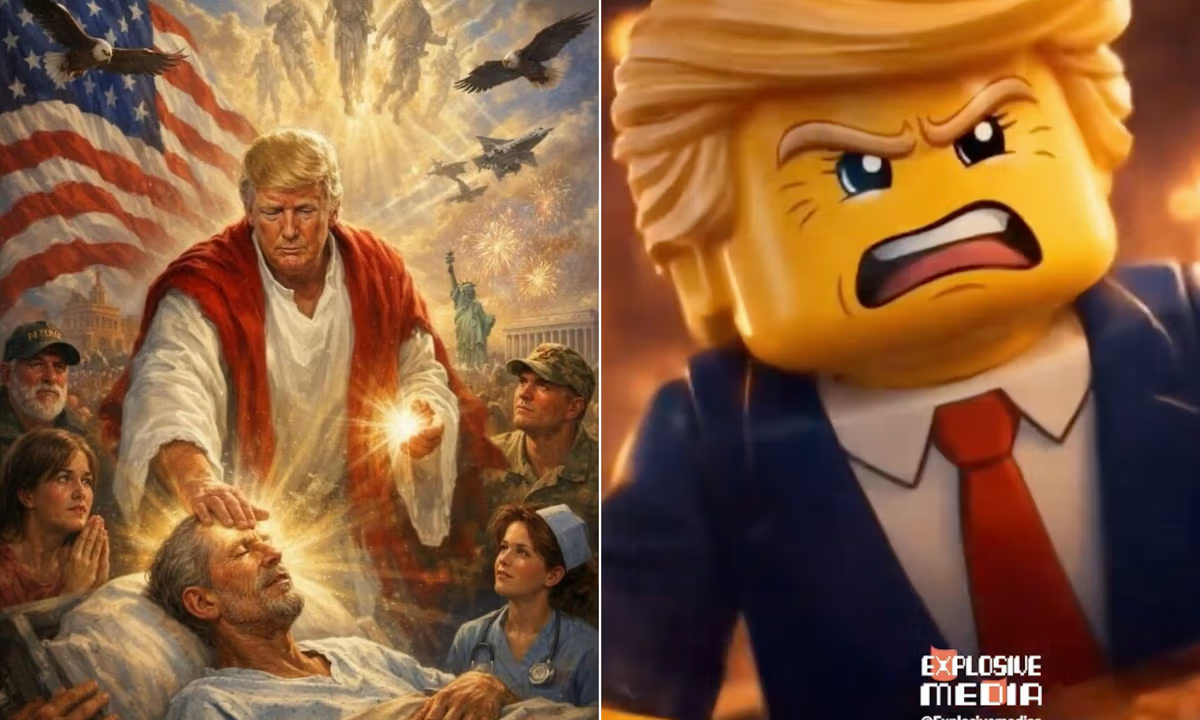
AI-generated images of Donald Trump as Jesus, so devoid of authorship, so utterly generic in their Christian young-adult novel cover aesthetic, now make up the visual vocabulary of a regime hellbent on wreaking havoc domestically and in the Middle East. Trump’s post featuring bland Christian iconography likening him to a Jesus-like figure drew criticism earlier this month, from his own Make America Great Again (MAGA) movement and the broader public. Members of the MAGA movement have at times co-opted the Third Reich’s slogans and aesthetics, so it was interesting to discover that their line in the sand was the president anointing himself as God-like.
Despite borrowing from a genre rich in storytelling, there is no coherent narrative in the current US administration’s use of these hollow Christian visuals, other than the absurd proposition that Trump is somehow divinely ordained. “AI-generated biblical imagery of Republicans” is not a category that can withstand much scrutiny, let alone the test of time.
The foils to these images, similarly facile but more intentional and structured, are the viral AI-generated animated Lego videos featuring militarised minifigures of the Iranian Revolutionary Guard Corps (IRGC) in high-tech control rooms rapping diss tracks criticising the US and Israel’s unsanctioned attacks in the Middle East. As an unhinged form of internet content, these videos would fit right into the digital community Newgrounds around the year 2000. But the idea that these videos are genuine propaganda tools today, inventive as they may be, strains credulity. Still, YouTube considered them dangerous enough to suspend the account behind them, Explosive Media, citing “violent content”. Explosive Media’s representatives also recently confirmed that although they are not affiliated with the Iranian government, the regime is a customer.
Learning from Gezi
As much harsher images of the US and Israeli military operations in Iran, Lebanon and elsewhere continue to inundate our social media and news feeds, I find myself remembering the Gezi Park protests in Istanbul in 2013. One of the most fascinating forms of resistance I witnessed then was the inventiveness with which Turkish people leveraged language and whimsy to counter an oppressive regime that had no tolerance for joy or humour. The slogans and posters are almost impossible to translate without ruining their comedic impact, but the unyielding glee of the Turkish people amid such turmoil introduced me, a naïve and idealistic college graduate who was returning home to get teargassed for an entire summer, to the notion that popular discourse and culture could be legitimate battlefields.
That resistance movement later bled into contemporary art, impacting an entire generation of Turkish artists, including me. In the years following the protests, it was common to see sculptors and installation artists (somewhat heavy-handedly) using empty tear gas canisters in their work, while others painted figurative or abstract depictions of the clashes between the crowds and the police. None of it necessarily became as iconic as, say, Pablo Picasso’s Guernica, but it was a fascinating process to witness in real time and, along with the slogans, those works are symbolic of a specific period in Turkish history.
It is disheartening that we are not seeing a similar artistic wave in gallery shows, art fairs or festivals in response to the atrocities being committed today. Yes, political art still exists, but it is not necessarily resonating beyond a few days of Instagram fame. The imminent edition of the Venice Biennale may turn into a cultural battleground itself, but the organisers of the US pavilion opting for an artist many see as non-political is telling. There is plenty of political art on the internet, but with the “enshittification” of the internet—the degradation of the platforms of distribution, which in turn degrades the content being distributed—political art today has become a parody of itself.
As most social media companies, such as Instagram and its parent company Meta, determine the relevance and sensitivity of a post based on their algorithms, and prioritise traffic over content, they also play a role in what sort of political visual output reaches broader audiences. In other words, the only political art that reaches our screens is either sanitised or deemed to be worthy of the traffic it will generate (or both). Explosive Media’s ban by YouTube (and its parent company Alphabet) is alarming, but it is also a timely reminder that as a battlefield the internet remains largely US-controlled, and therefore uneven.
Political art today has had to evolve to meet its audiences where they congregate, so the fact that it is sleekly digital in its visuals and adolescent in tone is unsurprising. But the transiency of its modes of exhibition and distribution leaves much to be desired. After all is said and done, we will have no digital monuments to this pivotal moment to revisit, recontextualise or perhaps even tear down.
Visual propaganda today often comes across as inconsequential or merely amusing because it treats the internet and post-internet culture as the only arenas of communication. It is so easily consumed that it lacks the canonical impact of ominous propaganda posters that adorned urban environments for much of the 20th century, serving as constant tension triggers. The AI slop representing the US and Iranian regimes’ messaging have no staying power, simply functioning as pawns on an infinite chessboard.
This is not a call to return to the reductive symbolism of 20th-century propaganda. Nor am I dismissing the very real human toll of the ongoing conflicts in the Middle East. The colourful visual languages used to present the US and Iranian perspectives are in part attempts to wash away some of their respective sins by earning digital clout. But by catering to adolescent internet culture, both the propaganda-makers and their resistors have stripped the legacy they are operating within of its intellectual and aesthetic heft. Derivative AI-generated imagery may be painfully apt for the period we are living in, but authorless, toothless and transient political art accomplishes very little except betraying the lack of imagination of its own creators. Between users’ over-reliance on AI, and platforms of distribution with dubious priorities and a penchant for (direct or indirect) censorship, there is very little room for any meaningful political art to exist on the internet today.
Is it so odd to crave more than AI slop, to desire a point of view that is not predicated on immediacy, to ask for a modicum of artistry to mark this moment? What happens if we have no mementos worth preserving—to serve as visual warnings, if nothing else—from this cruel and vicious era of human history?


