





An exhibition of work by Marisa Merz, originally scheduled to open this fall at the Fridericianum museum in Kassel, Germany, was canceled by the Italian artist’s daughter in protest of Documenta’s newly instated Code of Conduct. The code has sparked cultural controversy across Europe over its definition of antisemitism, which critics warn could penalize artistic expression.
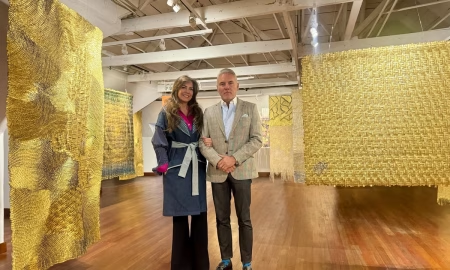
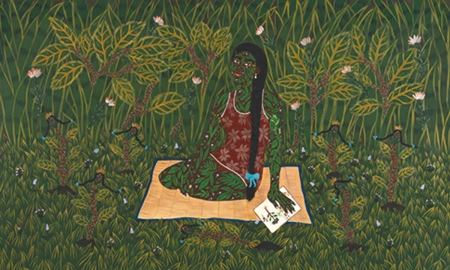
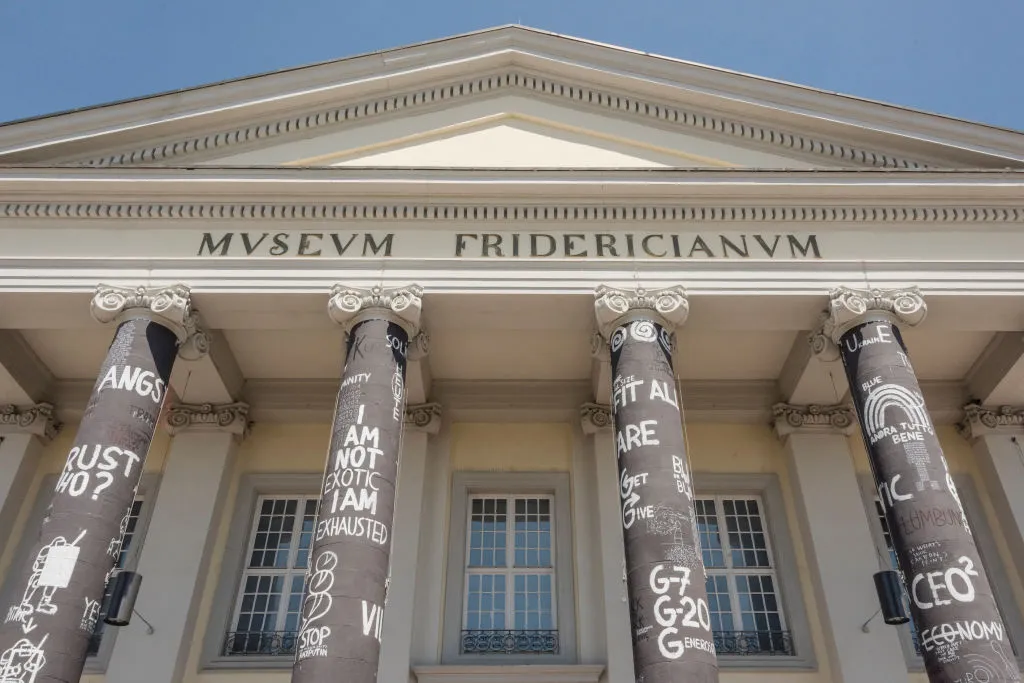
Marisa Merz (1926–2019) was the only woman among the core group associated with the influential Arte Povera movement, whose artists made sculptures from everyday materials instead of ones typically associated with fine art. Her exhibition was scheduled to open in August at the Fridericianum, which acts as the historic anchor of Documenta during the quinquennial’s run and mounts major surveys when that festival isn’t taking place.
Beatrice Merz, daughter of the artist duo Mario and Marisa Merz and president of the Fondazione Merz in Turin, told Monopol magazine on Thursday that she called off the exhibition because she opposed Documenta’s adoption of the International Holocaust Remembrance Alliance (IHRA) definition of antisemitism. Until this week, the exhibition’s cancelation was not publicly known; it appeared on a 2025 calendar that was released by the Fridericianum last December. The museum ended up replacing the planned Marisa Merz show with a Robert Grosvenor survey.
Under the IHRA definition of antisemitism, criticism of Israel or Zionism could be counted as a form of prejudice. Documenta adopted the policy after its controversial 2022 edition, which featured artworks that German politicians denounced as antisemitic. Many have worried that, in adopting the IHRA definition, Documenta will now limit freedom of expression at its 2027 edition.
“A collaboration with the Museum Fridericianum would have meant accepting the museum’s code of conduct, which uses the IHRA definition of antisemitism—a definition with which I don’t agree in every respect,” Beatrice Merz said. “In my view, it would have been more appropriate to use the JDA, the Jerusalem Declaration on Antisemitism. For this reason, as president of the Fondazione Merz, I felt it was right to cancel the exhibition project. I am convinced that art should not be restricted by borders and, above all, must be free of prejudice.”
Andreas Hoffmann, managing director of Documenta and the Fridericianum, confirmed the cancelation in a statement to Monopol, stating, “Discussions with the Fondazione Merz revealed that the framework for the planned exhibition featuring works by Marisa Merz was not entirely compatible. We respect the Fondazione Merz’s decision not to pursue the exhibition further.”
The cancelation is the latest sign that Documenta 15, the show that took place in 2022, has a legacy that remains divisive. At that show, a monumental mural containing antisemitic caricatures went on view to the public before being swiftly removed, generating a scandal that prompted a government inquiry into how the work passed Documenta’s vetting process. In the months that followed, the fate of the state-funded show appeared uncertain.
Documenta is hardly the only German institution to enforce a new definition of antisemitism since 2023. The German Bundestag also formally adopted the IHRA’s definition of antisemitism in 2024, despite opposition from many artists and academics in Germany.
In his statement, Hoffmann said that the Documenta Code of Conduct was binding for the institution’s employees, not for the exhibition’s artistic team or associates.
“Artistic freedom applies without restriction to curatorial work,” he said. “Documenta gGmbH guarantees artistic freedom within the framework of the laws applicable in Germany. Insofar as Documenta deems artistic expressions incompatible with the principles set out in this Code of Conduct, it reserves the right to comment on its resulting position and, if necessary, to explain it in the immediate visual context of the exhibited artworks.”
ARTnews has contacted the foundation and museum for comment.