

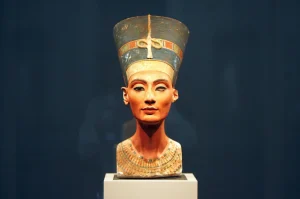






Zahi Hawass, a well-known Egyptian archaeologist, renewed his promise to bring an ancient bust of Nefertiti home this week, claiming that his country was readier than ever to host it once more, thanks to the recent opening of the Grand Egyptian Museum near Giza.
He called once more for Berlin’s State Museums to return the bust of Nefertiti, which dates to ca. 1351 BCE–1334 BCE and is among the most famous ancient Egyptian artifacts held outside Egypt. It has repeatedly faced calls for repatriation across the years, and was very nearly given back to Egypt during World War II, when the Nazi regime thought that doing so would help Germany curry favor with Egyptians.
Ludwig Borchardt, a German Egyptologist, found the bust in 1912 at Tell Al-Amarna and brought it back with him. Since 2009, the bust has been on view at the Neues Museum.
Germany has maintained that the bust was exported legally. Hawass’s position on what really happened in 1912 has changed over time. In 2010, Hawass told National Geographic that the sculpture was not looted, though he added, “I really want it back.” But in 2024, he described the bust as “brazenly stolen” in an interview with Deutsche Welle.
In a Washington Post interview published this week, Hawass rebutted a familiar argument against repatriation often given by Western museums: that institutions in parts of the Global South are not up to standard because they lack proper climate control systems and other measures found in American and European museums. “You cannot say that Egypt cannot protect its artifacts,” Hawass told the Washington Post. “There is no museum that has the quality of display of the Grand Museum.”
Hawass is a controversial figure in archaeology, having previously faced allegations of corruption and claims that he was overly involved with the autocratic Mubarak regime. Yet his pronouncements on Egyptian archaeology are closely followed—especially with the Grand Egyptian Museum now fully open following a partial inauguration in 2024. The 968,000-square-foot museum, known as GEM for short, has attracted at least 15,000 visitors daily, according to the Egyptian government.
Speaking to the Post, Hawass said GEM was the best place to view Nefertiti—and that he won’t visit Berlin to see the bust. “I refuse to go and see the bust of Nefertiti at all,” he said. “This bust should be in Egypt, and I will bring it to Egypt.”


