






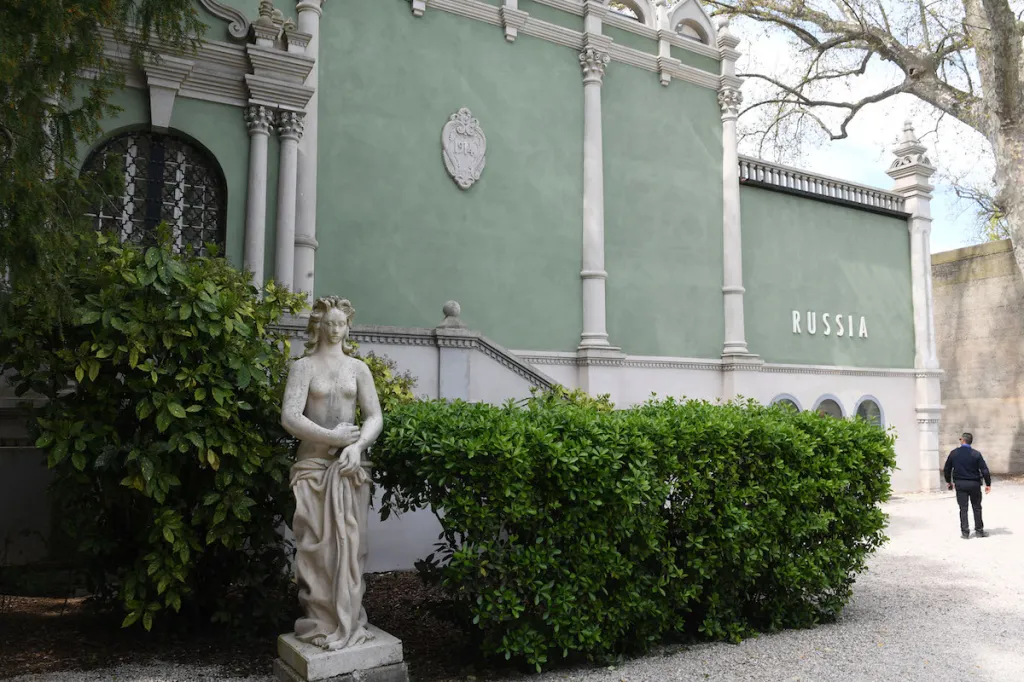
The European Union said it could pull funding to the Venice Biennale if the show goes through with hosting Russia, adding to mounting furor over plans by the country to show at the world’s most important art exhibition for the first time since its 2022 invasion of Ukraine.
Henna Virkkunen and Glenn Micallef, respectively the EU’s commissioners for technology and culture, said in a joint statement that staging the Russian Pavilion ran aground of the EU’s stance on the country, whose war in Ukraine is still ongoing.
“This decision by the Fondazione Biennale is not compatible with the EU’s collective response to Russia’s brutal aggression,” they wrote. “Should the Fondazione Biennale go forward with its decision to allow Russia’s participation, we will examine further action, including the suspension or termination of an ongoing EU grant to the Biennale Foundation.”
They called Russia’s war in Ukraine “illegal” and said, “Culture promotes and safeguards democratic values, fosters open dialogue, diversity and freedom of expression, and should never be used as a platform for propaganda.”
ARTnews has reached out to the Biennale for comment. It’s not clear how much money the EU provides to the Venice Biennale.
Queried about the Russian Pavilion on Monday, the Biennale directed ARTnews to a statement from last week in which the exhibition allows any country recognized by Italy to have a pavilion and that the show “rejects any form of exclusion or censorship of culture and art.”
This is the first time Russia has participated in the Biennale since 2019. In 2022, the pavilion closed because its curator and artists made the decision to shutter their show. In 2024, Russia ceded its pavilion to Bolivia, which staged an exhibition of its own there.
The 2022 Biennale appeared to feature a show of support for Ukraine. That edition featured a special pro-Ukraine showing staged in the Giardini, one of the Biennale’s main venues. “The aim of this project is giving a voice to artists and the art community of Ukraine as well as other countries in solidarity with the people of Ukraine in the aftermath of the brutal invasion by the Russian government, and to create a space for debate, conversation and support to Ukrainian culture,” the Biennale said at the time.
The Biennale has yet to take any stance on Russia’s war in Ukraine this time around, and the issue of whether or not the Biennale really is a nonpartisan entity has become central to a mass outcry from curators, artists, and institutions calling for Russia’s removal.
“The claim that ‘culture is above politics’ is never neutral,” reads one open letter regarding the Russian Pavilion that now has more than 6,000 signatures. “In the case of contemporary Russia, this formula has become a political instrument used to promote aggression and advance state agendas while disguising them behind the language of cultural exchange and dialogue.”
Ukraine and Lithuania have also bitterly called on the Biennale to drop Russia’s participation, which allows the nation to compete for one of the Biennale’s main prizes, the Golden Lion for Best National Participation.
One Venice art space has even weighed in on the matter. The PinchukArtCentre, a space run by Ukrainian collector Victor Pinchuk that regularly stages events with the Biennale’s blessing, said this week that it was “appalled” by the decision to allow Russia in this time.
“Inaction does not equal neutrality,” wrote the PinchukArtCentre. “We therefore call upon La Biennale di Venezia to take a clear position and refuse the participation of the Russian Federation, thereby condemning the illegal war of aggression it continues to wage against Ukraine.”


