






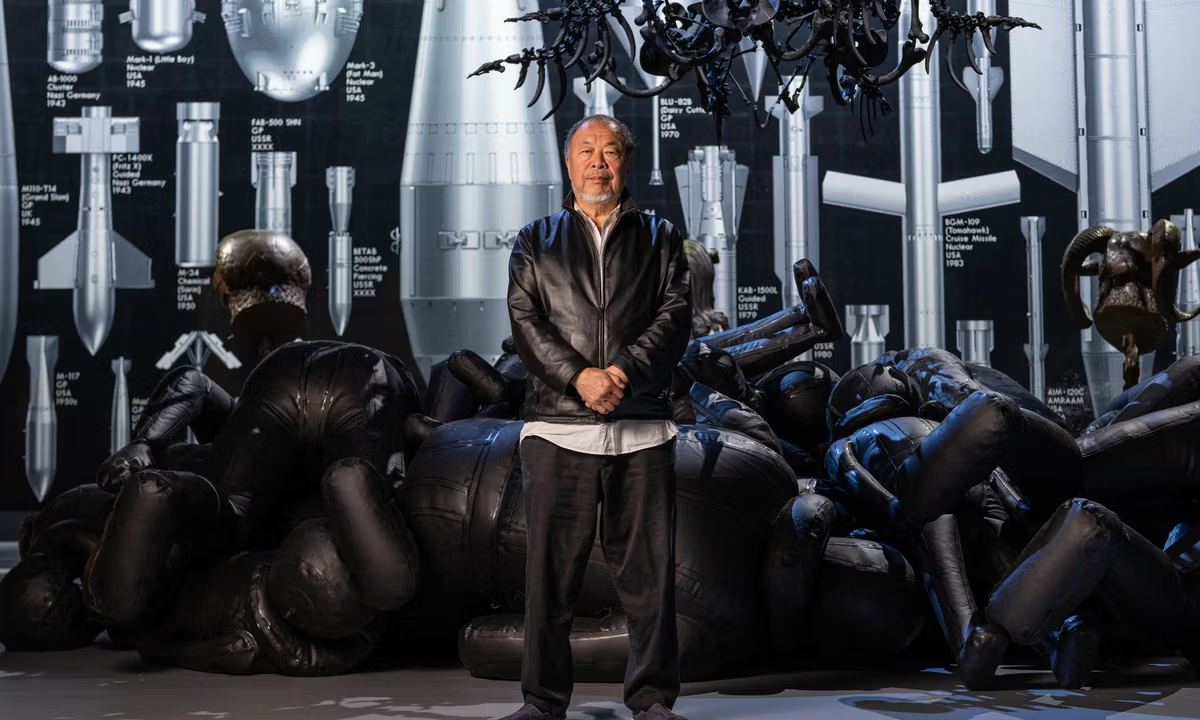
The Chinese activist-artist, Ai Weiwei, opens his monumental exhibition Button Up! at Factory International’s Aviva Studios today, 3 July, featuring a mix of large-scale new and existing works, many never before seen in the UK. Located in the cultural centre’s airplane hangar-like Warehouse space, Button Up! feels like a retrospective of enormity for the renowned gadfly, with over two-decades worth of work significant in both scale and meaning.
“For someone like me, travelling or exiled, and never really having a place that can be considered home…to see all this work being put in one unit, this is unthinkable,” he told The Art Newspaper on seeing his new commissions realised for the first time in Button Up!, especially alongside works that had long been in storage, such as traditional Mazha stools from 2014 that had never before been used.
Installation view of the exhibition in Aviva Studio’s The Warehouse
Photo credit Hugo Glendinning
The exhibition’s cheeky-sounding title is two-fold, with origins far less cute. The presence of buttons in the exhibitions is immediately evident by the eight gargantuan flags that divide the expansive gallery space, made from approximately 4 million buttons Ai acquired from a closing Croydon factory in 2019. Entitled Eight-Nation Alliance Flags, Ai’s team in Shandong have recreated the banners that flew when Russia, Japan, France, Germany, the US, Italy, Austria-Hungary, and, for course, the UK, invaded Qing-dynasty China in 1899 to quell rebellion against foreign influence and increase access to Chinese trade. With industrialisation, of which Manchester was a centre, driving the imperialism that defined this period, Ai weaves a literal thread from this traumatic moment in Chinese history to the Mancunian locale of his latest show.
The other button reference will become clear on Friday, when the artist performs his first-ever durational performance work in a purpose-built set in the centre’s theatre. The 24-hour Sewing a Button is his debut performance reenacting his 81-day detainment by the Chinese secret police in 2011. At a press preview, Ai regaled the inspiration behind the reenactment: after losing weight in detention, the button fasten of his trousers detached, causing his trousers to fall whenever he would do his daily walks around his tiny cell to stay active, sparking laughter in the otherwise stone-faced guards surveilling him. After a month of requests, Ai’s trousers were finally mended by the soldiers in front of cameras. “Even sewing a button can be subversive,” Ai said, adding jokingly: “I use zippers now.”
But the humour is more difficult to find in the last new work for this exhibition: History of Bombs, a 25-metre wide toy brick wall of weapons of mass destruction, the playthings of warmongers. The massive mural is flanked by renderings of rubber dinghies carrying refugees: Surfing (2023), a lego homage to Hokusai’s The Great Wave, and Law of the Journey (2017), a 49-foot inflatable boat carrying larger-than-life passengers. Both works allude to the consequences of mass displacement and civilian death that the weapons depicted in History of Bombs inevitably bring.
The visualisation of refugees and their plight feels especially pertinent in today’s politically fraught Britain; having lived in Europe, including Cambridge, since the Chinese government finally returned his passport in 2015 after his detention, Ai betrays a disillusionment with Western governments. At the exhibition preview, he compared his experience in the Chinese prison to detainments by democratic governments, such as that of the Wikileaks founder, Julian Assange, who Ai visited during his five-year imprisonment in London, and even the recent kidnapping of the Venezuelan president, Nicolás Maduro, by American forces. “I don’t lick my own scars”, he told the room. “We all have to take this ugliness to see that we are a part of it.”
The exhibition also comes off the heels of Ai’s treatise On Censorship (2026), in which he laments the omnipresence of censorship everywhere from authoritarian to democratic societies, including the UK, where Ai’s son lives, although the artist himself is now based in Portugal. His son, a student at Cambridge who will be attending Ai’s performance this week, has asked his father to “not criticise” given that he will be staying in the UK for a while yet. “This is good advice”, the dissident artist said.
- Ai Weiwei: Button Up!, Aviva Studios, Manchester, until 6 September 2026


