







When a monument to Confederate General Stonewall Jackson was decommissioned in Charlottesville, Virginia, in 2021, curator Hamza Walker managed to get ahold of it and transported it to a warehouse in New Jersey. The hefty monument’s move was no small feat, legally or logistically. But once it arrived, he offered it to the artist Kara Walker (no relation), inviting her to do with it as she pleased at a foundry in upstate New York.
Walker has been deftly probing the dark sides of American history since the 1990s, transforming its iconography until it reveals the violence too often lurking underneath. She approached the Jackson monument similarly, recombining its parts to form Unmanned Drone (2023), a 12-foot statue melding the general with his horse, named Little Sorrel. The sculpture is on view through May 3 at the Brick in LA, where Hamza Walker is director, in a show called “Monuments,” co-presented by the Museum of Contemporary Art Los Angeles. Amid federal initiatives to restore Confederate monuments to public view, Walker’s powerful retort renders at least one reversion impossible, insisting: We can’t put it back like it was.
Kara Walker: Unmanned Drone, 2023; at the Brick, Los Angeles.
Photo Ruben Diaz/Courtesy Sikkema Malloy Jenkins and Sprüth Magers, New York/©Kara Walker
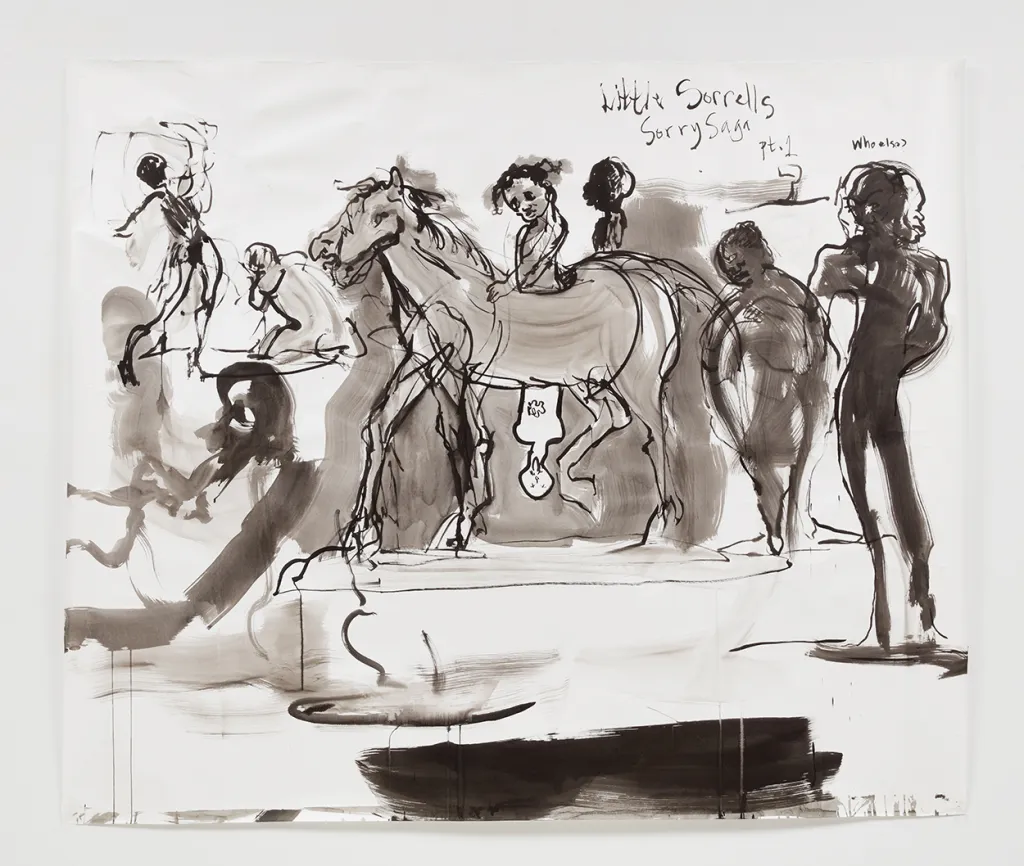
Little Sorrel’s Sorry Saga (Who Else?), 2023–25, is the title of the print that Walker contributed to this issue of Art in America. It’s a version of an ink drawing she made in preparation for Unmanned Drone. In both versions, we see Jackson rendered less as horseman, more as horse-man hybrid—a gesture that nods toward the persistent myths attending the Civil War and evokes the four horsemen of the apocalypse. More simply, he is revealed to be a grotesque monster, looming large but also arrested and maybe even collapsing, his sword dragging low on the floor. This is a monument not to a hero but to horror.
Walker’s title refers to Jackson’s famous little red horse—a creature who outlived not only Jackson but also thousands of Civil War veterans before dying in 1886. Of course, he’s far from the only thing from that era that lived on.


