







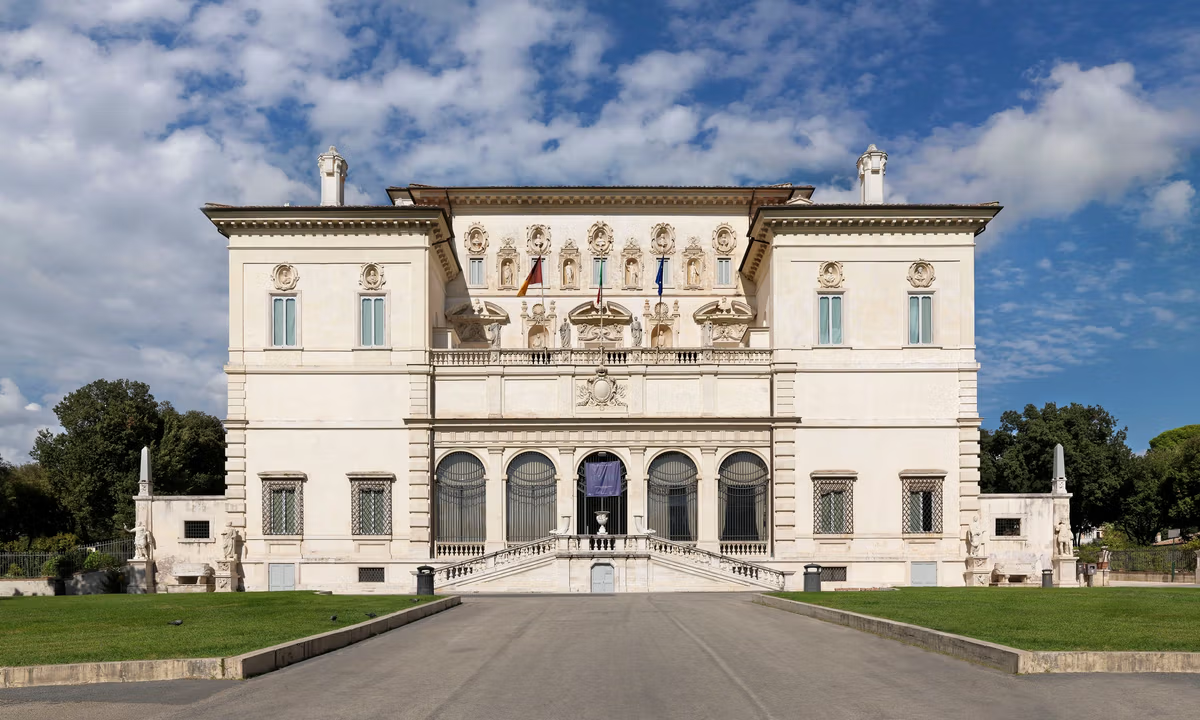
Rome’s Galleria Borghese—a celebrated 17th-century villa museum housing major works by Caravaggio, Bernini and Canova—is at the centre of a controversy in Italy after details emerged about a privately funded feasibility study for an addition to the complex.
Sponsored by the Italian engineering firm Proger, the approximately €900,000 initiative would fund an international architecture competition and feasibility study exploring whether additional exhibition and visitor space could be added to the Villa Borghese Pinciana grounds.
Museum officials say the initiative would address longstanding operational constraints. The villa’s historic interiors and conservation requirements limit access to 360 visitors per timed entry slot, which last two hours (around 4,000 visitors per day). Reservations can require waits of several weeks, many works remain in storage, and accessibility for visitors with disabilities remains difficult. Visitor pressure has intensified, with the museum drawing a record 630,760 visitors in 2025, up from around 506,000 a decade earlier, according to Reuters.
Preservation organisations including Italia Nostra Roma and Amici di Villa Borghese (Friends of the Villa Borghese) raised objections to any new construction within one of Rome’s most historically sensitive landscapes. The Galleria Borghese responded during a press conference on 18 May, where director Francesca Cappelletti emphasised that no project currently exists and the museum is only beginning a broader study process.
A report in ANSA, an Italian news site, noted a winner could be selected as early the end of this year.
The Caravaggio room inside the Galleria Borghese © Galleria Borghese
“Many possibilities”
In an email to The Art Newspaper, Cappelletti emphasises that discussions around the gallery’s extension remain at an extremely early stage and that no architectural proposal currently exists.
In response to the suggestion of a subterranean expansion—akin to those carried out at the Frick Collection in New York or the Städel Museum in Frankfurt—as a hypothetical solution, she says: “At present, there is no specific project, nor even a working hypothesis.”
While Cappelletti describes underground solutions as “intriguing”, she notes any excavation beneath the city would require extensive archaeological and technical study as “the subsoil beneath Rome always holds many surprises in store for us”. Recalling earlier excavations in the city, she adds that in past centuries “a multitude of statues would emerge from the earth”.
Cappelletti pushes back against current criticism saying that it has emerged before any competition brief or design proposal had been released publicly. “I believe this discussion is highly premature: there is no actual project yet, nor has the call for the competition of ideas even been issued,” she says.
At the same time, she says the public debate had generated potentially useful suggestions, including proposals involving the adaptive reuse of existing structures rather than entirely new construction. Cappelletti notes that the museum had explored similar possibilities previously but had been forced to abandon them because of what she described as “objective difficulties”.
“It is truly wonderful to know we can now count on so many new possibilities,” she says.


