






Last night, France’s lower house of parliament unanimously voted in favor of a long-anticipated bill to facilitate the restitution of artworks looted during the colonial era, making good on a nearly 10-year-old pledge by French President Emmanuel Macron to return African heritage to the continent. The vote, which came following a lively debate that went late into the night, comes after the Senate’s adoption of the bill in January, and sets it on a smooth path to be enacted as law, likely before the summer.
Members of parliament agreed the bill was a step forward in a decades-long, painful effort to confront France’s colonial past and return cultural goods that were unfairly and violently seized in the 19th and 20thcenturies. But both representatives on both sides of the political spectrum called the bill “imperfect,” engaging in heated debates that underscored the degree to which the issue remains politically charged.
A central issue is that the bill’s text, which is about returning stolen colonial-era artworks, doesn’t mention the word “colonialism.” Instead, it states that artworks looted between 1815 and 1972 are eligible for a more streamlined restitution process to countries that make formal demands. This omission has been characterized as a means of appeasing the far-right, which, as MP Florence Joubert said yesterday, staunchly opposes any “notion of repentance,” or “ideological discourse of guilt,” over France’s role during that period. Joubert also aligned with other critics who argued the bill opens a “Pandora’s box” of demands for artworks, risking a rush of restitutions, allegedly depriving the French public of some prized holdings.
Amid boos, MP Frederic-Pierre Vos asked: “Why not the Eiffel Tower, since I remind you Algeria claims it was made with Algerian iron?
Leftist MP Rodrigo Arenas responded, “There is no demand from anyone to reclaim the Eiffel Tower, just as France is not asking for the return of the Statue of Liberty from the New York harbor.”
Indeed, the bill stops short of making any kind of apology for wrongs committed by France, but it hopes to “repair” them and, in so doing, to send an olive branch to former French colonies that continue to eye France with distrust and suspicion.
The restitution of an artwork “can bring people closer together, in a spirit of appeasement and cooperation,” French Minister of Culture Catherine Pégard said in her introduction of the legislation.
However, left-leaning representative Sophie Taillé-Polian repeatedly warned that omitting the word “colonialism” from the legislative text weakened it, and instead strengthened the same racist logic that had underpinned colonial rule itself. Rather than stirring feelings of “guilt,” Taillé-Polian argued that directly naming colonialism in the text was a matter of historic rigor, not repentance. “To refuse to [do so] is to sugarcoat, and to sugarcoat is itself already a refusal to understand,” she said.
Still, the unanimous vote marks “a profound change in mentality, and in that sense, it is a true historic monument,” art historian Bénédicte Savoy told ARTnews. With Felwine Sarr, she co-authored a landmark 2018 report on African cultural objects in French museums that was commissioned by Macron. That report estimated that 90 to 95 percent of African artistic heritage is located outside the continent, and it was regularly referenced during last night’s debate as supporting evidence backing the legislation.
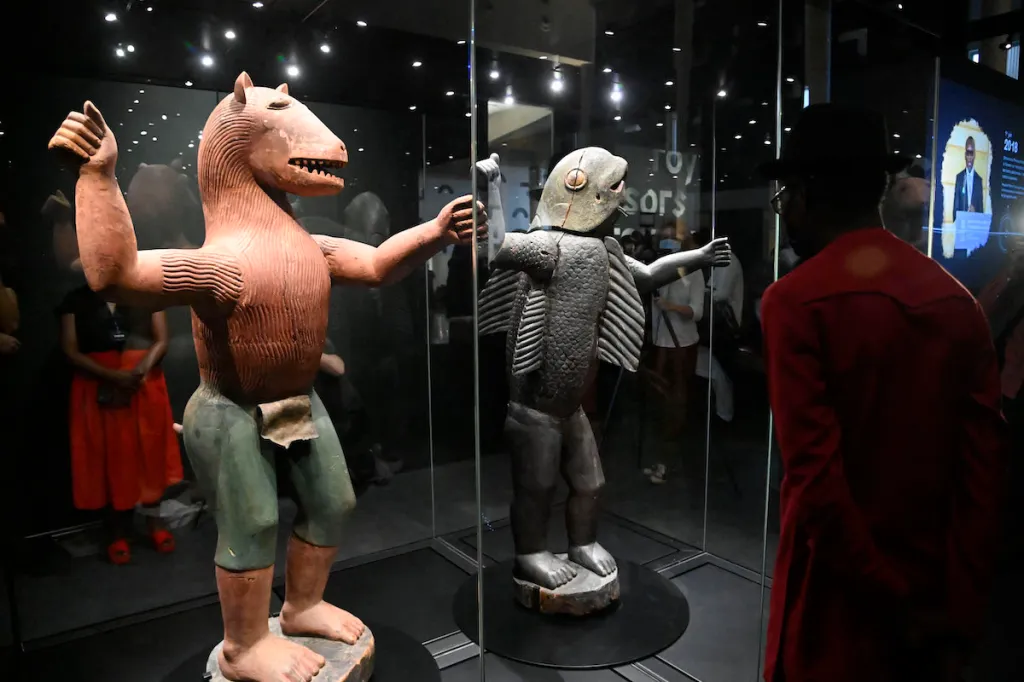
The Savoy-Sarr report has helped accelerate efforts to return some looted works, notably ones given back to Benin, Senegal, and the Ivory Coast. But in each case, those returns had to be made via separate laws. The cumbersome process inspired what is known as a trio of “framework” laws to facilitate restitutions. The first two framework laws, pertaining to Nazi-looted artworks and human remains, passed in 2023 without difficulty, but this third, far more contentious one, was delayed as debates raged about the implications of explicitly admitting, via the legislation, the harm caused by France’s colonial reign.
Yet even on the political left, leaders said the law was better off without delving into the colonial context. Instead, they advised sticking to the technicalities of whether an object was stolen and needed returning.
Per the proposed legislation, two committees will be given that forensic task, and based on their conclusions, decide whether to return an artwork formally requested by another country, pending government approval. The committees would include one with scientific experts plus representatives from the country making the request, and another including museum, government, and legislative personnel.
“I’m opposed to the mention of ‘colonialism’ in the law, because as a historian, I don’t think it’s up to parliament to write history and define what the official thinking should be on colonialism,” said left-leaning Senator Pierre Ouzoulias, who has been involved in drafting the law. Plus, he said, such a mention would restrict its scope.
Savoy agreed on that last point. “Anything that prevents the freedom of expression is a problem, but we saw in the debates that [the word ‘colonialism’] is used in reference to this law, so we can easily understand what it’s about,” she said. “I think the idea was not to shut out countries that were formally colonized, but to open up to them.”
“This law doesn’t solve everything, and it is far from perfect, but it opens up a stable framework, which will allow for real progress going forward,” she added.


