





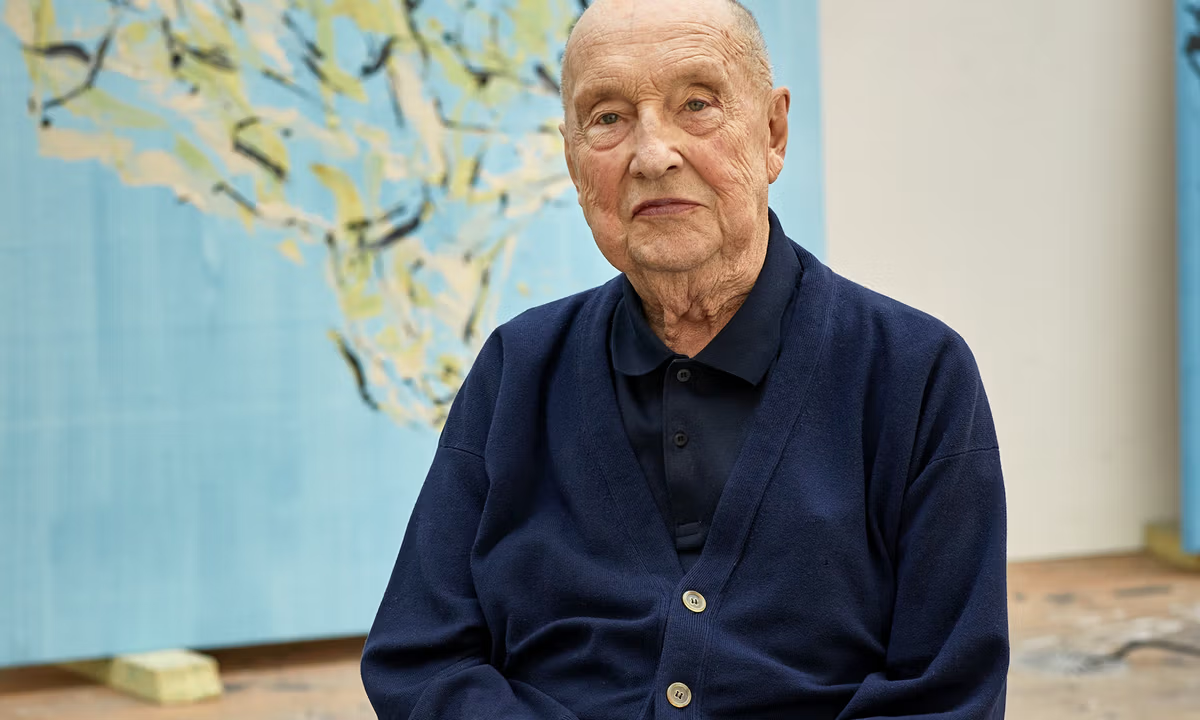
Georg Baselitz, who died today (30 April) at age 88, was one of the most consequential German painters of the post-war era—a figure of productive contradiction whose career spanned six decades of sustained formal invention and restless self-examination. Thaddaeus Ropac, the gallery that has represented Baselitz for many years, announced the news of his death but did specify a cause of death.
Born Hans-Georg Kern on 23 January 1938 in Deutschbaselitz, a village in Upper Lusatia, he grew up amid the ruins of the Third Reich. That formative immersion in literal as much as moral destruction would become the ground of everything he made. As he once said: “I was born into a destroyed order, a destroyed landscape, a destroyed people, a destroyed society.” He adopted the name Baselitz as a tribute to his Saxon birthplace.
His trajectory was shaped by a dogged refusal to bend to any kind of political or aesthetic expectations. Expelled from the East Berlin Academy for “sociopolitical immaturity”—a charge that, under the circumstances, amounted to a kind of honour—he crossed to West Berlin, where he encountered gestural abstraction (particularly during an especially formative experience seeing The New American Painting at the Hochschule für Bildende Künst in 1958) and the legacy of European Expressionism. He admired both but rejected each as insufficient.
Georg Baselitz, Die Grosse Nacht im Eimer (1962-63) © the artist. Photo by Jochen Littkemann, Berlin
“When I work, I always think about my past. My background was very ordinary and rural in a place far off the beaten track,” he told The Art Newspaper in a 2023 interview. “The kinds of statements on daily politics that we see a lot in contemporary art are not my thing.”
While other European artists looked to the stylistic fluctuations of the United States, to the intellectual detachment of Conceptualism or the maximalist Americana of Pop, Baselitz reasserted the centrality of the figure, painting mythic, often grotesque presences in sparse and violently worked fields. His first solo exhibition in 1963 was closed by a public prosecutor, who seized two paintings on grounds of obscenity. It was the kind of institutional interference that serves, in retrospect, as the mark of an unflinching artist. A decisive formal breakthrough came in 1969, with his first inverted painting. Turning his subjects upside down, Baselitz severed the relationship between image and representation, as the upended canvas became the emblem of an entire career and proof that figuration could sustain itself on purely painterly terms, without the crutch of narrative or representation.

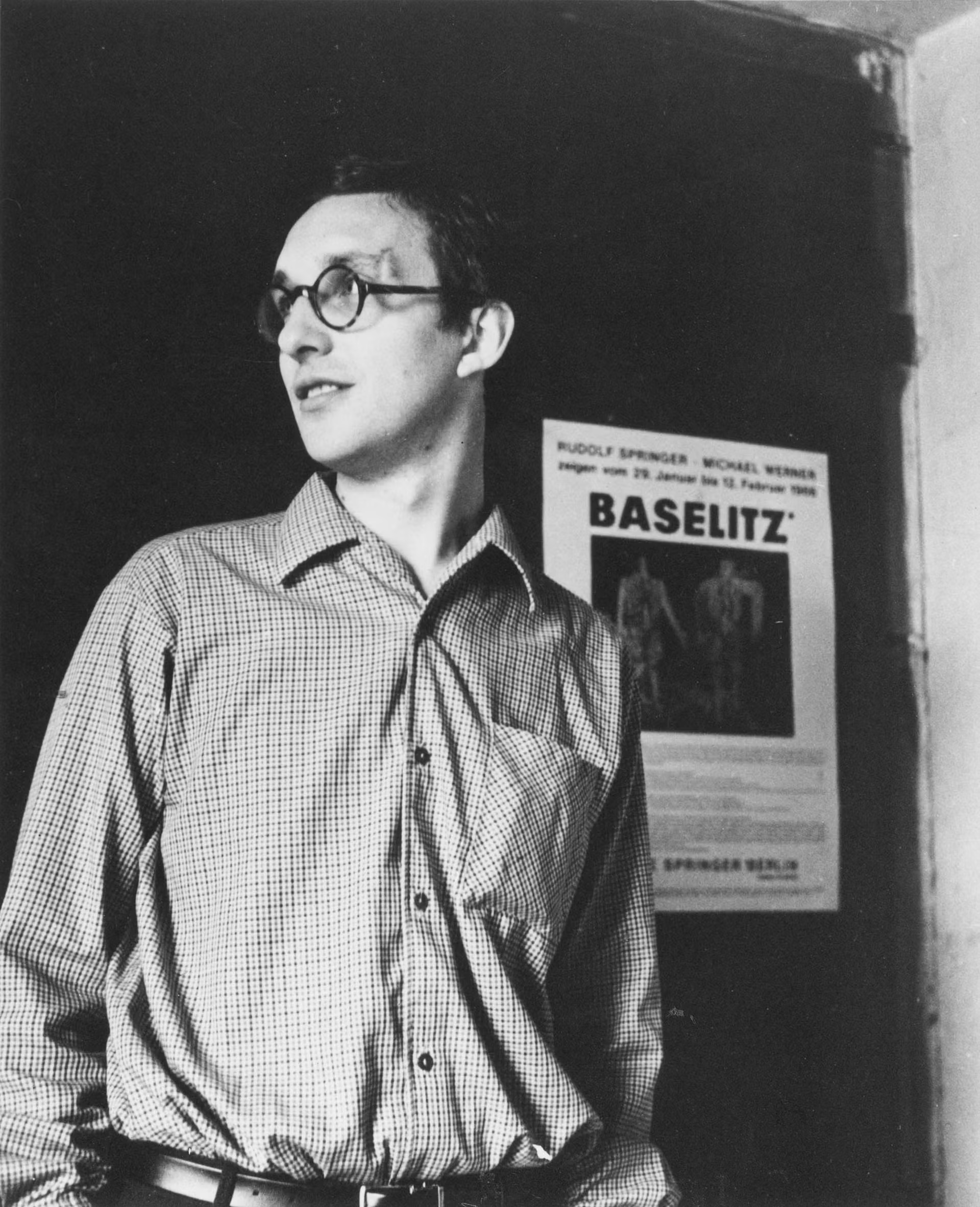
Georg Baselitz in 1966 Photo: Elke Baselitz
His example animated the Neo-Expressionist generation of the 1980s and his influence on German artists attempting to work through the heavy burdens of national history remains incalculable. He went on to make what he called “primitive and brutal” carved sculptures: larger-than-life-size figures gouged and hacked from single tree trunks, preferring the axe and chainsaw over the chisel. But the final chapter of his career was, by any measure, the most astonishing.
Writing in an obituary commissioned by Thaddaeus Ropac, the poet and scholar Robert Isaf observes that Baselitz’s later series, from the 2014 Avignon paintings onward, allowed the artist’s vision to reach its full potential and “the earlier years look in hindsight like a long exploration, a master at work producing studies, preparing for a later, greater masterpiece”. At the centre of that masterpiece stood the artist Elke Kretzschmar, whom Baselitz married in 1962 and continued to paint to the very end.

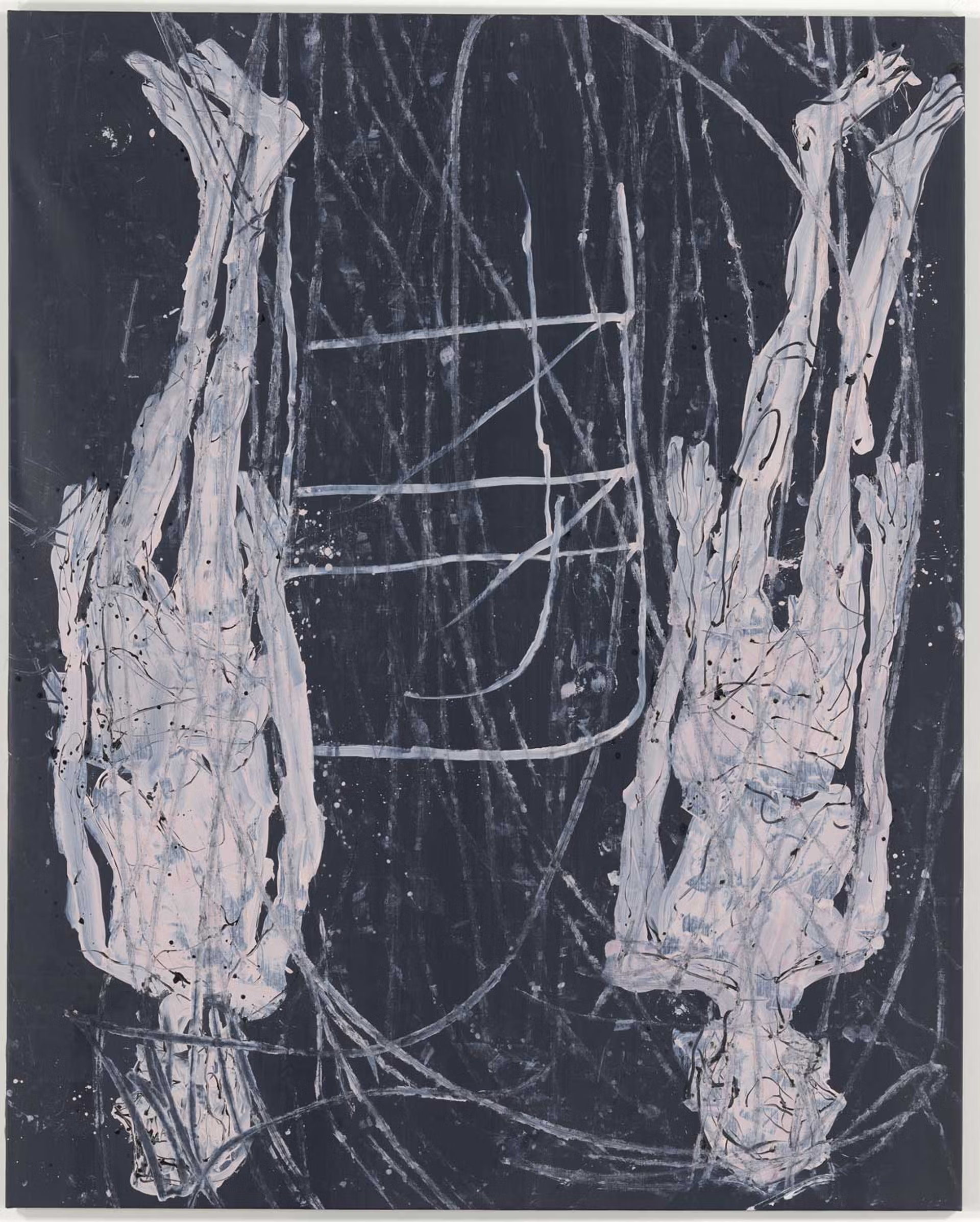
Georg Baselitz’s Indigene Kunst von damals (indigenous art from that time) (2025) © the artist. Photo by Jochen Littkemann; courtesy Thaddaeus Ropac
“I try to work every day, for a very limited amount of time. My physical condition is not the best. I use various aids such as walkers, carts, walking canes, chairs, extended brushes, extended palette knives and quicker decisions,” he told The Art Newspaper in 2023. “All my work and my sculptures generally have a biographical or autobiographical background. Nothing I have made so far is conceivable without my background.”
In recent years, Baselitz’s work had been the subject of large-scale institutional exhibitions at the Kunsthistorisches Museum in Vienna (in 2023) and the Centre Pompidou in Paris (in 2021-22), among others. An exhibition devoted to Eroi d’Oro, his final series—monumental self-portraits and portraits of Elke suspended against grounds of luminous gold, their spectral lines recalling medieval icon painting and Japanese calligraphy in equal measure—will open at the Fondazione Giorgio Cini on the island of San Giorgio Maggiore on 6 May, in conjunction with the 61st Venice Biennale, and will remain on view until 27 September. He is survived by Elke, and by his two sons, Daniel and Anton.


