





If great collectors are distinguished by their ability to shape our understanding of art history, then George Costakis (1913-90) must surely rank among one of the greatest. Born in Moscow to Greek parents, he spent three decades hunting down, and saving, thousands of Russian and Soviet avant-garde works of art—at a time when they were hidden, vilified by the state and at risk of disappearing into history.
Costakis left some of his collection to the Tretyakov Gallery when he left the Soviet Union in 1977 but took a sizeable chunk to Greece. His collection was first exhibited there in 1995 at the National Gallery in Athens. Now, 30 years later, another show is opening at the same institution, reinterpreting the works through the theme of humans and their relationship to the environment.
Many of the artists included in the exhibition were caught up in the sense of immense creative possibility brought about by the Russian Revolution in 1917, which saw the overthrow of the Russian monarchy and the beginning of a new Soviet era. The show will reveal how these artists pushed at the boundaries between art and life: how, for example, Gustav Klucis and Liubov Popova began to imagine the machines and textiles of the Soviet future, and Kazimir Malevich promoted a type of painting that he thought could help people reach a higher realm of consciousness.
Gustav Klucis, Radio Orator. Agit stand with screen and speaker’s platform, (1922)
Today most of these artists are well known in the West, but they may not have been were it not for Costakis. He was working at the Canadian embassy in Russia, ferrying foreign diplomats to antique shops, when, legend has it, he first saw Olga Rozanova’s Green Stripe (1917), and “immediately realised that this was something different, something valuable, something new,” says Syrago Tsiara, the National Gallery’s director and the exhibition’s co-curator. A Rozanova work became his first avant-garde acquisition in 1946.
Selling everything for art
From that point “he became like crazy,” says Costakis’s daughter, Aliki Costaki. “He started to sell all of his silver, carpets, everything, and little by little search for avant-garde paintings”. His journey took him to the homes of Kliment Redko’s widow and Popova’s brother, who each sold him several works.
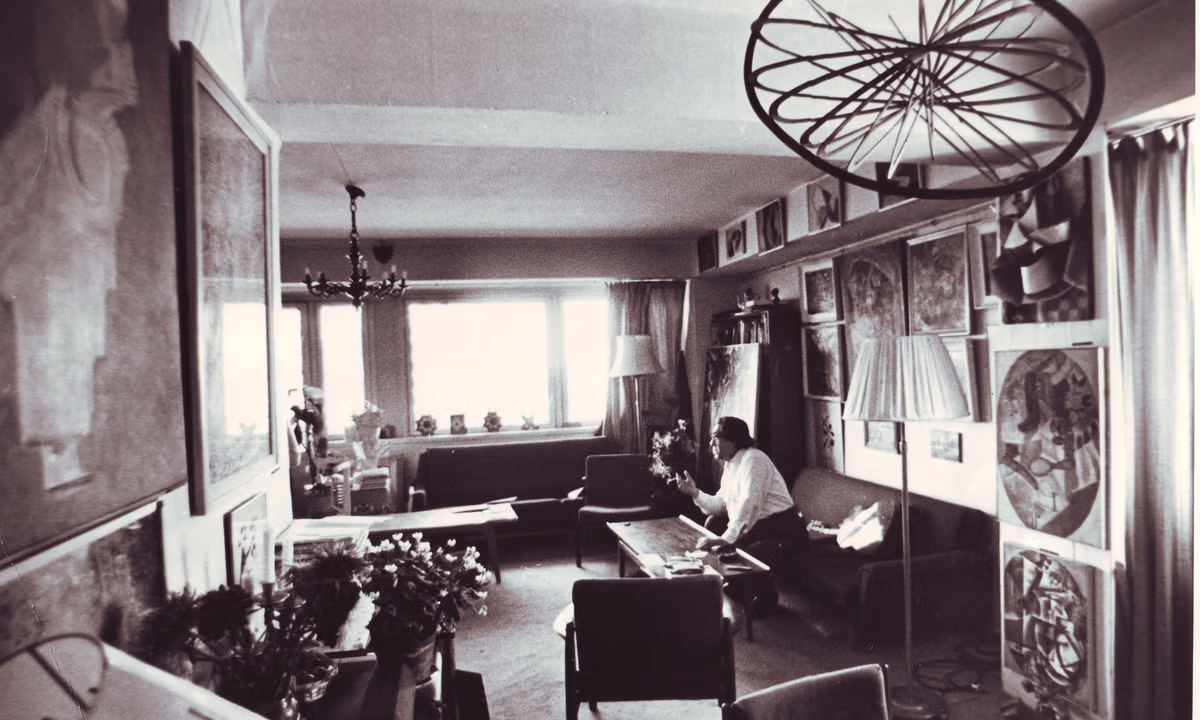
Aliki and her mother, Zinaida, assisted Costakis with his mission. Aliki recalls being bought a fur coat by her parents. “[Then Costakis said] I need money now. And so, I said, okay, we’ll sell it.” A car was at one point exchanged for some Popovas. Costakis’s large apartment in southwest Moscow became “an open museum, 20 hours [a day],” Aliki says.
Costakis faced many obstacles. From the late 1920s, freedom of expression began to be repressed by the Soviet authorities, and this had intensified significantly by the time Costakis began collecting. Strict rules were put in place about what kind of art could be made under the regime, and “some people were afraid of what they had,” Aliki says. Yet, as his collection garnered attention abroad, Costakis was burgled several times and a dacha in which he stored works was set ablaze.
Costakis left many of his best works in Russia, Aliki says. She adds that she stays in touch with the Tretyakov over its handling of the works. In 2013, Aliki also left a donation from the Costakis collection of more than 600 works by the nonconformist artist Anatoly Zverev to the private AZ Museum in Moscow.
Tsiara notes the exhibition is taking place in “a strongly nationalistic world, a strongly divided world”, in which Ukraine and Russia are at war. This, she says, makes it even more important to note the nationalities of each artist who took part in the so-called “Russian” avant-garde: from the Latvian Klutcis to Malevich, who was born in Ukraine to Polish parents.
The show is also an opportunity to acknowledge how the collection shaped the museum sector in Greece, becoming the core of the Museum of Modern Art in Thessaloniki, which has collaborated on the show. Most of all, it is a testament to a man who saved a sliver of art history for us all. “Costakis said once that we will need these artworks,” Tsiari adds. “I agree with him 100%—we need them.”
• The Avant-Garde World: City, Nature, Universe, Human, National Gallery-Alexandros Soutsos Museum, Athens, 15 April-27 September


