
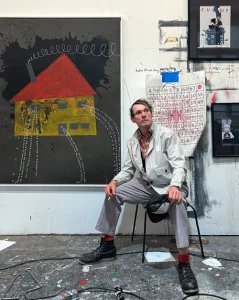






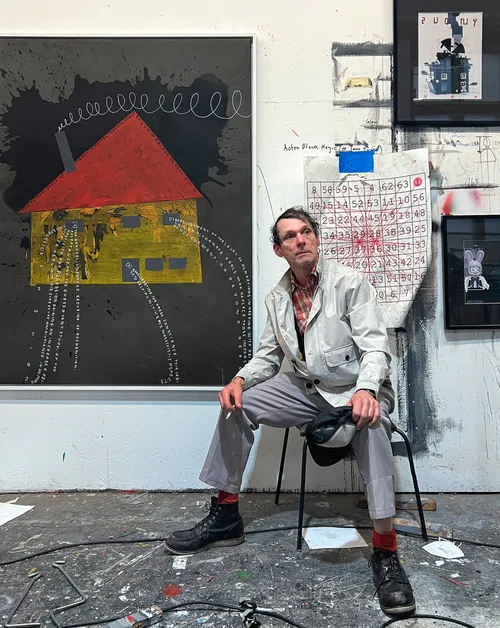
German artist Thomas Zipp, known for his uncanny artworks that explored history with a punk attitude, has died at 60. Berlin-based Galerie Barbara Thumm, who represented the artist, confirmed his passing on Instagram on April 4th. “It is with a heavy heart and great sadness that we say goodbye to Thomas Zipp, who left us far too soon yesterday,” the post read.
Zipp is perhaps best known for his massive, theatrical installations, often focused on the dark side of humanity. These scenographic artworks blur the line between stage set and psychological landscape, unfolding as immersive environments that channel themes of control, violence, and historical memory. Dadaism also informed Zipp’s work, which drew on absurdity, fragmentation, and anti-authoritarian gestures to destabilize meaning.
The artist was born in West Germany in 1966 and studied at the Städelschule in Frankfurt. He worked closely with German artist Thomas Bayrle, an influential figure known for his engagement with mass culture and systems of repetition. Zipp furthered his studies at the Slade School in London, from 1992 to 1998, and expanded his approach with drawing and installation.
Zipp’s paintings feature careworn palettes: his dark greens, burnt umbers, ash whites, and other austere tones feel weathered and deliberate. Grids frequently surface in the background, structuring the composition and emerging from his criticism of sociopolitical systems of control. Beneath this formal restraint, the work reads as pointed political and social commentary; the nuclear bomb was among the artist’s most consistent motifs.
Much of Zipp’s work also engaged directly with historical figures. Perhaps most of all, the artist grappled with the legacy of Otto Hahn, the scientist known as the “father of nuclear chemistry.” During a 2005 solo show at Madrid’s Galería Heinrich Ehrhardt, Zipp presented a series of sculptures, pictures, and collages related to the German physicist and future armageddon. This interest persisted and extended to the artist’s sculptures and installations, as in a 2006 solo exhibition at London’s Alison Jacques Gallery, where Zipp hung a large black balloon, evocative of a mushroom cloud, from the ceiling.
Zipp’s Comparative Investigation about the Disposition of the Width of a Circle (2013) was among the most talked about works at the 2013 Venice Biennale. This installation resembled a historical sanatorium, complete with clinical beds and washrooms. The artist embodied both the doctor and the patient, exploring themes of control and critiquing medical practices.
As a professor at the Universität der Künste Berlin, Zipp taught and made art until his death. Recent solo exhibitions include “Profondeville” at Galerie Barbara Thumm in 2025, “Society of the Spectacle” at Vienna’s Galerie Krinzinger in 2024, and “Response to Transient and Steady State Flickering Stimuli” at Berlin’s Galerie Guido W. Baudach in 2021.


