







Gloria Steinem, the feminist activist who furthered the modern women’s movement, died at 92 years old, as confirmed in an Instagram post.
“She spent her recent years doing the two things she loved most: being in community with others and writing. She has welcomed hundreds of guests into her living room for Talking Circles, a tradition she insisted will continue long after she is no longer with us,” the post explained.
“As Gloria wrote in her forthcoming book, An Unexpected Life, ‘I have now lived for more than fifty years in this brownstone, in rooms that have witnessed lives before mine, and will know others after I am gone.’ This book, along with her commitment to her home becoming a center for social justice movements, are among the many gifts Gloria has given the world with the hope they have ripple effects for generations to come,” the post continued, without sharing a cause of death.
Steinem’s influence touched many points, particularly art, photography, and popular culture. She was portrayed by the likes of Kristie Alley in the 1985 film A Bunny’s Tale, inspired by one of her articles in which she posed as a Playboy Bunny to expose the realities of working as a waitress at Hugh Hefner’s New York Playboy Club, as well as Ryan Kiera Armstrong, Lulu Wilson, Alicia Vikander, and Julianne Moore in the 2020 biopic The Glorias. That same year, she was also portrayed by Rose Byrne in the FX miniseries Mrs. America.
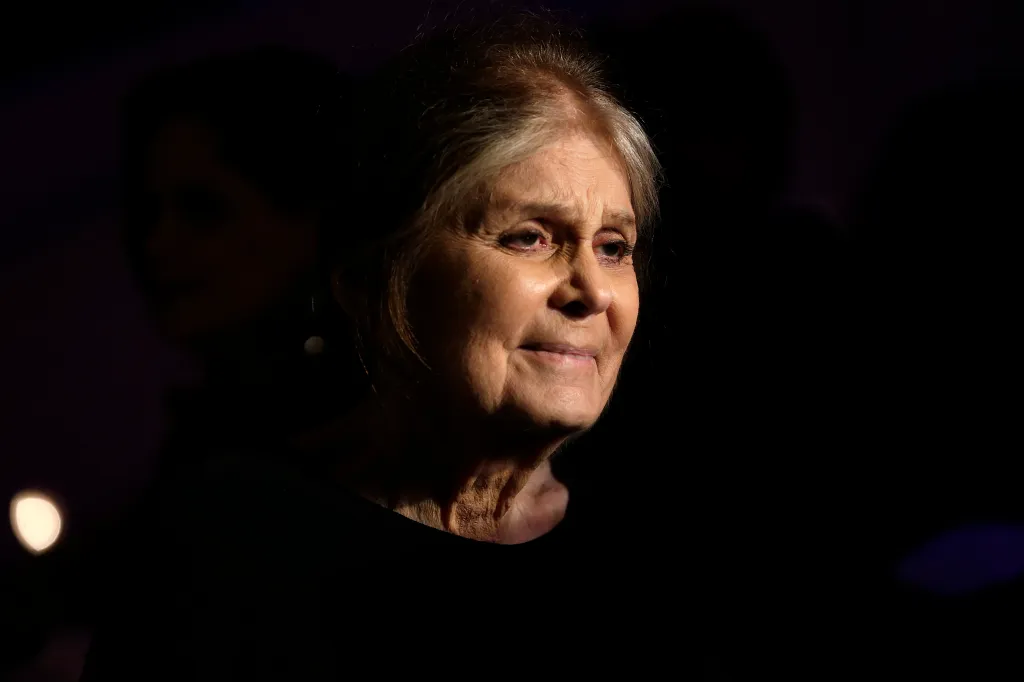
Gloria Steinem with photographer Annie Leibovitz attend Annie Leibovitz’s “Women: New Portraits” Exhibition Opens In New York on November 15, 2016 at the former Bayview Correctional Facility in New York City. The exhibition was commissioned by UBS.
Getty Images
In addition to her onscreen portrayals, the American activist befriended many artists in her lifetime, most notably Barbara Nessim, with whom she lived for six years. The pair met through Henry Wolf, an art director at Esquire, who was dating Nessim at the time, while Steinem was dating Wolf’s assistant at the magazine, Robert Benton. In a 2016 interview with i-D Magazine, the two women sat down together to reminisce about their friendship. Steinem said that she learned from Nessim “how to look at form rather than function. She’s so visual.”
Steinem was also a friend and mentor to the fashion photographer Annie Leibovitz. She wrote the introduction text for Leibovitz’s 2016 exhibition “Women: New Portraits” at the Bayview Correctional Facility in New York.
In her later years, Steinem shied away from public life, but if there was one person who would bring her out, it was artist Judy Chicago. Ann Philbin, former director of the Hammer Museum, told The Art Newspaper that she invited Steinem many times to attend the Hammer gala, but was rejected until she was asked to introduce Chicago, who was honored at the museum gala in 2019. “You can pretty much divide the art world, and certainly I can divide my life, into before and after Judy Chicago,” said Steinem of the artist. “We love you, we honor you. There’s no one on earth I’d rather be introducing than Judy Chicago.”
In 2023, Marilyn Minter painted women that she admired in her solo exhibition at the LGDR gallery on East 89th Street in New York. Her subjects included Gloria Steinem, Monica Lewinsky, and Lady Gaga. In a 2022 interview with ARTnews, following the overturn of Roe v. Wade, the artist said “Do not give up hope. As Gloria Steinem – a self-proclaimed hopeaholic – regularly reminds us, it’s vital that, despite it all, we act on our hopes every day.”
Steinem’s 1983 bestseller Outrageous Acts and Everyday Rebellions inspired the Brooklyn Museum’s exhibition “Everyday Rebellions: Collection Conversations,” which ran from October 10, 2025 to July 5, 2026. The show, according to the museum’s website, “revealed how contemporary artists infuse daily life with mindful gestures of creative defiance […] Much like Steinem’s essays, Everyday Rebellions celebrates how individual choices can disrupt familiar narratives and reimagine resistance.”
Despite her numerous successes, however, not everyone was welcoming of Steinem and her women’s movement messaging. According to The Guardian, in the 1970s, Steinem visited Georgia O’Keeffe’s home in New Mexico, where she quickly found herself turned away at the door. While Steinem greatly admired O’Keeffe’s paintings, O’Keeffe fiercely resisted being labeled a “woman artist” and hated the idea that her gender defined her work.


