He was a self-proclaimed atheist, who eschewed his native Spain in his lifetime for political reasons. But this week Pablo Picasso was remembered under a gilded 16th-century altar in a city two hours’ drive north of Madrid, in the presence of a host of Catholic clerics, at the opening of an exhibition that seeks to explore the religious heritage, iconography and ideas that underpin some of his best-known works.
Picasso: Biblical Roots, on display from 3 March to 29 June, brings together 44 works, is the first-ever show of the artist’s work in a cathedral, and it takes place in Burgos, a medieval city he visited on his last trip to Spain in 1934. He was accompanied by his first wife Olga and teenage son Paulo, whose own son Bernard Ruiz-Picasso was present at the opening.
Despite Picasso’s decision to sever himself from his Catholic upbringing, his work is steeped in memories of the church in which he was raised. The exhibition’s curator Paloma Alarcò says that Picasso was “an atheist who…was very pious”. He had his son baptised and he “always had spirituality”, distinct from “dogma”, she says.
Pablo Picasso, Maternity (1921)
Fundación Almine y Bernard Ruiz-Picasso, Madrid © FABA
Photo: Hugard & Vanoverschelde
Some of Picasso’s earliest works are on show, including The Altar Boy (1896), in which a red and white robed youngster is lighting a candle. As a teenager, Picasso studied in the atelier of the devotional painter José Garnelo Alda. Though he would soon leave his conventional Catholicism behind, he continued to create work with an ecclesiastical flavour, such as The Family (1920), a large-scale charcoal drawing of a family leaving church on Christmas Day. Other works show the clear influence of religious iconography, such as his portrait of his wife and baby son Maternity (1921), which resembles a traditional Virgin and Child.
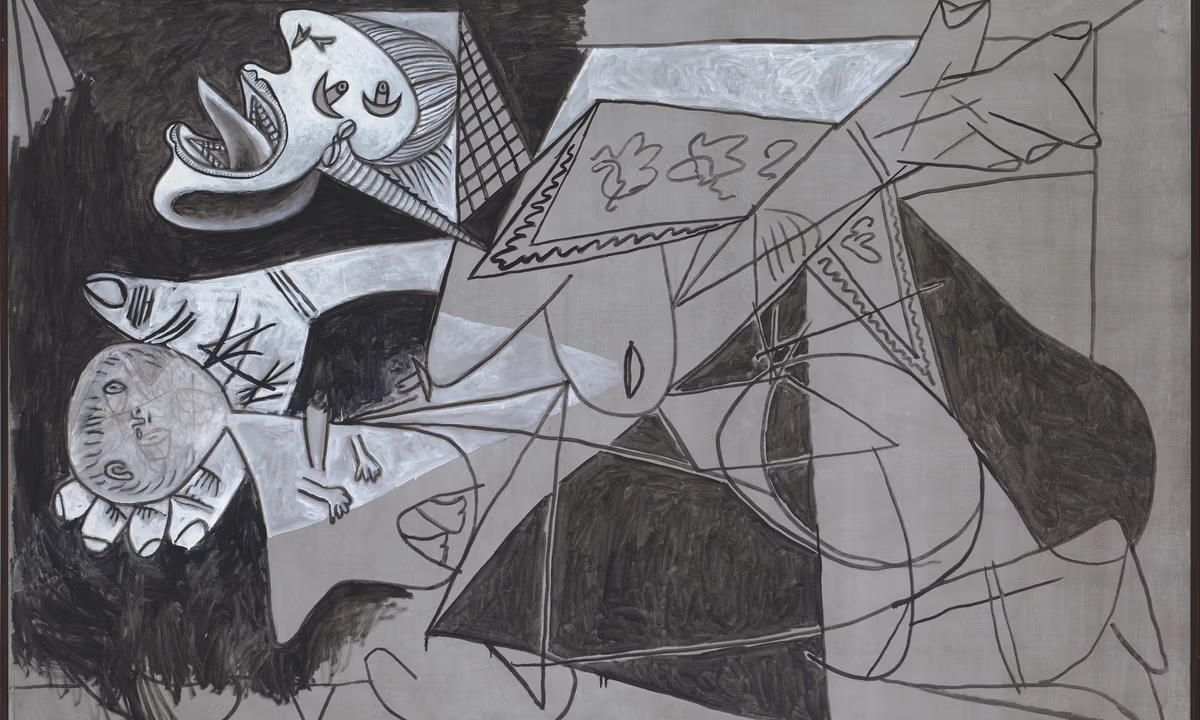
But it’s during the build-up to the Second World War that the show makes its strongest case, with the inclusion of works such as The Crucifixion (1932), inspired by a Renaissance altarpiece as a means of portraying the threats surrounding the world at the time, his Pieta-like Mother with Dead Child (II); Postscript to Guernica (1937), and his many dove drawings that allude to the biblical story of Noah, and reference hope and new beginnings.
During the Nazi occupation of Paris, Picasso created a series of drawings of a man carrying a lamb, reminiscent of Christ as the Good Shepherd, and returned to the theme with a metal sculpture The Man with a Lamb (1961). According to the Vatican head of culture, José Tolentino de Mendonça, who was present at the exhibition launch along with Queen Emerita Sofia of Spain, for Picasso “the Bible was not merely a source of quotations, but a profound structure of his sensibility”. His masterwork Guernica, which “reveals the human condition without any veil…[was] in this sense perhaps the greatest religious painting of our time”, says Mendonća.
Bernard Ruiz-Picasso says it is important to remember that, however a life unfolds, something of the past always remains: “There’s a lot to be said about my grandfather and the church, but Spain was his homeland and [this show] blends with all his love and willingness for peace.”