


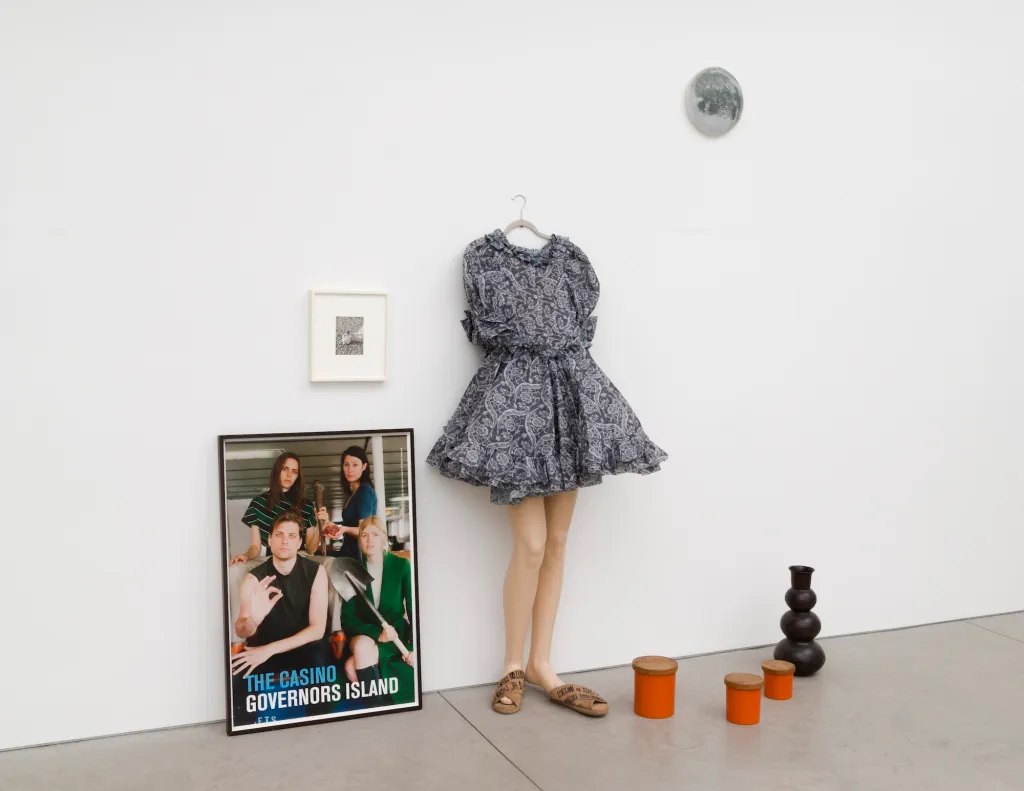
To spend a few minutes with the staff at the New York location of Matthew Brown Gallery these days, talking about how the current show, Darren Bader’s “Youth,” came together, is to be regaled with tales that sound too unlikely to be true. That’s the way it often goes with the New York conceptual artist, whose works explore truly absurd territory. They may seem like jokes, but at least to me, they often open up the mind to a sense of wonder that leaves them resonating far beyond the initial gag.
“I was talking to a friend who came by,” director Jack Eisenberg told me during a recent call. “‘You’re really fired up about this,’ he said. ‘Are you this fired up about every show?’” Brown and Eisenberg have long been excited about Bader, who has previously shown with esteemed dealers Blum & Poe (Los Angeles, New York and Tokyo), Andrew Kreps (New York), Sadie Coles (London), and Franco Noero (Turin); it’s his first show with Brown, so the enthusiasm is merited.
The fabrication of the simplest pieces created surprising challenges. For example, one group of Bader works consists of an “A on B” format; an example in this show has a mound of fruit spread, placed on a 1986 Stephen King horror novel centered on a villain that goes by a simple pronoun: jam on It. Those three words, of course, make up the title of a 1984 hip-hop hit by Brooklyn troupe Newcleus. It turns out that even in New York, jam is a hard food to find, said Eisenberg. (Nota bene: Bader does not assign dates to his works.)
Darren Bader, detail from 9 plinths (no date).
Brian Boucher
The artist has for years reliably served up amusing conceptual pieces, sometimes also involving edible items, like Chicken Burrito Beef Burrito, which consisted of the two named foodstuffs in an art gallery. Seems like a joke, right? But when the Calder Foundation awarded him a prize in 2013 and asked how his work extends Alexander Calder’s legacy, he replied, “In questioning what the limits/defiinition of sculpture could be.”
In an art world frequently dominated by discussions of price, he has often explored the concept of value, for example in a 2014 show with Kreps, in which some pieces consisted solely of exchanges of money. For $25,800, you could purchase the piece $15,031, consisting of the named amount. If that doesn’t seem like a bargain, well, you could also, for just $4,200, get $16,937. And in “Innate Value,” his last New York show, at Blum Gallery, the works were each assigned a value; if the piece was later re-sold for any amount other than the one agreed upon, it would be considered a forgery. Flippers, beware!
His work has also gotten even more meta, as in 2023, when, to mark two decades as an artist, he staged what might be deemed a simultaneous celebration and surrender, when he offered his artistic practice for sale, with an asking price in the low seven digits. If you bought it, you would get to be Darren Bader, artist, and he would have to take on a new profession. (He apparently didn’t get an offer at that level, so fortunately for us he is stuck being Darren Bader, artist.)
He’s appeared in notable exhibitions like the 2014 Whitney Biennial and the 2019 Venice Biennale, and been the subject of solo exhibitions at institutions including New York’s MoMA PS1, but he might be the first artist to downplay himself; his bio page at Andrew Kreps’s website calls him “an aging sculpture/literature brand working in AR, elision, found object, humor, permutation/chance, poem, rhetoric, and video.”

Darren Bader, socks (suite) (no date).
Charles Benton
Back to the Brown show, where three bins near the entry solicit donations of socks. (That clothing item seems to be of enduring interest to the artist; his email address includes the word hosiery.) Tied to the handle of one of the bins is an example printed with the face of a popular nineteenth-century mystery writer which has been injected with an in-demand neurotoxin for reducing facial wrinkles: Poe socks with Botox. Wrangling the injectable form of the medicine was difficult.
Darren Bader, socks (suite) (no date), detail.
Charles Benton
“It comes in a pulverized form and you can’t even see it,” Bader explained in a phone call, explaining that to create the injectable form, you have to suspend it in a diluant (the liquid in which something is diluted). “It is generally injected but you can’t have the solution sitting around, because it has an expiration date, whereas the powder has a longer shelf life,” he said. Eisenberg explained that the injectable form actually requires a prescription; to get it, the gallery called upon art-collecting Tribeca dermatologist Evan Rieder.
How much could the liquid even interact with the hosiery, I asked Bader? What physical matter do the Poe socks offer to inject the stuff in?
“It was just about doing it,” said Bader, not really answering but comparing it to a well-known earlier piece in which he injected an Italian food staple with narcotics: “It was like the notorious lasagna on heroin. I had to get it done. It had to be physically realized.”
When Bader showed at Los Angeles’s Felix Art Fair in 2020, it was under the made-up name of an exhibitor, Fomo Haber, supposedly of Athens, Greece, and all the artists were fictitious. Finley James/James Finley, for example, made artworks called “Ours” out of celebrity memorabilia like a goblet that once belonged to Ringo Starr. That was, Bader told me, the first time he introduced works that brought together curious items formerly owned by famous people.
Darren Bader, CS26 (no date).
Charles Benton
The new show has a passel of them. Take, for example, one work that consists of the following, per the exhibition’s checklist: “Amy Winehouse’s weight machine; Shirley MacClaine’s [sic] shoe; Ray Bradbury’s posters; Richard Petty’s globe; Mae West’s hat; Christine McVie’s wall art; Pat Morita’s decor object.” You might think the artist is kidding; he is not. For example, Winehouse’s weight machine, a Vision Fitness ST-740 ab/lower back model, still bears a tag from Julien’s Auctions marked with its lot number, 584, from a sale of 837 items from her estate, as Eisenberg pointed out when I expressed some incredulity. Julien’s website indicates that lot 584 sold for just $320.
That’s funny in itself, since these machines retail for far more than that. Did Winehouse’s ownership of the machine somehow make it less valuable?
“Who knows?” said Bader. “The auction did well in general.” Indeed, the sale exceeded estimates to bring more than $4 million, with every item sold, led by a dress designed by the soul singer’s stylist, Naomi Parry, which Winehouse wore at her final performance, in 2011, before she died from alcohol poisoning. Estimated at $15,000, it fetched $243,200.
“These auctions are just ridiculous,” said Bader. Of Winehouse’s ab machine, he said, “No one wanted that gym equipment.”
As Bader brings these wayward objects together, Eisenberg explained, so the buyer has some liberty in deciding how to display them. The pieces come with a certificate of authenticity, he said, that stipulates that the objects should remain together as often as possible, although perhaps not all the time.
“Once someone acquires the work, they almost become part of it,” he said. “They’re welcome to participate in a way that for most artists, it’s not even fathomable for their work to exist in this way.”
The first item on the exhibition checklist is for a piece, everything you don’t need, that, for Eisenberg, provides a kind of conceptual key, though it has no physical form. Its dimensions are, as checklists often indicate for installation artworks, “variable.”
“So many objects in the show belonged to other people,” Eisenberg said. “The creation comes from other people saying, ‘I don’t really need these things.’” Leave it to Bader to challenge prospective collectors as to whether they really want to bring home other people’s junk, one day, perhaps, to be ejected, Marie Kondo style.
Darren Bader, CS25 (no date).
Charles Benton
Another piece in the Brown show consists of Sylvester Stallone’s chaise longue, Mary Tyler Moore’s drill round, Shelley Duvall’s hat, Elgin Baylor’s cufflinks, Ellen Burstyn’s book, Tom Petty’s cake knife, and Elvira’s quilt.
Don’t know what a drill round is? “Neither did I until I won that lot,” Bader said. A dummy artillery round, it’s used for training purposes. This item in particular is a U.S. Navy style MK6 drill round, which Bader got at a Doyle auction for $320 on a $400 high estimate. It’s not surprising that it might be the odd lot in a sale including antiquities, artworks, furniture, jewelry, handbags and the like. Made of wood and metal, it stands some 32 inches high.
“It was no easy task,” Bader recalled. “It was one of the few items I bid on. I went to pick it up a few months after the fact. There it was, unwrapped on the auction house floor. It was Rosh Hashanah and I walked by some synagogues on the way to pick it up, and I thought, ‘It is probably not wise to walk around with a drill round.’ I said, ‘Can you wrap this up? I don’t want to get arrested today.’
“So they wrapped it up, and then I had lunch with [collector/artist/journalist] Kenny Shachter,” said Bader. “There was Kenny at a fancy restaurant, and there I was with a drill round in a moving blanket.
“But,” he said, “that’s beside the point.”
Darren Bader’s “Youth” is on view at Matthew Brown Gallery through January 10.
