






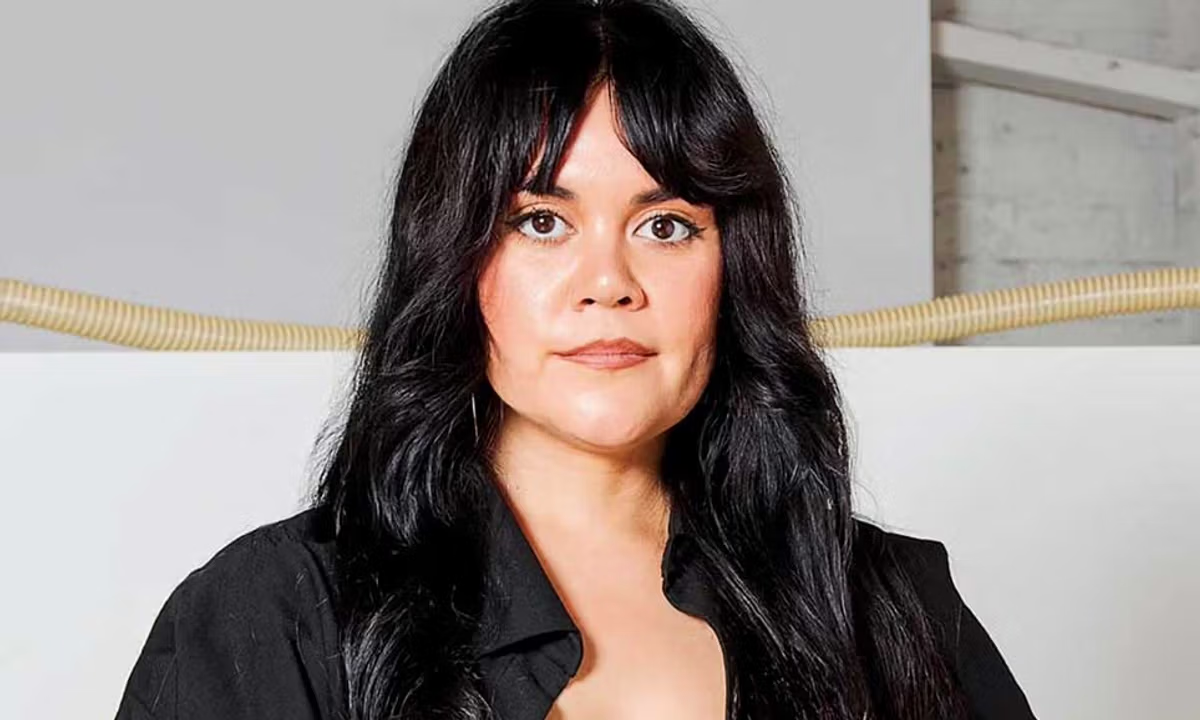
Growing up in north-east Los Angeles, Sarah Rosalena was deeply influenced by the knowledge and skills passed down by her family, from her grandfather’s work in astrophysics at LA’s Jet Propulsion Laboratory to the weaving traditions of her maternal Wixárika heritage, as well as master weavers across the Southwest.
I exist because of the diversity and culture of Los Angeles
These interests in science, technology and craft developed into her cutting-edge artistic practice of the last 20 years, and her tenure as an associate professor of computational craft and haptic media at the University of California, Santa Barbara. By elaborating new methods and breaking down the divisions between craft and technology, human and non-human, past and future, Rosalena’s work subverts the extractive, colonial systems of mapping, imaging and capture to envision new worlds and possible futures. Commissioned by LACMA to create a permanent work for the David Geffen Galleries, Rosalena produced a richly textured 27ft tapestry, her largest to date. Using her personal handweaving patterns, she distorted computer-generated satellite imagery of planetary terrains, transforming them into woven structures, to blur land and cosmos, earth and atmosphere. The result was woven on an industrial-scale jacquard-rapier loom.
The Art Newspaper: How is your practice of combining Indigenous craft techniques and emerging technologies informed by your background?
Sarah Rosalena: I see myself first and foremost as a weaver working at the intersection of craft and technology. As an Angeleno, I grew up learning how to weave in the Wixárika tradition of my matriarchal bloodline by watching my mother and my grandmother. That allowed me to see and understand patterns line by line through textile.
I was also always fascinated by cameras, media, capture and resolution—and understanding them from a weaving standpoint. It’s about challenging the hierarchies that isolate these [disciplines], whether that’s textile, Indigenous craft or technology, from one another.
Sarah Rosalena’s monumental textile piece Threading the Boundless: Omnidirectional Terrain (2025) © Sarah Rosalena; photo: © Museum Associates/LACMA/Jonathan Urban
My practice is what happens when all these things come together. And that’s where interesting things begin to emerge, such as alternative futures, opportunities for world-building, thinking about power, land and the cosmos, and how we see and understand ourselves.
How does this manifest in your commission for LACMA?
I always start all my work by handweaving it on the loom and designing my drafts from scratch. To play with how certain yarns hover or burrow under others, I combined different types of yarn, such as soft mohair, to invoke the atmospheric. I also use something more reddish and metallic that looks almost Martian or alien, and blues that are completely oceanic.
What was it like working at this scale?
This commission was one of the most challenging I’ve done to date, because of constantly having to sample and experiment to get the effect that I wanted in 27ft. There are over 12,000 warp threads and it was necessary to calculate how they were going to be interacting with one another and what would be revealed.
There are only a few looms in the world that are large enough, and which would also allow me to experiment, because looms at this scale are traditionally used for production and industry. I really enjoyed challenging the nature of the pattern, but this piece is also an accumulation of all the digital weaving patterns that I’ve generated over the years, so there’s a little bit of me throughout it.
How did you use Nasa’s satellite images?
This work is an imagined planetary landscape that uses altered satellite imagery of Mars and Earth as the groundwork for adding weaving patterns. I’m interested in breaking the binaries, barriers and boundaries that are expressed through tools such as mapping, cartography or extraction to generate an alternative viewpoint and a world that disrupts geospatial edges. Even though it is woven, the piece looks almost like it’s glitching out—there is a refusal of digital smoothing and an undoing of digital capture.
In thinking about the planetary imaginary, how does that idea push up against notions of Mars, and outer space more generally, as the next frontier to be colonised?
That’s what the resistance is for. Who gets to visualise these terrains? Who has access to them? I see this work as a site of resistance. Textile is the oldest technology on Earth that we all share, yet it has been so disregarded in thinking about imaging, even though it’s the origin of where all of these technologies come from. [With LACMA’s Art + Technology Lab grant in 2019] I made work combining machine-learning and textile, and began to confront the origins of the technology itself, because it is based on this colonial, structured framework that holds the power of vision, naming and knowing. Weaving is a way that I could pull it apart, retie it in a knot or redo it altogether. That’s because weaving uses the same binary language of zeros and ones. Textile is a powerful site in which to make hybrid works.
As a native Angeleno, what is the significance of working on a permanent installation for LACMA?
This work is 100% a love letter to Los Angeles. My grandfather worked for the Jet Propulsion Laboratory and, on the other side, my family worked predominantly as gardeners and migrant workers. I exist because of the diversity and culture of Los Angeles.


