








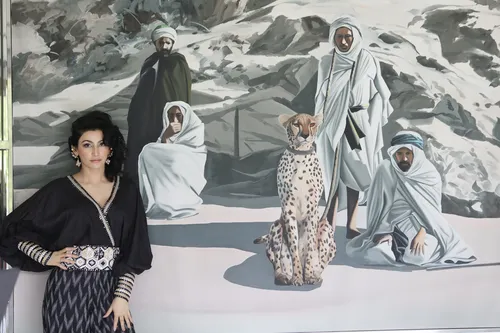
Passi’s stature in the Indian art world is reflected in the two platforms she established, the Shalini Passi Art Foundation and the digital platform MASH, as well as in her enduring support of initiatives such as Khoj Studios and the Kochi-Muziris Biennale. Long recognized within the Indian art ecosystem for her role as a collector and patron, she has more recently entered a wider public consciousness through Netflix’s Fabulous Lives of Bollywood Wives, which offered glimpses into her art-filled home among many other facets of her life, including her society doyenne-meets-surrealist wardrobe. The show introduced Passi at the MASH ball, a Met Gala–inspired charity ball in support of UNICEF, where one of her personas for the night was Cleopatra.
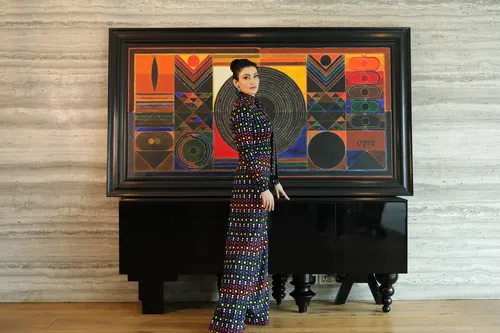
Passi’s South Delhi residence is both home and a living museum—she believes the artworks she acquires live and grow with her. In its cascading halls, she drifts down the staircase, often in vintage saris or Roberto Cavalli gowns, passing works by the likes of Anita Dube, Atul Dodiya, and Anish Kapoor. Here, contemporary art nestles comfortably alongside 17th- and 18th-century French and Italian furniture: a Baccarat Mille Nuits chandelier hovers above a Damien Hirst skull painting, a Hudson antique teak-root table rests on a circa-1900 Feraghan Mahal carpet, and a 19th-century Italian gilded mirror reflects S.H. Raza’s painting Germination (1995). A lacquered gilt chinoiserie chest coexists with Jeff Koons’ Puppy (Vases) (1998) and an Hervé van der Straeten “Passage” console. Across generations and geographies, what emerges is a collection that shows confidence in curiosity, built with thoughtfulness rather than a prescriptive vision.
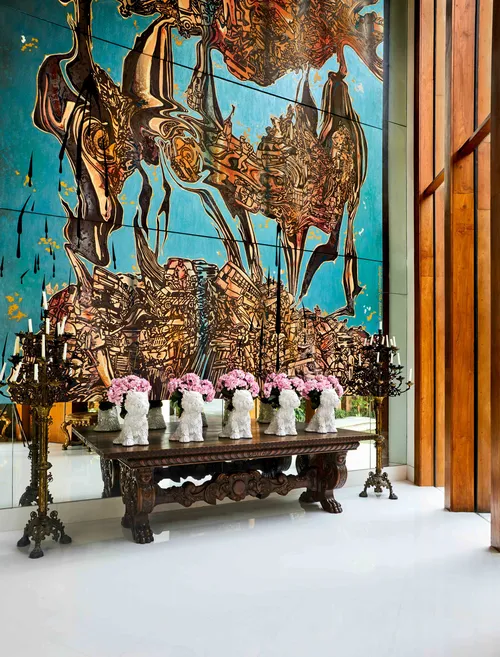


The interiors open onto a manicured lawn offering pristine sightlines across sculpture and landscape. Stepping outdoors, the building’s curvature holds the artworks from indoors within view, meeting the moving gaze from multiple angles.
While her collection spans Indian modernists such as M.F. Husain and contemporary artists Bharti Kher and Sheba Chhachhi, Passi traces her earliest relationship with art to spaces far removed from the gallery. “My earliest interactions with art were through temples, architecture, and the visual richness of Indian homes—not museums,” she said. “As a child, I was drawn to colors, textures, and sacred imagery. I learned to feel art before analyzing it. That instinctive relationship has stayed with me. Art has always felt alive rather than decorative.”
Passi recalls how early encounters with artworks lingered in her mind. When she started buying art, ownership felt less like acquisition than responsibility. “My first acquisition was emotional, not intellectual,” she shared. “I felt I was taking responsibility for a work, not purchasing an object. It felt like adopting a living presence into my home. That moment taught me that collecting is about custodianship, not ownership.”

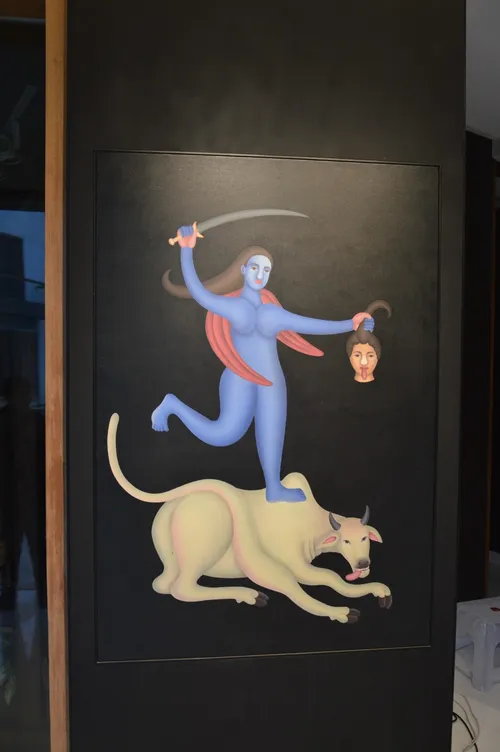
That work was Goddess Kali (1989) by Manjit Bawa, an Indian modern painter known for his fluid, descriptive figures and bold colors. “Manjit Bawa was a friend of my art teacher at Modern School,” she said. “That work ignited everything.”
Her collection retains the clarity of its initial visceral nature. “I have always said, ‘I collect with my heart first, and my mind follows later,’” she shared. Over time, her collection began to reveal its own internal logic. “Sculpture, the human body, nature, and spiritual energy became recurring themes,” she said. “My collection is a reflection of my inner journey rather than an academic framework. It grew as I grew.”
While her collection spans varied periods and practices, certain pieces remain touchstones. Living with sculptures, especially the hemp sculpture Kusum (1996) by Mrinalini Mukherjee, is an experience she describes as quintessentially human. “Living with her work is like living with a living being,” Passi said. “Her sculptures breathe—they change with light, with mood, and with time. They create silence and contemplation within the home. They make you pause. For me, they embody the idea that art is not separate from life—it is life.”

Patronage, as it operates in Passi’s world, is informed by those who understood collecting as a public responsibility. “I’m inspired by patrons who saw themselves as cultural guardians rather than luxury consumers,” she said, citing J.R.D. Tata, Peggy Guggenheim, and J. Paul Getty as influences. “True collecting is about stewardship, not trophies.”
Passi’s advice to aspiring art buyers is straightforward: “Begin with sincerity,” she said. “Spend time looking. Ask questions. Build relationships with artists and galleries. Do not collect out of fear or fashion.” Art, she insists, should hold a personal resonance above all. “Remember that you are not just acquiring objects—you are becoming part of a larger cultural conversation.”


