







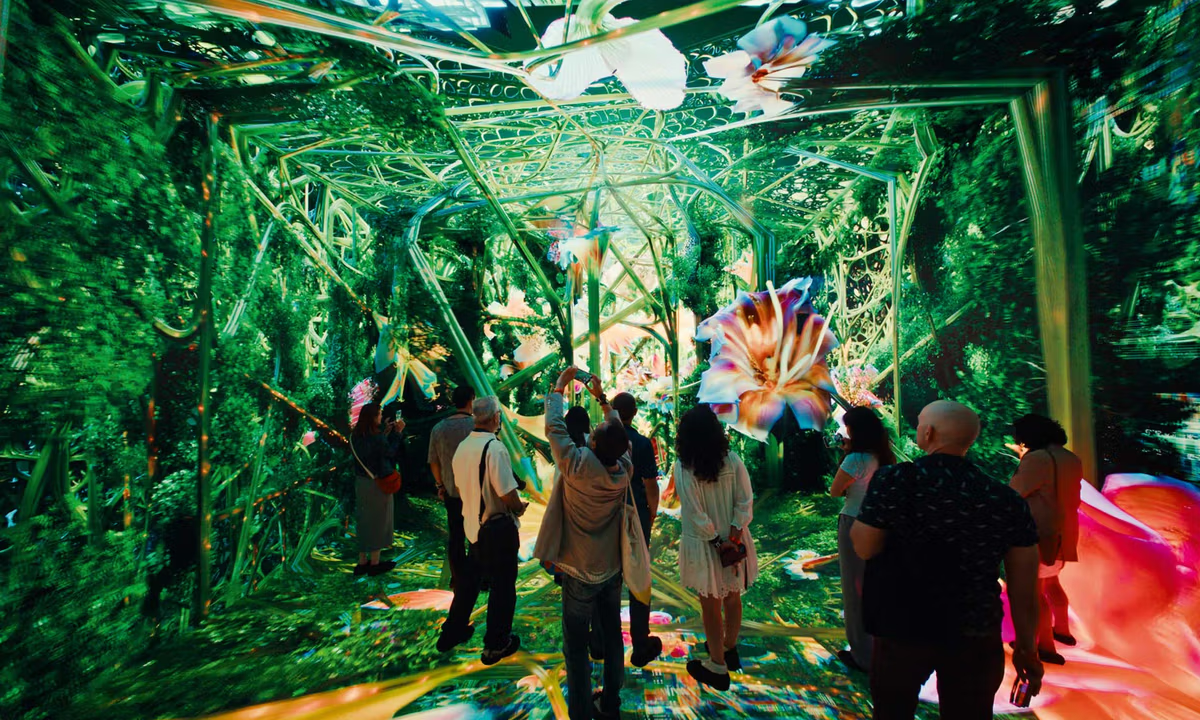
It is a sunny, warm California day outside, but stepping into Dataland, visitors are taken from the skyscraper-laced Grand Avenue in Downtown Los Angeles straight to the Amazon rainforests and beyond, in an immersive, imagined future where machines and the natural world come together. The artist Refik Anadol’s Dataland has taken over 25,000 sq. ft in the Frank Gehry-designed Grand LA development, located just across from the architect’s Walt Disney Concert Hall, onto which Anadol projected one of his early data pieces back in 2018. The Dataland experience is part science experiment, part deeply reverent art museum and part immersive theme park.
A lifelong movie fan, Anadol is a bit like Jurassic Park’s John Hammond (as played by Richard Attenborough), a mad scientist who is translating one of the most complicated questions of our time—how we can use AI for human connection and deeper understanding—into a visceral experience that both asks visitors to use their imaginations and grounds itself in actual data.
Anadol believes artists have a role to play in the conversations about AI, and Dataland is his contribution. “As an artist pioneering this field for ten years, I felt that we should have a kind of responsibility,” he says. “This is a laboratory of imagination. We have walls, but no limits in the ideation.”
The museum uses over half a billion pixels to create rooms that reflect the natural world (using datasets from collaborations with the Smithsonian Institution, Getty et al.) and our own bodies. A technology pack with a wristband tracks visitors’ heartbeats and physical reactions to the art and feeds them into the work itself. A ring goes around attendees’ necks, providing a rotating combination of 12 scents designed with the olfactory team at L’Oreal Luxe and triggered by the live biodata.
One of the inaugural exhibits at Dataland Photo: Refik Anadol Studio; © 2026 Refik Anadol Studio/Dataland
Going through the museum, Anadol makes sure that, as images evolve, scents change and music shifts, visitors catch every bit of the work that has gone into creating this Disneyland for art and tech. Anadol’s delight captures something that has been lost in many more traditional museums’ experiments with new technology—a sense of joy.
That is not the only thing setting Dataland apart from traditional museums. It is a for-profit enterprise, with tickets starting at $49. For Anadol, the effort and expense—for visitors and the museum itself—are part of turning the museum experience on its head. “For 5,000 years, we looked at artworks and we felt something, right? Now, my challenge question is: ‘Can the artwork feel us back?’”
His first attempt to answer that question is Machine Dreams: Rainforest, which was inspired by a visit to the Amazon, where Anadol met with Indigenous leaders in the Yawanawá community, which is largely cut off from modern technology. Of the inaugural experiences at Dataland, it is the most narratively driven and uses Anadol’s Large Nature Model to follow a story that came to him in a dream about a hummingbird in the forest, creating a throughline between data and the artist’s experience.
“This bird symbolises a focus and attention to nature,” Anadol says, but it “also reminds us of real data from the real world and a real memory of nature”. He adds: “The chief of the tribe allowed us to visualise this dream.”
A scent-sual experience
The Infinity Room gallery relies more heavily on visitors giving themselves over to the possibilities of technology and a suspension of disbelief about how pixels and binaries can become waves of images. It will also be more familiar to visitors who already know Anadol’s work, as it has appeared in some form in more than 35 cities since its inception in 2015.
As the introduction begins, a scent wafts up that is reminiscent of taking a hike first thing in the morning—at least, that is what this writer smelled; other visitors may have a different experience. Every few minutes, a scent shifts and someone in the gallery exclaims: “Do you smell that one?!”

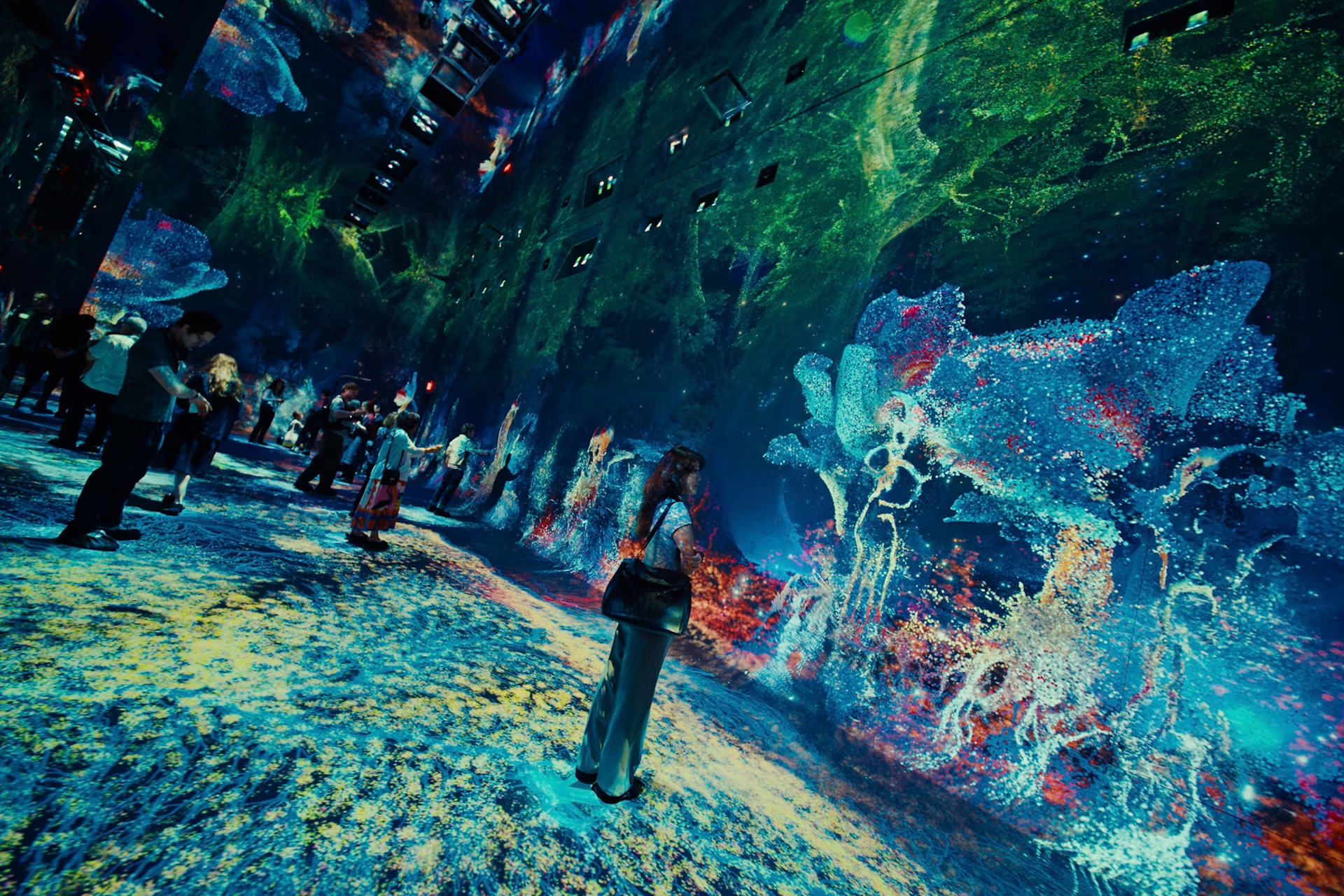
Visitors explored one of the interactive exhibits at Dataland in Los Angeles Photo: Refik Anadol Studio; © 2026 Refik Anadol Studio/Dataland
While the outputs generated from the AI inputs and each person’s experience will differ somewhat, the structure undergirding the experience is steeped in art history as well as Anadol’s influences in the Los Angeles art world and beyond. The first room is a large mirrored space with audiovisual elements that invite visitors to stay at least 30 minutes. Many of the AI-driven images intentionally echo the works of artists like Dan Flavin, Yayoi Kusama, James Turrell and others.
“I have huge respect for [Kusama and] the Light and Space movement. [They’re] all heroes,” Anadol says.
Anadol and his partner in the studio, in the museum and in life is the artist and producer Efsun Erkiliç. Erkiliç likens the storyline of the entire museum to a way of visualising the invisible. “The funny thing is, nature itself is magical,” she says. “Not in the sense of an enchanted forest, but the forest
itself is quite magical. We just want to show it—you can still have a childlike feeling.”
For all its data-backed customisation, more than anything, Dataland is a uniquely post-Covid approach to collective storytelling and communal experience. In a departure from experiences designed for social media like the Museum of Ice Cream (in several US cities, plus Singapore) or the countless immersive Van Gogh exhibits, Dataland encourages visitors to put their phones away and become truly immersed and engaged.
Anadol hopes to see people use the space in unique ways. “I see people in contemplation,” he says. “I see people in flow states. I see people vibecoding. I see people sketching the world.”
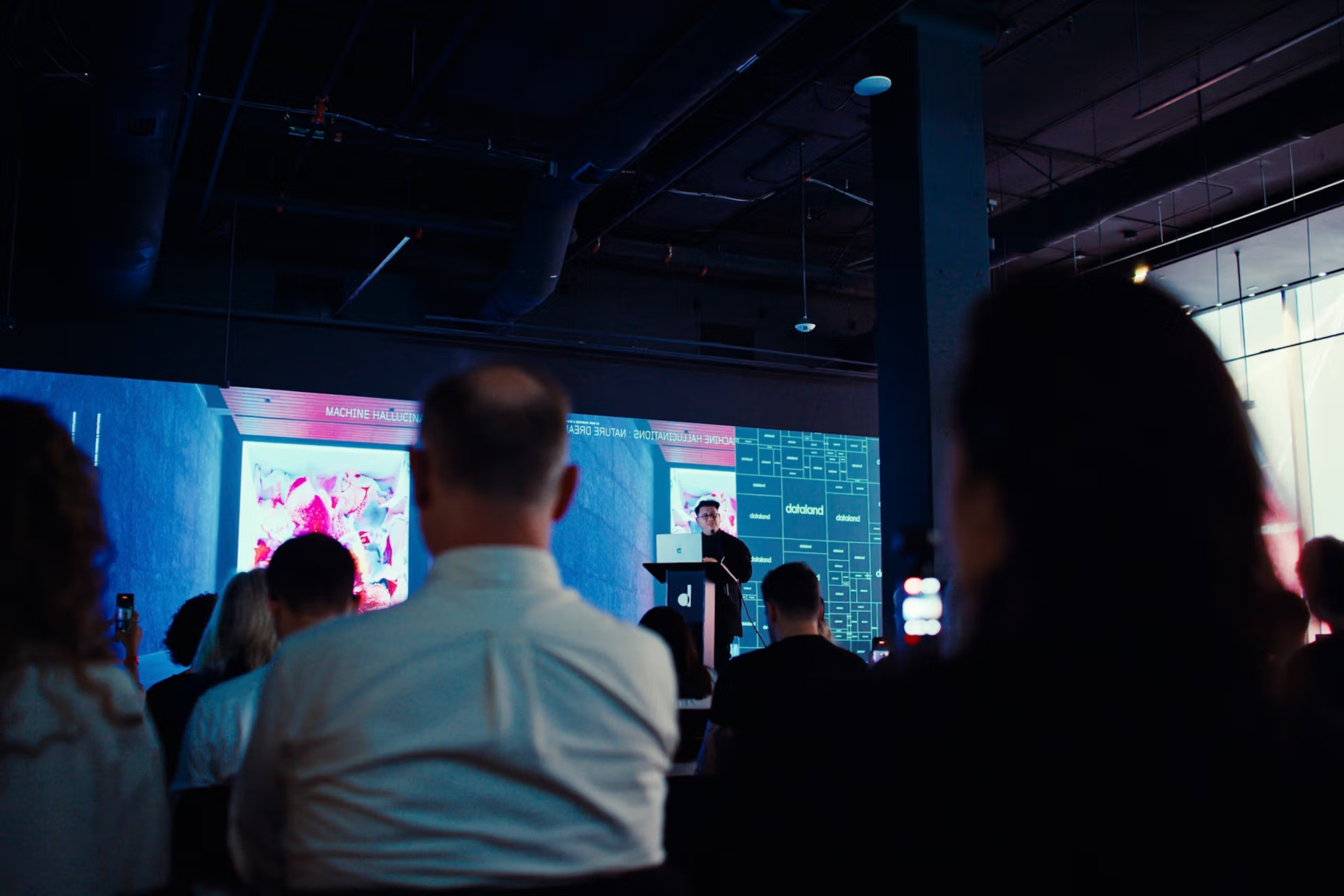
Refik Anadol speaks during a preview event at Dataland in Los Angeles Photo: Refik Anadol Studio; © 2026 Refik Anadol Studio/Dataland
While the museum does not lend itself easily to traditional shows of works from other artists, Anadol and Erkiliç’s studio is launching a partnership with Google Art & Culture to open up access to their AI models and create new work that could be shown at Dataland. They are working with the Los Angeles Philharmonic for much of the featured music and hope to bring in more innovators from the worlds of film and music to create projects for the space, particularly in the Sanctuary area that aggregates the data visitors share to build a unique data sculpture in real time. It is easy to imagine artists like David Byrne, Björk, Ryoji Ikeda and others who blend music, images and technology in their work having a field day here.
The leading edge of a new wave
Melissa Yunk, a spokesperson for the Los Angeles Tourism and Convention Board, sees Dataland as the leading edge of a wave of new institutions and experiences focused on technology and storytelling that are opening in the city in the coming months. “Dataland is the epicentre of this larger shift in the museum experience that we’re seeing with the [opening in September of the] Lucas Museum of Narrative Art,” she says, also citing a new immersive experience at the Holocaust Museum LA and the expansion of the Meow Wolf interactive experience franchise to the city.
The opening of Dataland on 20 June, along with the coming expansion of The Broad, is key to the revitalisation of Grand Avenue, Yunk says. “It is further establishing downtown as an arts and culture hub, which is how it began,” she says. “It used to be the centre of film and art in the city and it’s had many different lives since then.”
This vision, Anadol says, is what his mentor, Gehry, who died last December, would have wanted if he had lived to see the museum and this stretch of Grand Avenue come fully to fruition. “He’s one of the most important architects for human history,” Anadol says. “He left these concrete shells for dreamers. And I think we are following this.”
- Dataland, Los Angeles, opens to the public on 20 June


