






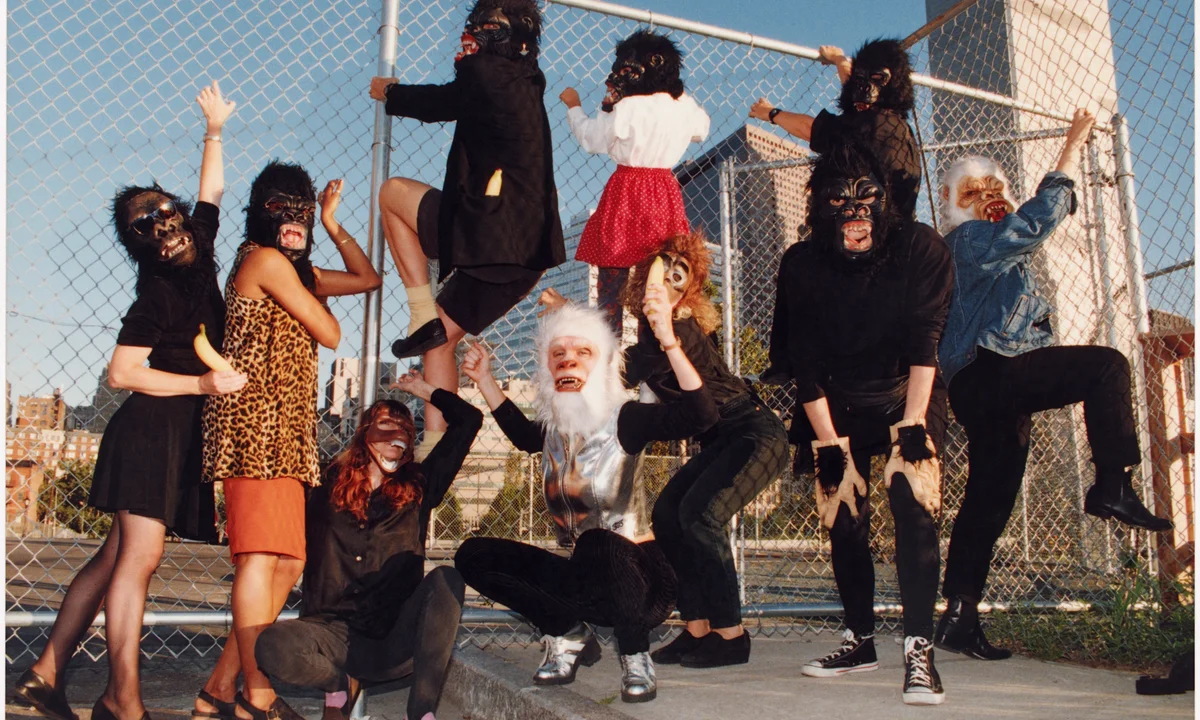
Just five years after the original Guerrilla Girls put on their first set of gorilla masks, each choosing the name of a deceased woman artist as an alias, they decided to unmask themselves. They designed a poster that blared in all caps like a National Enquirer headline: “GUERRILLA GIRLS’ IDENTITIES EXPOSED!” Underneath ran a list of nearly 500 artists’ names, including Eleanor Antin, Rochelle Feinstein, Jenny Holzer, Faith Ringgold, Cindy Sherman, Carolee Schneemann, Amy Sillman, Annie Sprinkle, Kay WalkingStick and Hannah Wilke.
Only this poster, made in 1990, was an artful dodge or strategic tease, which might (or might not) have contained the names of some (or all) of the actual Guerrilla Girls. A real roster would have numbered in the dozens, not hundreds, and the poster’s smaller print explained: “We’ve signed up to fight discrimination in the art world. Call us Guerrilla Girls.”
This poster is now on display in the gutsy and engaging Getty exhibition How to Be a Guerrilla Girl (until 12 April), the institution’s first show drawn from its 2008 acquisition of 96 boxes, plus portfolios and flat files, of art and archival material. But the Getty is not spilling the beans either. After 40 years of fighting misogyny with “facts, humour and fake fur”, the identity of the Guerrilla Girls ranks as one of the art world’s best-kept secrets, with remarkably few public or published leaks.
First They Try to Take Away a Woman’s Right to Choose (around 1991)
© Guerrilla Girls; Photo: J. Paul Getty Trust
“Kathë Kollwitz” and “Frida Kahlo”, the founding Guerrilla Girls who participated most actively in this show, say they have long used anonymity as a strategy because it was protective. “Early on, some of our members were afraid that if their involvement with Guerrilla Girls got out, their galleries or critics would use it against them,” Kahlo says. What’s more, both say, anonymity was a way to maintain focus on widespread social conditions instead of personal situations, so nobody could dismiss their concerns as the whining of a particular woman.
Yet the undercover nature of their operations makes for an interesting tension or contradiction in the Getty show. The exhibition sets out to explore the Guerrilla Girls’ legacy in feminism and activism, but it is not clear whose legacy is being shored up. The show tells the story, per the Getty press release, “of their collaborative process” in developing posters and campaigns, but it does not differentiate the collaborators, their skill sets or contributions.
For example, take the wickedly pointed 1988 poster The Advantages of Being a Woman Artist, which touts such benefits as “working without the pressure of success” and “knowing your career might pick up after you’re 80”. The Getty exhibition showcases the early drafts of this list, starting with a longer and wordier litany of the advantages of being a male artist.

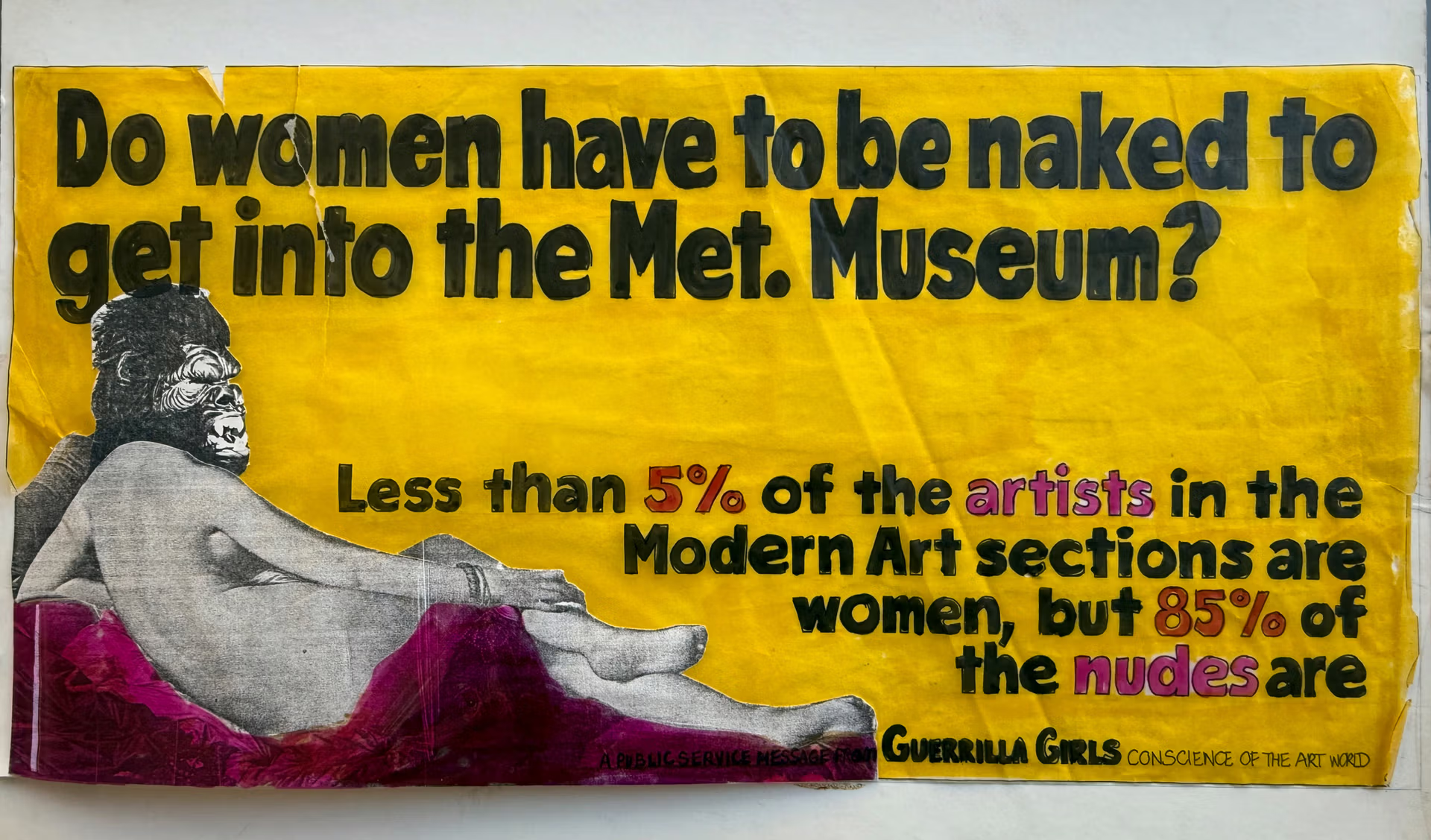
Draft of Do women have to be naked to get into the Met. Museum? (around 1989)
Courtesy Guerrilla Girls © Guerrilla Girls
Who flipped the script to focus so brilliantly and acerbically on women? And who put a gorilla mask on Ingres’s Grand Odalisque in the memorable 1989 campaign Do women have to be naked to get into the Met. Museum? Or, more generally, who brought the mad Madison Avenue copywriting skills and the powerful graphic punch to the table?
The Getty is not telling. The six-member curatorial team at the Getty Research Institute (GRI) decided from the outset to protect individual identities. They have redacted names and phone numbers that might be incriminating. And they have not even opened two redacted boxes of archival material, which contain unmasked photographs, according to the lead curators Zanna Gilbert and Kristin Juarez, and will not be accessible until the deaths of the relevant artists.
Secret histories
The preservation of anonymity also, conveniently, allows the curators to gloss over conflicts between personalities in the group and omit two unauthorised offshoots developed in the 1990s: Guerrilla Girls on Tour! and Guerrilla Girls BroadBand. (Since the Getty archive ends in 2003, the show does not cover the lawsuits filed by the original Guerrilla Girls against these entities either.)
As for whether we can understand the creation of art without knowing the creator, the curators credit the feminist collective with forcing exactly these kinds of questions. “It’s part of the Guerrilla Girls’ project to question this kind of notion of the single genius artist,” says Juarez. “You don’t get a sense of the individual, because they’re working against the way art history has always favoured that at the expense of what we know to be true—there are always many people involved.”

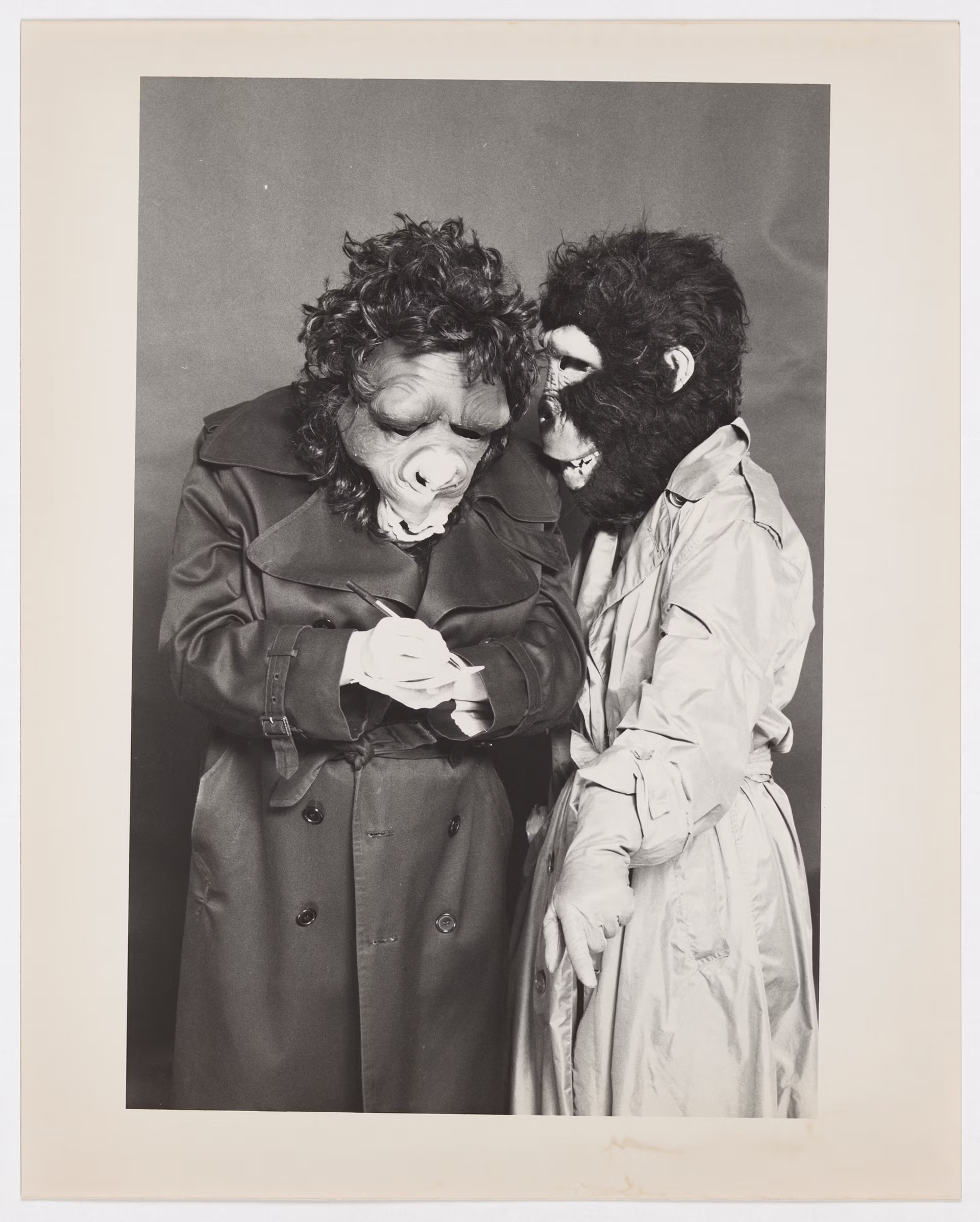
Guerrilla Girls Dressed as Detectives (1987)
© Guerrilla Girls. Photo: J. Paul Getty Trust
“We don’t think the Guerrilla Girls have been given enough credit beyond their feminist campaigning. The light they shed on the mechanisms of the art world has also been a major project throughout their 40 years,” Gilbert adds. “We may all be trained in this idea of biography and interested in the people who are behind a project, but their strategy of anonymity is very clever: it really did enable their work to be focused on the issues.”
Summarising the way anonymity shapes the Getty exhibition, Gilbert says: “We like to think that our show can tell us who they were—not what their names were, but what their concerns were.”
Group dynamics
Juarez and Gilbert’s own working approach was also inspired by the Guerrilla Girls’ ethos. The show originated with the GRI research group Expanding the Study of Performance in Women Artists’ Archives. From there, GRI staffers with different specialities joined forces to develop the content for the show, dividing up boxes of material to comb through. These curatorial team members—Thisbe Gensler, Alex Jones, Daniela Ruano Orantes and Megan Sallabedra—are credited alongside Gilbert and Juarez in the exhibition wall text.
The GRI’s interim director, Andrew Perchuk, calls it “likely the largest curatorial team in GRI’s history”. Gilbert says that even if it is not actually the largest team, it could be the largest to be fully named and credited. “Since we were very interested in showing the labour behind the Guerrilla Girls work, it made sense also to try to underline the labour that was put in by members.” (Labour takes on a double meaning here, as three of the curators had children during the making of the show, and they stepped up to cover for each other while on maternity leave.)

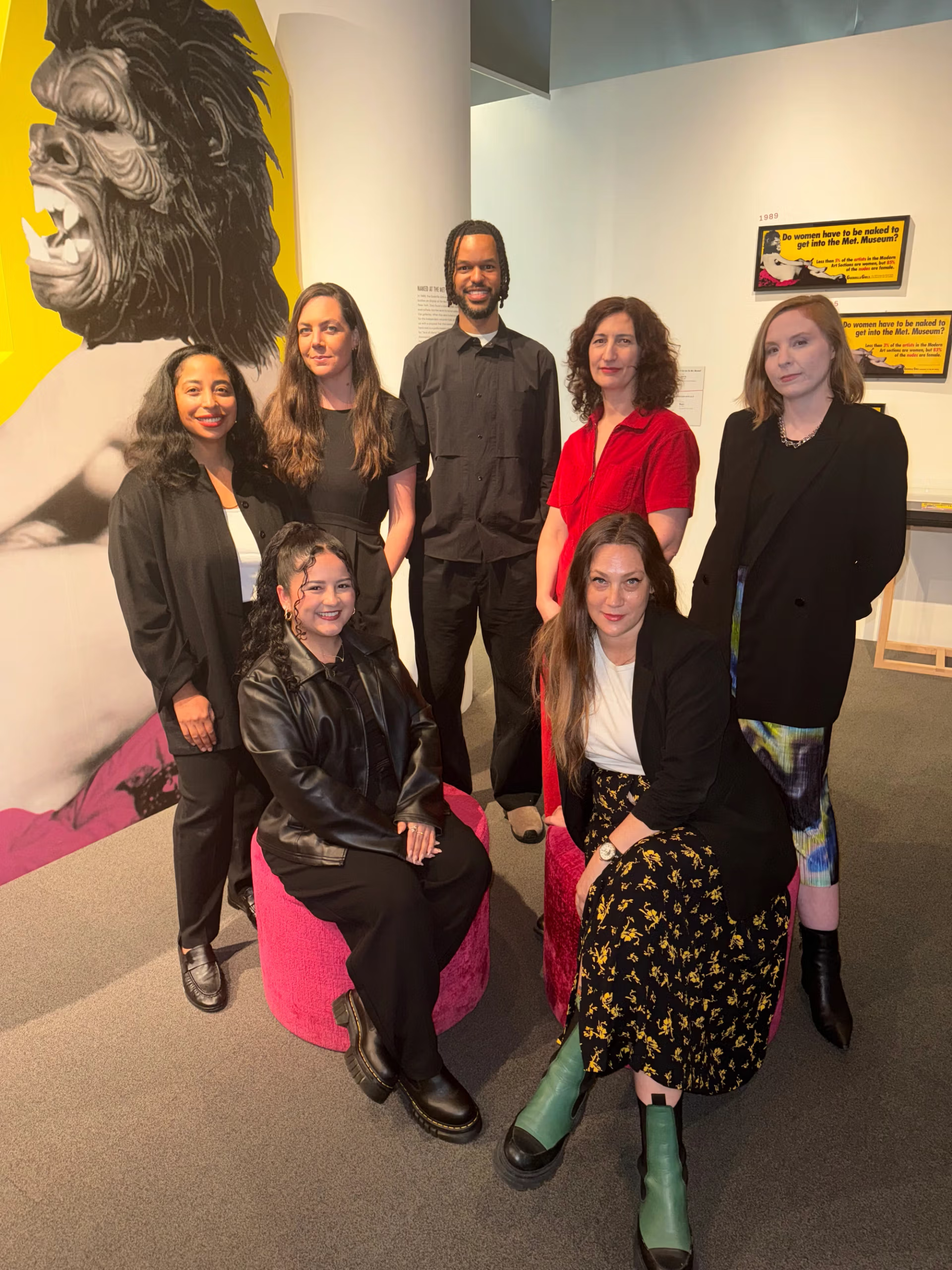
No monkey business: members of the Getty Research Institute curatorial team who collaborated on How to Be a Guerrilla Girl
Photo: J. Paul Getty Trust
By this same token, though, there is an argument to be made for acknowledging individual Guerrilla Girls. And as they reach their 70s, 80s or older, it must be tempting for artists involved to come forward and claim credit for particular work—as Lorraine O’Grady, who died in 2024, did more than a decade ago. She revealed herself to be the Guerrilla Girl known as “Alma Thomas”, in part to establish her authorship of an important “anonymous” essay on Flannery O’Connor.
What about founding members like Kahlo and Kollwitz? Don’t their gorilla masks feel especially heavy or hot these days? An audience member at their recent talk with the Bad Feminist author Roxane Gay at the Getty asked a similar question. They joked that their masks are equipped with fans or worked as facials. They also answered more directly.
“We’re stuck with our anonymity. I don’t think it matters anymore, because the work is really the thing,” Kollwitz said. “That’s what people respond to, that’s what people see all over the world. It seemed hugely important at the beginning, because we felt we would be attacked, our careers would be over, that kind of thing. But now, it just makes us a little bit more delicious.”
Kahlo offered a different take. “I think that if we took our masks off, it would be over,” she said. “I work really well with this mask, because it’s a mask. It allows me to speak truth to power.”
- How to Be a Guerrilla Girl, Getty Center, Los Angeles, until 12 April


