







Self-portraiture is commonly thought to be one of the most revealing genres of artmaking: In presenting an image of yourself to the world, you are baring it all, or so the thinking goes. What, then, is one to make of Martin Puryear’s 1978 sculpture Self? Composed of a large piece of carved mahogany topped off with a hunk of cedar, this work does not represent much. Its sinuous wooden surface stained a shade of black returns its viewer’s gaze with a whole lot of darkness.
Self is a joy to look at, to be sure, but it is not exactly telling about who Puryear is or what he looks like. That evasiveness seems to be exactly the point. The sculpture, like so many of Puryear’s other dazzling works, is about the act of withholding. It seduces with its elegant curves and its skillful construction, then stonewalls its viewer by refusing to explain itself in any way whatsoever.
Sound familiar? The description I’ve provided for Self could easily be applied to so many other sculptures by artists thinking through weedy ideas related to refusal today. Words like “opacity” and “Glissantian” have become staples in press releases for gallery shows by young artists; a new kind of Minimalism appears to be the ascent. But for the past seven decades, Puryear has seemingly pointed the way for multiple generations of sculptors.
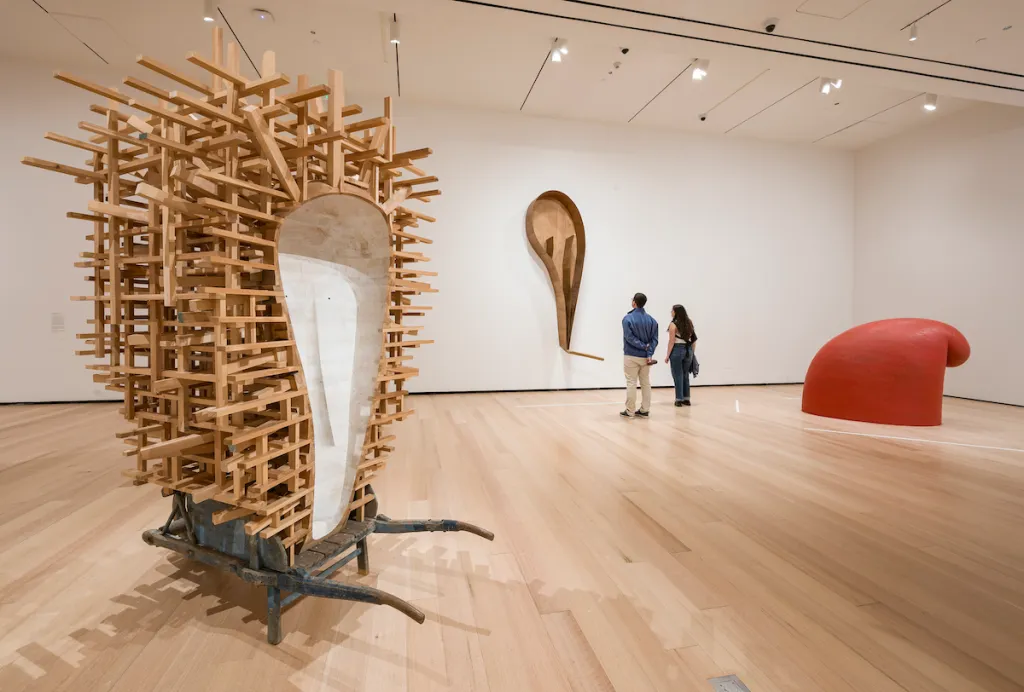
Might Puryear be the most influential American artist working today? I repeatedly asked myself that question while walking through the concise, thrilling Puryear survey at the Museum of Fine Arts, Boston, which ends its run on Sunday before heading next to the Cleveland Museum of Art in April. The exhibition is titled “Martin Puryear: Nexus,” and the curators—Emily Liebert of the CMA and Reto Thüring of the MFA Boston, with Ian Alteveer providing additional work on the MFA version—have chosen the name well. As this exhibition proves, Puryear is indeed a crucial nexus point within the cosmos of contemporary art of the past half century.
Installation view of “Martin Puryear: Nexus,” 2025–26, at Museum of Fine Arts, Boston.
©Museum of Fine Arts Boston
Few would dispute Puryear’s greatness, especially following his United States Pavilion at the 2019 Venice Biennale. But critics have tended—until very recently, anyway—to read Puryear’s spare art in formalist terms, asserting that it is all about craft, largely without references to the outside world. When Puryear had his last major US survey, 15 years ago, at the Museum of Modern Art, critic Peter Schjeldahl asserted that his art “commonly eschews extrinsic meanings.”
That reading has at times been reinforced by Puryear, who once said, “I come from a generation where the work is itself the information.” But the MFA Boston show made me wonder how much Puryear’s art really contains all the information one needs to understand it.
Certainly, a work like A Column for Sally Hemings (2021), in which an iron handle is planted firmly into a scalloped marble base, won’t reveal itself through extended viewing. The title alludes to a woman enslaved by Thomas Jefferson who, according to some historical accounts that are still debated by specialists, bore several of his children. The closest Puryear gets to representing the nonconsensual sexual relationship between Hemings and Jefferson is through the merger of brown metal and white marble. Those who disavow the scholarship around Hemings and Jefferson’s ties, as some of the Founding Father’s descendants have done, are unlikely to be offended by A Column for Sally Hemings, for its elegant surface is legible only to those who know how to read it. The work is the information, but the information is mostly kept secret.
The MFA exhibition demonstrates that Puryear’s abstractions are not apolitical—and that they never have been, either. The show features lesser-known works by Puryear such as one 1966–67 etching featuring a keeled-over form divided into four parts. One of those quadrants is black; the rest are of a lighter shade of beige. What is this being, and what is it trying to tell us? Its title may offer an answer: Quadroon, the racist word used to describe someone who has one Black grandparent, rendering them only “one-quarter Black,” as that logic would have it.


Installation view of “Martin Puryear: Nexus,” 2025–26, at Museum of Fine Arts, Boston.
©Museum of Fine Arts Boston
In a work like Quadroon, Puryear is showing that one’s identity is never entirely separable from one’s art, even when it appears otherwise. He suggested as much early on with Head (1965), one of the few figurative works on view here. This woodcut features a Black man’s head laid atop the old logo for ARTnews, which rarely featured work by Black artists on its cover back then, as was common for art magazines at the time. (Not even the following year, when ARTnews published a profile of the short-lived artists collective Spiral, of which Puryear was not a member, did a piece by a Black artist make the cover.) The work implies that people are art news, bucking the wisdom pervasive among white male critics of the postwar era that one’s identity and lived experiences did not matter to one’s work.
How interesting, then, that people all but disappear from works made by Puryear during the ’70s. With their sleek, pared-down look, these works have been viewed as a response to the era’s prevailing Minimalist aesthetics. Some Lines for Jim Beckwourth (1978), featuring seven long strings of twisted rawhide pulled taut across a wall, definitely looks a little like Minimalist art; it even vaguely recalls the yarn sculptures of Fred Sandback. But the Puryear work’s title refers to a multiracial fur trader who was born into enslavement and freed as an adult, and that’s something Sandback would never have done. The coloration of Puryear’s rawhide—variously hued copper, dark brown, and white—further seems to emphasize that this work is about more than it lets on.

Martin Puryear, Nexus, 1979.
©Martin Puryear/Courtesy Museum of Fine Arts Boston/Collection of halley k harrisburg and Michael Rosenfeld, New York
Other sculptures from the ’70s and ’80s continue to marry materials colored in differing tones. Nexus (1979), the exhibition’s titular work, is a circle of cedar whose edges have been pressed together and respectively painted black and white. A sequel of sorts arrives with Night and Day (1984), a swooping arc of pine that is divided in two; one half is painted white, the other black. If these are variations on a theme already evident in Some Lines for Jim Beckwourth, Puryear doesn’t come right out and say it.
Certain sculptures by Puryear since Night and Day seem even more cryptic. Alien Huddle (1993–95), the most beguiling work in the MFA show, features several orbs of cedar; the joinery is taut, formed with such precision that it seems damn near impossible to ever take the strips apart again. Looking Askance (2023) is an abstracted head with bulging eyes and a triangular nose. Curiously, it lacks a mouth.

Martin Puryear, Alien Huddle, 1993–95.
©Martin Puryear/Courtesy Museum of Fine Arts Boston/Cleveland Museum of Art
The adjective commonly applied to works like these is “silent,” a descriptor that implies an unwillingness to speak. Some will undoubtedly want Puryear’s sculptures to get louder, to say more. Yet, seemingly by intention, this artist has never been so forthcoming. In 1991, when he was asked by Chicago Tribune whether his work was about race, Puryear left it at this: “Probably something is there to tease apart, but I’m not going to become involved in it because I prefer to respect my own complexity.” One could easily imagine that remark being said by a younger participant in the Whitney Biennials of the last half decade.

Martin Puryear, Confessional, 1996–2000.
©Martin Puryear/Courtesy Museum of Fine Arts Boston
Puryear is therefore not going to explain his own art to us, and he shouldn’t have to, either. That means we need to look and to listen closely to it. At least one artwork here is explicitly about murmurings not meant to be heard by everyone: Confessional (1996–2000), a wood mass sheathed in tarry wire mesh. One unvarnished area of the sculpture looks a bit like a door, with a handle on it and a block on the floor that seems to invite viewers to kneel. Yet the portal cannot be opened, and viewers aren’t allowed to touch the sculpture. Whatever is concealed under the sculpture’s mesh shield remains inaccessible to the viewer, but it’s certainly fun to imagine what lies beneath.


