





Israel will officially take part in the 2026 Venice Biennale, two years after the pavilion closed to the public amid protests on opening day. But this time around, the pavilion will not be staged in Israel’s dedicated site in the Giardini. Instead, it will appear in the Arsenale.
Belu-Simion Fainaru, the sculptor representing Israel this year, said this was because the Israeli Pavilion in the Giardini was under construction. In a phone conversation with ARTnews, the Haifa-based artist said he welcomed the opportunity to show alongside countries such as the United Arab Emirates, Turkey, and Saudi Arabia, whose pavilions are located in the Arsenale.
“The experience will be really great, because now I have the chance in an old building, not a modern one, like the Israeli Pavilion,” the artist, a winner of the state-issued Israel Prize, said.
The reaction on social media has not been quite as positive. An Instagram post by Art Not Genocide Alliance (ANGA), an artist-run group that protested Israel’s presence at the last Biennale, termed its entry this year the “Genocide Pavilion.” The post, which published on Monday, currently has more than 1,500 likes.
Fainaru, who was born in Romania and represented that nation at the 2019 Venice Biennale, will work with curators Sorin Heller and Avital Bar-Shay to realize the pavilion. Fainaru and Bar-Shay previously worked together on the 2024 edition of the Mediterranean Biennale in Haifa, which featured a work by Fainaru that the Times of Israel described as a wall clock that is “set to turn backward, for that wish to go back in time, to October 6.”
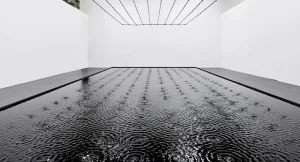
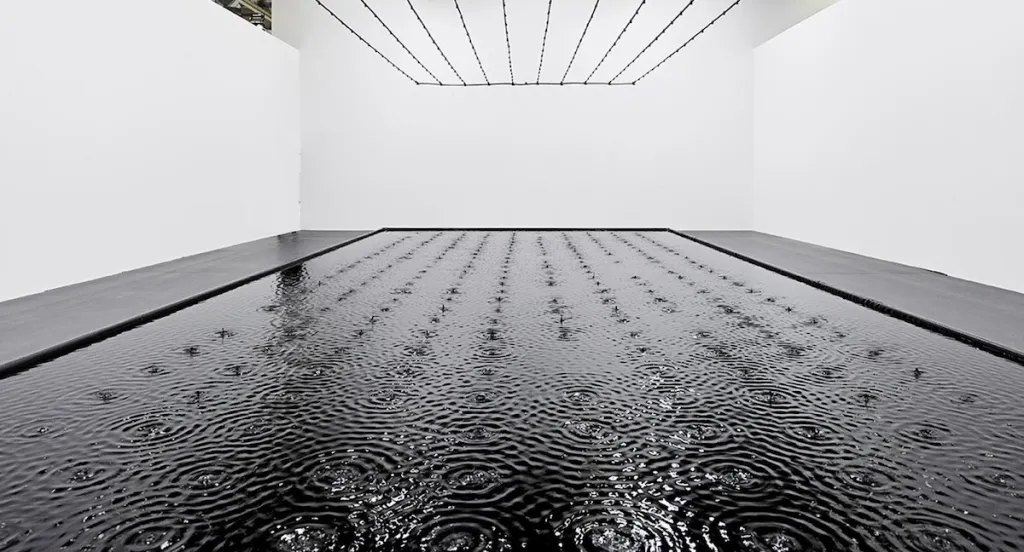
Fainaru’s pavilion will be titled “Rose of Nothingness” and will be largely centered around an installation about water. Inspired by poet Paul Celan’s concept of black milk, the installation will involve 16 pipes that drip black water into a pool, with 16 referring to the number signifying transformation in Kabbalah, a Jewish mystic tradition.
“The installation is akin to a spatial embodiment of a living Talmudic page: a text devoid of letters, in which knowledge crystallizes through lingering, gaze, and attentiveness,” a description of the pavilion sent to ARTnews reads. “The meaning of the installation emerges in the tension between one drop and the next, between presence and absence, calling upon the viewer to become an active participant in an ongoing experience of time, memory, and consciousness.”
Israel’s Venice Biennale pavilion was shuttered to the public on opening day by artist Ruth Patir.
Photo Luc Castel/Getty Images
Though the Israeli culture ministry has not officially announced the pavilion, word of the exhibition was first hinted at via a LinkedIn post by Heller, one of the curators. But it has received wider attention via ANGA’s Instagram post, which also renewed the group’s protest of the Israeli Pavilion on Monday. ANGA had already threatened a boycott of the Biennale in October.
“ANGA again calls on the Biennale to exclude Israel from the forthcoming edition,” the group wrote on social media. “There can be no place for repair, healing or cultural dialogue until the state of Israel is brought to justice for its crimes.”
ANGA said that it had chosen to protest once more because Israel “continues its genocide despite the so-called ‘ceasefire’ declared on October 10, 2025.” According to the Gaza government, Israeli attacks have killed more than 440 Palestinians since the ceasefire began. Israel has claimed that it is responding to actions by Hamas, whom Israel claims has violated the ceasefire agreement.
Fainaru said he disagreed with ANGA’s approach. “Dialogue is the best way to express ourselves,” he said. “I am totally against boycotts, and not just in Venice.” Moreover, he said, his installation “will be a vision of hope and human feeling, the total opposite of boycott and exclusion, giving space to everybody.”
ANGA’s post noted, “Following the principles of PACBI [Palestinian Campaign for the Academic and Cultural Boycott of Israel], we do not call for the exclusion of any individual artist. Instead we demand the exclusion of the Israeli state which continues its genocide despite the so-called ‘ceasefire’ declared on October 10, 2025.” The group did not respond to ARTnews’s request for comment by press time.
Past protests in support of excluding Israel from the exhibition were rejected by the Venice Biennale, which said in 2024 that it did not have the right to kick out any nations that were recognized by Italy. For that reason, Iran, which faced protests from women’s rights groups, was also included in the exhibition. (Russia, which has not participated in the Biennale since the onset of its war in Ukraine, did not take part on its own volition, the Biennale said.) Palestine, which is not recognized as a nation by Italy, has never had an official national pavilion, though curators have mounted shows in support of it alongside the Biennale in what are known as collateral events, or shows mounted with the Biennale’s blessing.
Gennaro Sangiuliano, then the Italian culture minister, put a finer point on things, calling ANGA’s efforts “shameful.”
Ultimately, Israel ended up participating in the 2024 Venice Biennale—but without ever opening its doors to the public. The artist representing Israel, Ruth Patir, said she had made the decision to shutter her pavilion until Hamas released the hostages taken on October 7 and Israel instituted a ceasefire, neither of which happened during the Venice Biennale’s run. (As part of the current ceasefire agreement, all of the living hostages have been released by Hamas.)
There has been doubt that Israel would participate in the 2026 Biennale ever since last spring, when Haaretz reported that the pavilion was facing budgetary issues resulting from the renovation of the structure in the Giardini. Notably, Israel did not participate in the 2025 Architecture Biennale, despite having mounted pavilions for that exhibition in the past. The Israeli culture ministry did not respond to ARTnews’s request for comment.
Other pavilions are facing uncertainity for different reasons. Just last week, for example, South Africa canceled its planned pavilion because its selected artist, Gabrielle Goliath, wanted to show a work that addressed Israel’s war in Gaza. South Africa’s culture minister claimed that the piece was “polarizing”; the artist said she was being censored. Last year, Australia rescinded its appointment of Khaled Sabsabi as the artist for its pavilion after some publications raised concern about a past work featuring a Hezbollah leader, but later reinstated him after an outcry over censorship.
Fainaru said he hoped his pavilion would meet this tense moment. “Art is a place for dialogue, not for exclusion,” he said. “It’s one of the main places to overcome politics and try to express the voice of people freely, without any borders. The politics of exclusion also comes into art and culture, and it’s a bit lost in humanity. Dialogue is important.”


