





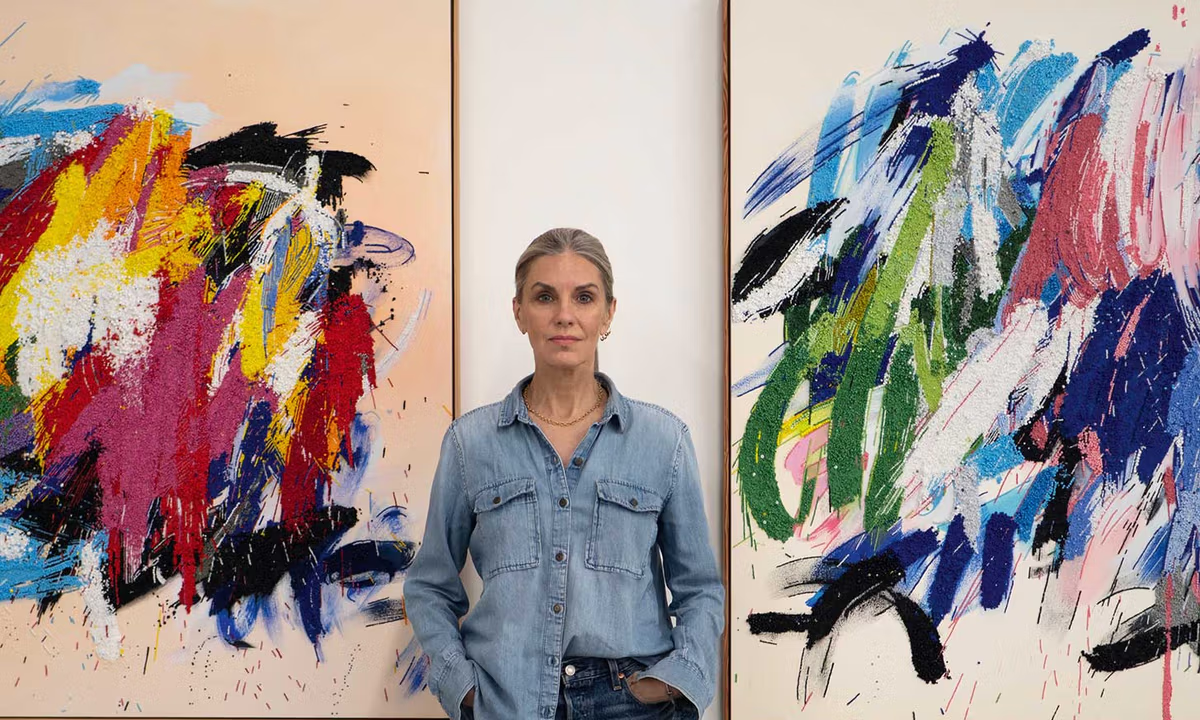
Liza Lou lives and works in the San Fernando Valley, California. She first came to attention with a work called Kitchen, which she made in isolation over five years, from 1991 to 1996, its full-scale interior entirely covered in vibrantly coloured tiny glass beads. Subsequently, she spent 15 years working with a group of women in South Africa, creating bead-encrusted sculptures in increasingly monochrome tones. Her latest work, though, marks a return to working in solitude and to colour with a new fusion of oil painting and glass beads. Colour, she says, offers the ultimate view.
“Colour, for me, is this ineffable search. I think about the laughter of colour, the necessity of colour, the way in which colour offers a relief to the darkness that surrounds us. I like the limitations of ready-made colour. I work with beads and oil paint straight out of the tube. I start my day in the studio by making a drawing with oil sticks and I draw until I feel my brain makes a click from logical brain to wild brain; once I’m there, the rest of my day is freestyle. Time is like bubble gum and who knows what day it is. The other day, I took my daughter to the dentist and it turned out her appointment wasn’t for another month.
Like most artists, my entrance into art was through drawing and, as I matured, I narrowed my means and began to use materiality and beads as a conceptual project—to question what is and what is not considered a valid art material, and by extension who is and who is not included in the canon. The drawings became very functional, as a way to plan things or as conceptual indexes of time; I’d draw tiny bead-like dots over and over again. But, in the past few years, something shifted, and there is this headlong love affair with colour itself; I’m weighing its essence and making side-by-side comparisons between my material and viscous pigment as I work with beads and paint.
I spend a lot of time in the Mojave Desert in California. On first glance, it can appear that the desert has a limited palette but, when your eyes adjust, you begin to see the saturated chroma and the way in which a peacock-blue sky strikes against a peach boulder, or the way a blood-red plant chokes a sage brush, and it’s almost hallucinatory. When I hike, I sometimes collect colour to take back to the studio. It will be a little scoop of red sand into a small glass vial, and then a yellow patch of sand. It’s lovely when the colour has a smell, like eucalyptus or lavender. Then I bring that attunement into the studio where I work with ready-made, factory-made colour. My walks in nature are a way to increase my sensitivity, finding that click where I feel as though I’m awash in colour.
From dark to light
For the past few years, I’ve been working in an industrial part of the San Fernando Valley in Los Angeles in a warehouse with no windows and no natural light. When you walk in, it’s pitch black, and the light switch is across the room. It used to drive me crazy. It felt so dark and miserable, just this big cold-meat locker with no colour, no juice, no sun.
Then I realised that this darkness was the exact condition of the art process itself. You arrive in the dark, knowing nothing and then slowly the lights come on. I began to make the daily drawings, applying units of colour in side-by-side adjacencies, and then the gestural paintings started to emerge and I began to see that the canvases themselves were windows, and it was my job to create the view.”
• Liza Lou: FAQ is at Thaddaeus Ropac, London, until 23 May


